$11,033 in Annual Dividends: What You Keep in a Roth IRA vs. a Taxable Account
Six dividend stocks, one portfolio, two very different tax outcomes depending on where you hold them. The account you choose today quietly determines how much of every future payout you actually get to keep.

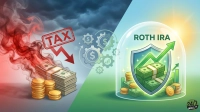
At the 24% federal bracket, a $400,000 portfolio of six dividend stocks generates about $11,033 a year in dividends. In a taxable account, roughly $1,655 goes to the IRS each year. Inside a Roth IRA, all of it stays in the account.
Same Six Stocks, Two Very Different Paychecks
This portfolio places an equal share, about $66,667, into each of six companies with verified records of raising their payouts. The equal-weight average yield is 2.76%.
- ADP (NASDAQ:ADP | ADP Price Prediction): yields 2.32%. Its quarterly dividend rose from $1.54 to $1.70, and each raise adds to the taxable income a brokerage account reports.
- Aflac (NYSE:AFL): yields 2.02%, backed by 43 consecutive years of dividend increases. That long a run builds decades of payouts that a Roth keeps out of IRS reach.
- McDonald’s (NYSE:MCD): yields 2.98%. Its latest quarterly dividend of $1.93, up from $1.86, adds income that gets taxed every year in a brokerage account.
- PepsiCo (NASDAQ:PEP): yields 4.26%, the highest in the group. That makes it the largest single source of tax drag and the best candidate for Roth location in this group.
- Procter & Gamble (NYSE:PG): yields 2.71%. P&G noted its 70th consecutive year of dividend increases, the kind of record that makes decades of untaxed growth realistic.
- Colgate-Palmolive (NYSE:CL): yields 2.26%. Its quarterly payout went from $0.52 to $0.53. The raises are small, but they keep coming, and each one goes untaxed in a Roth.
All six pay qualified dividends. Those are taxed at 0%, 15%, or 20% if you hold the shares for more than 60 days during the 121 days around the ex-dividend date. At the 24% bracket, the qualified rate is 15%. That reduces the Roth gap compared with BDCs or mortgage REITs. If the same income were taxed as ordinary income, the bill would be $2,648.
| Account | Gross Income | Federal Tax | Net Income |
|---|---|---|---|
| Roth IRA | $11,033 | $0 | $11,033 |
| Taxable (15% qualified) | $11,033 | $1,655 | $9,378 |
The Roth advantage is $1,655 a year, or $16,550 over 10 years, assuming no growth.
Bracket Multiplier: Top Earners Lose the Most
Under IRS brackets, the 37% rate starts at $626,351 for single filers and $751,601 for joint filers. Top-bracket filers generally pay the 20% qualified rate.
| Ordinary Bracket | Qualified Rate | Taxable Net | Annual Roth Advantage |
|---|---|---|---|
| 22% | 15% | $9,378 | $1,655 |
| 24% | 15% | $9,378 | $1,655 |
| 32% | 15% | $9,378 | $1,655 |
| 37% | 20% | $8,827 | $2,207 |
Higher earners can also owe the net investment income tax, which applies to gross income from interest, dividends, annuities, royalties, and rents. That makes the real gap larger than the table shows.
Growth Cost Most Investors Never See
Reinvest the $1,655 annual delta at a conservative 3%, and it grows to about $18,973 after 10 years and $44,470 after 20. Without reinvestment, the 20-year total would be $33,100. At the 20% rate, the 20-year figure hits $59,294.
These figures keep every dividend flat, which understates the cost for this group. P&G increased its dividend by 3% in fiscal 2026. Each raise like that widens the annual tax bill in a taxable account. Read these totals as the permanent cost of holding these stocks outside a Roth.
What to Do Before Your Next Tax Filing
- Get out your 1099-DIV and split box 1a from box 1b. Ordinary income costs more in a taxable account, so move it to the front of the line for Roth space.
- If PepsiCo or another 4%-plus yielder sits in a taxable account, multiply its annual dividends by your qualified rate. That shows what it costs you each year to hold it outside a Roth.
- Before ruling out a Roth conversion, compare the upfront tax with the 20-year growth delta for your bracket. The quiet years between your last paycheck and your first RMD are usually the cheapest time to convert, which we sized up in a free guide: The Roth Window. Use the dividend growth rates of the stocks you actually own.
Contact [email protected] for any questions or corrections.
Chris Lange is a financial and geopolitical writer with more than a decade of experience covering a myriad of topics. He has published thousands of articles for 24/7 Wall St., with past coverage focused heavily on stocks, IPOs, healthcare, defense, global affairs, and technology.
His work has been quoted, or referenced by a number of outlets including Business Insider, USA Today, Yahoo Finance, MSN, The Motley Fool, and many other publications. A graduate of Southwestern University, he studied business with a focus on investments and has previous experience in banking and startups.
When not reading or writing the news, he is following his passion for Lacrosse, playing chess, or building solar projects with his dad.