Nvidia’s Valuation and Narrative Risk are High Now So Act Accordingly
NVIDIA keeps beating earnings forecasts while its stock barely moves, and the reason why reveals a financing arrangement even management admits looks circular. The next two quarters will determine whether the AI trade holds together or quietly unravels.


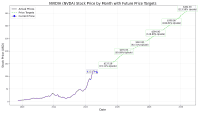
NVIDIA (NASDAQ:NVDA | NVDA Price Prediction) trades at $214.13. The business keeps beating forecasts, but the stock now carries enough valuation and narrative risk that the next few quarters need to resolve.
NVIDIA sells the GPUs, networking and software that power AI data centers. Data Center revenue reached $89.02B last quarter, up 117%, and the company is worth about $5.17 trillion. Shares fell 6.61% over the past week while the S&P 500 slid 1.97%.
Revenue Doubling at 25x Forward Earnings Looks Cheap
Revenue of $96.22B rose 105.8%, and EPS of $2.22 beat the $2.09 consensus, a sixth straight beat. Guidance calls for $108.0B next quarter, and management expects “to grow revenue by approximately 70% in fiscal 2028. This is a supply-constrained outlook.”
Yet the stock trades at a forward P/E of 25 with a PEG of 0.479. The fiscal 2028 EPS estimate rose from $12.7636 to $15.9146 in 90 days. Vera Rubin lifts revenue opportunity to $40 billion per gigawatt.
Circular Financing and Margin Compression Threaten the AI Story
NVIDIA increasingly funds its own demand. It carries $108.5B in guarantee obligations, has invested nearly 50 billion in frontier AI labs and expects balance-sheet-supported labs to drive roughly a quarter of our business next year. Management acknowledged “some will call this circular financing.”
Supply commitments hit $279.0B, DSO rose to 60 days from 45, and gross margin should bottom at 71% to 72% on memory costs. China is excluded from guidance. Among tracked funds, 12 cut versus 6 buyers, and a beta of 2.216 magnifies any sentiment shift.
Six Straight Beats Yet a Stock Stuck in Place
Over the past month the stock moved just 0.11%. It sits below its 50-day average of $223.08 but above its 200-day of $202.97. The market is rewarding beats less while it weighs financing and margin questions. Strong fundamentals support the bull case, while unresolved risks moderate it.
Wall Street Sees 54% Upside While Shares Barely Beat the Market
The consensus target of $328.72 implies 53.5% upside from $214.13 across 62 analysts. Price targets reflect analyst opinions and can change.
- Strong Buy: 10
- Buy: 49
- Hold: 2
- Sell: 1
Year to date, NVIDIA is up 15.08% versus 11.93% for the S&P 500. Over one year it gained 18.06% against 15.53%. Trailing P/E is 27 and price-to-sales is 17.07.
Vera Rubin and Financing Risks Will Decide NVIDIA’s Next Move
At $214.13, NVIDIA balances strong growth against unresolved financing and margin risk.
Near-unanimous bullishness means the upside case is already crowded. Revenue has doubled, yet the stock has only modestly outpaced the index. That gap reflects doubt about how much growth NVIDIA finances itself.
A bullish signal: next quarter meets the $108.0B guide, Vera Rubin reaches about 20% of Data Center revenue, and DSO steadies. A bearish signal: guarantee obligations expand again, margins fall below the guided floor or hyperscaler capex plans slip. All that spending has to flow through power, cooling, and networking suppliers too, which is why we highlighted seven non-chipmaker beneficiaries in a free AI infrastructure report.
Continued beats could lift shares further, while a 2.216 beta leaves the stock exposed to a sentiment reversal. Track receivables, margins and financing quarter by quarter. Those metrics reveal whether NVIDIA’s customers can pay for their own compute.
Contact [email protected] for any questions or corrections.
Alex Sirois is a financial writer with experience spanning both retail and institutional investing. He has written for InvestorPlace and held roles at BNY Mellon and Bernstein, giving him a perspective that bridges Main Street portfolios and Wall Street analysis.
Alex holds an MBA from George Washington University and has built his career across multiple industries, including e-commerce, education, and translation — a breadth of experience that informs how he breaks down complex financial topics for everyday investors. His writing is conversational, actionable, and grounded in long-term, buy-and-hold investing principles.
At 247 Wall St., Alex focuses on delivering analysis that is both accessible and useful, with a clear emphasis on helping readers make more informed decisions with their money.