Retail Investors Oversubscribed This AI IPO 400 Times. It Fell 32% Anyway
Korean retail investors flooded an AI infrastructure IPO with record demand, then watched it crater on opening day. The forces behind that collapse reach far beyond Seoul and straight into the finances of the biggest GPU cloud names trading in…

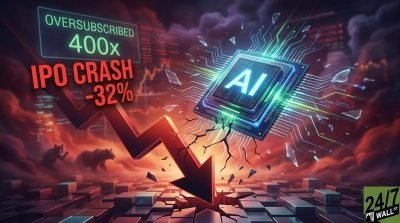
Korean retail investors placed about 10.3 trillion won in subscription deposits for the Kosdaq IPO of Elice, a Seoul company that runs GPU data centers. That demand oversubscribed the retail tranche more than 400 times. On its debut on October 20, 2026, the stock still fell as much as 32%, to an intraday low of 61,400 won. The IPO had priced at 90,500 won, the top of its marketed range. A closing price had not been confirmed.
Elice is a “neocloud,” meaning it rents out GPU computing capacity, so its slide bears directly on CoreWeave (NASDAQ:CRWV) and Nebius Group (NASDAQ:NBIS | NBIS Price Prediction). On October 19, CoreWeave fell 0.44% to $61.12. Nebius rose 2.88% to $170.24.

What Elice Sold Versus What It Only Promised
The deal raised 201 billion won, about $151 million, the largest Kosdaq IPO of 2026 so far. Mirae Asset Securities and Samsung Securities underwrote it.
KAIST doctoral students founded Elice in 2015 as a coding-education platform. It now sells liquid-cooled GPU servers, modular data center platforms and AI-cluster software.
The money raised is only the committed portion. Chief executive Jae Won Kim said proceeds will fund more AI data centers in Korea and abroad, but the company named no sites, capacity or customers.
The business itself is growing. First-half 2026 revenue rose 200% to 34.4 billion won, and the company swung to an operating profit of 10.3 billion won.
Why 400 Times Demand Still Produced a Drop
When a retail tranche is oversubscribed that heavily, each investor receives only a small allocation. Many sell on the first day to lock in whatever gain they can, and pricing at the top of the range left almost no margin.
Market mood mattered too. Albert Yong, managing partner and chief investment officer at Petra Capital Management, said “Elice’s debut comes at a time when sentiment toward AI infrastructure companies has weakened, particularly in the US,” adding that it “has been highly volatile and often disconnected from underlying fundamentals.”
Less than two weeks earlier, Firmus Grid pulled its planned IPO, citing rising borrowing costs, competition, and uncertain returns on AI spending. Two weak signals in a row suggest it is getting harder for GPU-cloud builders to raise money.
How CoreWeave and Nebius Absorb the Signal
Elice’s funds are tiny compared with CoreWeave’s $9.4 billion in second-quarter capital spending. What carries over is the cost of money: interest expense hit $640 million, up from $267 million a year earlier, and third-quarter guidance calls for $860 to $940 million.
That is why the stock fell 23.85% over one week and 55.34% over one year, even with a $104 billion backlog. Investors are pricing in financing costs.
Nebius fell 18.96% over the same week but is still up 103.38% for the year. It holds $8.042 billion in cash, although three customers made up 24%, 21%, and 14% of second-quarter revenue.
What Could Change the Outlook for CoreWeave Stock
CoreWeave’s business is growing, but its shares respond to borrowing costs, and Elice’s debut shows that strong results do not protect a neocloud stock when funding sentiment turns. A major bank upgraded CoreWeave to buy on October 19, and the stock still fell that day. Rising interest expense is the reason the lower price has not eased pressure on the shares. Nebius looks better positioned because it has outperformed through the same AI selloff, although its customer concentration is a real risk.
Investors can measure this outlook against CoreWeave’s third-quarter earnings report. Revenue inside its $3.45 to $3.6 billion guidance, with interest expense at or below the low end of its range, would weaken the bearish case, as would Elice holding above 61,400 won.

Contact [email protected] for any questions or corrections.
Omor Ibne Ehsan is a writer at 24/7 Wall St. He is a self-taught investor with a focus on growth, cyclical, and dividend equities that have strong fundamentals, value, and long-term potential. He also has an interest in high-risk, high-reward investments such as penny stocks.