It’s Been All Downhill Since Cerebras Systems May IPO: 180% Gains Await According to This Wall Street Analyst
Cerebras Systems has shed more than 60% since its splashy debut, yet Wall Street analysts keep raising their price targets. One report about a single customer could determine whether this AI chipmaker stages a massive comeback or slides further into…


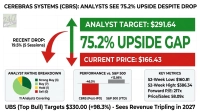
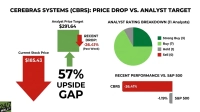
Cerebras Systems (NASDAQ:CBRS) currently trades at $117.98. The average analyst price target is $282.55, meaning 139.5% upside.
Cerebras makes wafer-scale AI chips and sells fast cloud inference to CrowdStrike (NASDAQ:CRWD | CRWD Price Prediction) and others; key customers are OpenAI, AWS, CrowdStrike, and G42. The Street-high target goes to UBS analyst Timothy Arcuri at $330.00, meaning about 179.7% upside. That rounds to 180%.
Implied upside above 40% means the market and analysts disagree sharply about this company’s future. The stock has also fallen more than 30%, so the disagreement shows up in real losses for shareholders.
A Hot AI IPO Has Lost Most of Its Debut Value
The latest blow involved NVIDIA (NASDAQ:NVDA), via a SemiAnalysis report claiming OpenAI may use NVIDIA GPUs instead of Cerebras hardware for the “Ultrafast” mode of GPT-6.1 Sol. Meanwhile, 19.4 million shares became eligible for trading as post-IPO lock-ups expired. The stock fell 16.61% over the past week and 43.41% over the past month. It has dropped 62.07% from $311.07 at its debut and recently reached a 52-week low of $115.13.
The selloff is specific to Cerebras. Over the same month, the S&P 500 moved -0.04%.
Fundamentals had already started the slide. Second-quarter GAAP revenue of $180.11 million missed the $193.55 million consensus. GAAP EPS of -$2.98 missed the -$0.1801 estimate, mostly because of $377.0 million in stock-based compensation. Management guided third-quarter core gross margin to 38% to 40% and said it expects that to be the low point.
Analysts Still Point to a $25.4 Billion Backlog
The bullish argument begins with $25.4 billion in remaining performance obligations. That figure excludes any AWS or other hyperscaler business. Management plans to “more than triple our core revenues in ’27”. Core revenue already rose 103% to $209.87 million last quarter. The CEO said, “Looking forward, we see unbound demand for fast inference.”
UBS makes its thesis on three points: the wafer-scale engine’s speed advantage over GPU clusters, contract backlog visibility, and hyperscalers diversifying away from GPU supply bottlenecks.
Several catalysts are scheduled. The disaggregated inference product with Advanced Micro Devices (NASDAQ:AMD) is due to deploy in Q4. AWS Bedrock availability follows in Q1 2027, and revenue from other hyperscalers should start in mid-2027. Management is aiming core gross margin of 60% plus over time.
Analyst view remains firmly positive. Three analysts rate it Strong Buy, seven rate it Buy, one rates it Hold, and none rate it Sell. The 2027 EPS estimate rose to $1.2737 from $0.9613 60 days ago. That came from nine upward revisions and no cuts. Those revisions show no reaction yet to the OpenAI report. Treat the targets as one data point among many.
Cerebras Fell Hardest While NVIDIA and AMD Slipped
The rest of the group fell far less than Cerebras.
NVIDIA slipped 3.01% over the past month but is up 19.02% this year. At $221.97, it sits below a $328.72 aiming, which meaning 48.1% upside. It has 10 Strong Buys, 49 Buys, two Holds, and one Sell. That upside is far smaller than Cerebras’, and NVIDIA is also the reported alternative for the OpenAI work.
AMD fell 11.39% over the past month but remains up 158.09% this year. At $552.72 against a $636.21 aiming, implied upside is 15.1%. It has five Strong Buys, 40 Buys, and 11 Holds.
Cerebras has by far the largest analyst-implied upside in the group. That gap reveals how much execution risk investors see in the smaller company.
A 62% Slide Against a Rising S&P 500
At $117.98, Cerebras trades well below the $282.55 consensus of 11 analysts, meaning 139.5% upside. Shares are down 62.07% since the debut. The S&P 500 has gained 13.37% year to date.
The balance sheet gives the company room to wait. Cash and equivalents total $6.74 billion, and the $850 million revolver remains undrawn. Analysts expect revenue to rise from $887 million this year to $2.95 billion in 2027.
OpenAI Is the Swing Factor for This Rebound
The recovery case strengthens if the third-quarter report meets the $214 million to $216 million core revenue guidance and OpenAI confirms its 750 MW, $20 billion-plus commitment. The case weakens if OpenAI switches high-speed inference to NVIDIA. The backlog depends heavily on one customer, and stock-based compensation keeps GAAP losses deep.
I am cautiously bullish. The backlog, cash position, and rising estimates support a recovery. Still, I would want management to address the OpenAI report directly before believing the Street’s targets.
Contact [email protected] for any questions or corrections.
Alex Sirois is a financial writer with experience spanning both retail and institutional investing. He has written for InvestorPlace and held roles at BNY Mellon and Bernstein, giving him a perspective that bridges Main Street portfolios and Wall Street analysis.
Alex holds an MBA from George Washington University and has built his career across multiple industries, including e-commerce, education, and translation — a breadth of experience that informs how he breaks down complex financial topics for everyday investors. His writing is conversational, actionable, and grounded in long-term, buy-and-hold investing principles.
At 247 Wall St., Alex focuses on delivering analysis that is both accessible and useful, with a clear emphasis on helping readers make more informed decisions with their money.