Bank of America Fell Harder Than Wells Fargo. Does That Make It the Better Dividend Buy?
Both banks have fallen from their highs, both pay dividends, and both trade at the same forward earnings multiple. Yet one held its dividend through the 2020 crisis while the other slashed it by 80%, and that history still shapes…

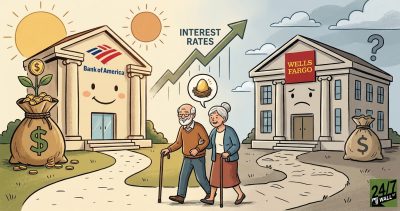
Bank of America (NYSE:BAC | BAC Price Prediction) or Wells Fargo (NYSE:WFC): which beaten-down bank offers a retirement-focused income investor more right now? Bank of America has fallen 8.8% over the past month, compared with 0.2% for Wells Fargo. It now trades about 21.7% below its one-year high of $64.90, while Wells Fargo is 15.1% below its own high.
Interest rates make the choice harder. The Federal Reserve raised the upper bound of its target range from 3.75% to 4.00% in September. The two-year Treasury yields 4.65%, and the 10-year yields 4.96%, a gap of only 0.31 percentage points. Either Treasury pays more than both banks’ dividend yields. So a bank stock has to justify itself with two things a bond can’t offer: a dividend that grows and a price that has already come down.
Income Now and Dividend Growth: Bank of America Takes It
Bank of America yields 2.5%, against 2.4% for Wells Fargo. Its latest quarterly dividend of $0.32 reflects a 14.3% raise. Wells Fargo pays $0.50 per quarter after an 11.1% increase. The yield edge is thin, but Bank of America leads on both counts, and the bigger raise adds up over a retirement horizon.
Dividend Safety: Bank of America’s 2020 Record Settles It
Both dividends are well covered. Bank of America pays out 27.6% of trailing earnings and Wells Fargo pays out 26.5%. In 2020, Bank of America kept its quarterly dividend at $0.18 for every 2020 payment. Wells Fargo cut its dividend from $0.51 to $0.10.
Capital levels point the same way. Bank of America ended the third quarter with a CET1 ratio (the main measure of capital available to cover losses) of 10.9%. It still returned $8.3 billion through dividends and buybacks in the quarter. Wells Fargo’s ratio of 10% is at the bottom of the 10% to 10.5% range that CFO Mike Santomassimo targeted on October 13. He also said buybacks will depend on the rate environment.
Dip Quality and Rate Sensitivity: Bank of America Has More Upside
Bank of America’s drop traces to a $1.2 billion non-tax-deductible charge to settle Office of the Comptroller of the Currency (OCC) and Financial Crimes Enforcement Network (FinCEN) consent orders over anti-money-laundering and sanctions compliance. The charge reduced GAAP EPS by $0.17, and adjusted EPS of $1.08 missed the $1.11 consensus. Quarterly earnings fell 14.3% from a year earlier. Barron’s has also raised questions about the bank’s leadership.

Bank of America’s lending business kept growing. Net interest income rose 8% to $16.6 billion. On October 14, CFO Alastair Borthwick guided to approximately 8% net interest income (NII) growth for 2026 and 8% or more for 2027. Borthwick’s outlook assumes three 25-basis-point rate increases in December 2026, March 2027, and June 2027. Borthwick estimated that a 100-basis-point rise in rates above the forward curve would add $1.4 billion of NII over 12 months.
Wells Fargo, by contrast, has better near-term momentum. Third-quarter EPS was $1.87, up 13%, and net interest income grew 5%. Santomassimo kept full-year NII guidance at $50 billion, plus or minus, and the bank’s income is only modestly sensitive to rate changes. CEO Charlie Scharf highlighted the risk on the call: “Inflation and higher interest rates continue to be headwinds, and the longer they persist, the more pressure they could place on both consumers and commercial clients.”

Bank of America trades at 11 times forward earnings and 1.3 times book value. Wells Fargo trades at 11 times forward earnings and 1.5 times book. Bank of America wins this round because a one-time charge caused its drop, its interest income is growing faster, and it gains more if rates stay high.
Verdict: Bank of America Has the Stronger Dividend Case
For income investors buying the dip, Bank of America wins. It offers a higher yield, faster dividend growth, a dividend it held through 2020, a bigger capital cushion, and more earnings upside if rates stay high. Wells Fargo is the better fit for investors who prioritize near-term earnings momentum over dividend reliability.
Three developments would shift the verdict to Wells Fargo:
- A Fed that holds rates at 4.00% instead of raising them, reducing Borthwick’s interest income assumptions
- More regulatory costs at Bank of America
- Wells Fargo sustaining its double-digit EPS growth
The December Fed decision is the first test.


Contact [email protected] for any questions or corrections.
Trey has been an editor and author at 24/7 Wall St. for more than a decade, where he has published thousands of articles analyzing corporate earnings, dividend stocks, short interest, insider buying, private equity, and market trends. His comprehensive coverage spans the full spectrum of financial markets, from blue-chip stalwarts to emerging growth companies.
Beyond 24/7 Wall St., Trey has created and edited financial content for Benzinga and AOL's BloggingStocks, contributing additional hundreds of articles to the investment community.
Trey's editorial expertise extends across multiple publishing environments. He served as production editor at Dearborn Financial Publishing and development editor at Kaplan, where he helped shape financial education materials. Earlier in his career, he worked as a writer-producer at SVE. His freelance editing portfolio includes work for prestigious clients such as Sage Publications, Rand McNally, the Institute for Supply Management, the American Library Association, Eggplant Literary Productions, and Spiegel.
Outside of financial journalism, Trey writes fiction and has been an active member of the writing community for years, moderating workshop sessions at regional conventions.