My Nvidia Stock Price Prediction for 2027 Is More Bullish Than You Might Expect
Wall Street already sees more than 50% upside in NVIDIA, but one analyst thinks even that target is too conservative. Here is the specific combination of catalysts that could push shares well beyond what most investors are pricing in.

Jensen Huang put it simply in August: “AI has reached its inflection point. It’s doing useful work. Its tokens are productive and profitable. Now, compute is revenue.” That line explains why NVIDIA (NASDAQ:NVDA | NVDA Price Prediction) remains the center of the AI expansion.
Shares are up 15.08% year-to-date at $214.13, even after a 6.61% drop last week tied to a global tech rout on AI funding worries. Over five years, the stock has gained 883.76%. I think that decline sets up the next leg. Here’s what NVIDIA needs to do to hit $350 in 2027.

Wall Street Already Sees More Than 50% Upside
The consensus price target sits at $328.72, roughly 54% above today’s price. Analysts are nearly unanimous, with 10 Strong Buy and 49 Buy ratings against 1 Sell.

Estimates keep climbing. Fiscal 2028 EPS forecasts rose from $12.7636 90 days ago to $15.9146, with 7 upward revisions and 0 downward over the last 30 days. In the latest quarter, EPS of $2.22 topped the $2.09 consensus, marking a fifth consecutive earnings beat, on revenue up 105.8%.
Here’s What It Takes for NVIDIA to Reach $350
At $214.13, NVIDIA changes hands at about 13x fiscal 2028 earnings estimates. At $350, that multiple would be roughly 22x, close to a market-average valuation for a company projected to grow EPS about 71% from fiscal 2027’s $9.3124 estimate.
How might NVIDIA reach $350?
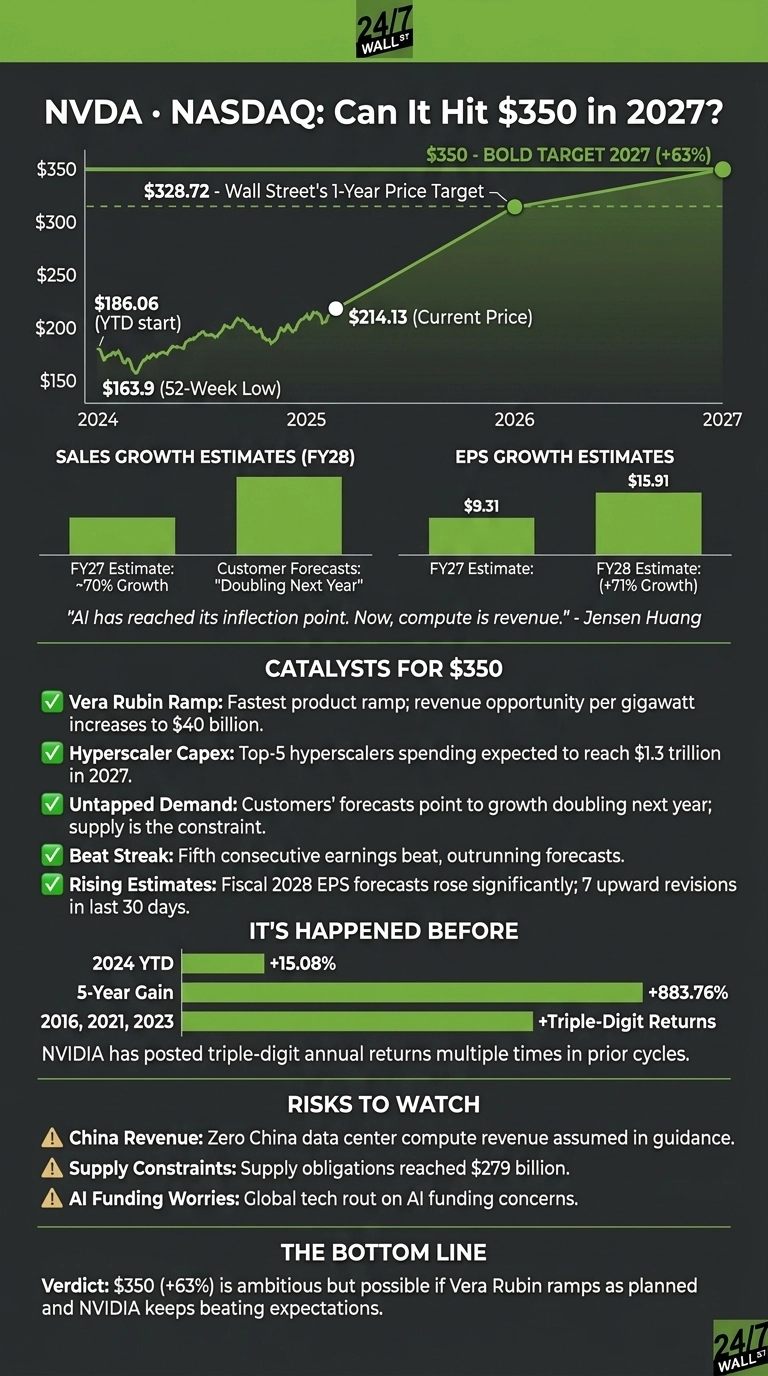
- Vera Rubin: Management expects the fastest product ramp in company history, lifting revenue opportunity per gigawatt from $25 billion with Blackwell to $40 billion.
- Hyperscaler capex: Top-five hyperscaler spending is expected to reach $1.3 trillion in 2027, and AWS is deploying an additional 2 million GPUs.
- Untapped demand: Management guided to roughly 70% fiscal 2028 revenue growth while noting “Customers’ forecasts point to our growth doubling next year.” Supply, rather than demand, is the limiting factor.
- Beat streak: Five straight beats suggest actual results may outrun forecasts again.

All of that expansion has to be powered, cooled, and networked by somebody other than NVIDIA, which is why we rounded up seven non-chip AI infrastructure names in a free report you can grab here.
NVIDIA’s History Says a 63% Gain Is Within Reach
Hitting $350 requires a 63% gain. NVIDIA has posted triple-digit annual returns in 2016, 2021, 2023, and 2024, and shares are up 13002.9% over ten years.
With a market cap near $5.17 trillion, repeating those moves is harder, but a beta of 2.216 means big swings remain part of this stock’s character.
Is $350 Realistic? Here’s My Take
Reaching $350 asks for a 63% gain, but Wall Street already projects about 54% upside and estimates are rising. The challenges are real: guidance assumes zero China data center compute revenue, supply commitments reached $279 billion, and AI funding worries could weigh on the group.
A 22x multiple on next year’s earnings looks reasonable, assuming Vera Rubin ramps as planned and NVIDIA keeps beating expectations. Such returns shouldn’t be expected every year, but we’ve outlined the blueprint for how NVIDIA could see outsized returns in 2027.
Contact [email protected] for any questions or corrections.
Vandita Jadeja is a financial publisher with over a decade of experience writing about financial topics, including investment, savings, retirement, insurance and banking. Vandita is a Chartered Accountant who loves to debunk financial concepts for readers.
Her work has appeared on sites that include The Motley Fool, InvestorPlace, and Benzinga. She covers investing and focuses on stock picks and price prediction for 24/7 Wall St.
When not looking for the next stock investment opportunity, she can be found traveling, reading, chasing sunsets and enjoying her iced latte.