Nvidia Has Built an AI Empire. Here’s What It Could Be Worth
NVIDIA's Data Center revenue more than doubled year over year, yet the stock sits well below its 52-week high while Wall Street debates a bold price target that would require nearly 90% gains. The math to get there is tighter…

This post may contain links from our sponsors and affiliates, and Flywheel Publishing may receive compensation for actions taken through them.

NVIDIA (NASDAQ:NVDA | NVDA Price Prediction) has become the operating system of the AI economy, extending its role well beyond that of the world’s most important chip company.
Data Center revenue hit $89.02 billion last quarter, up 117% year over year, and CEO Jensen Huang told investors “AI has reached its inflection point. It’s doing useful work. Its tokens are productive and profitable. Now, compute is revenue.”
Shares trade at $210.85, up just 13.32% year to date. So can NVDA hit $400 in 2027? Let’s run the math.

Why NVIDIA Shares Are Stuck Despite Record Numbers
The fundamentals are accelerating while the stock lags. NVDA is down 8.36% over the past week and 5.8% over the past month. Recent coverage frames it plainly: “Nvidia Stock Drops. It’s Still the Best Chip Bet in an AI Slowdown” from Barron’s captures the mood.
Investors are worried about a hyperscaler capex pause, memory pricing (management flagged “extreme pricing conditions in memory“), zero China Data Center compute revenue in guidance, and $279 billion in supply commitments that raise eyebrows about future absorption.
With a beta of 2.22, NVDA moves violently in both directions. Right now, the market is punishing anything that smells like AI overbuild, regardless of how good the underlying numbers are.
Wall Street Sees 55% Upside. Our Model Says Something Similar.
The Street is overwhelmingly bullish. Alpha Vantage shows 9 Strong Buy, 48 Buy, 2 Hold, and 1 Sell ratings, with a consensus target of $327.18. Our internal base case comes in at $306.02, implying 40.19% upside, with a bull case of $348.59 and a bear case of $258.47. Confidence: high.

Pushing back on the consensus: with 95 bullish analysts against 2 bearish and forward EPS revisions running 39 up and zero down over the past 30 days for fiscal 2028, analysts are actually behind the curve. Management guided fiscal 2028 revenue to grow approximately 70%, and that number is supply-constrained.
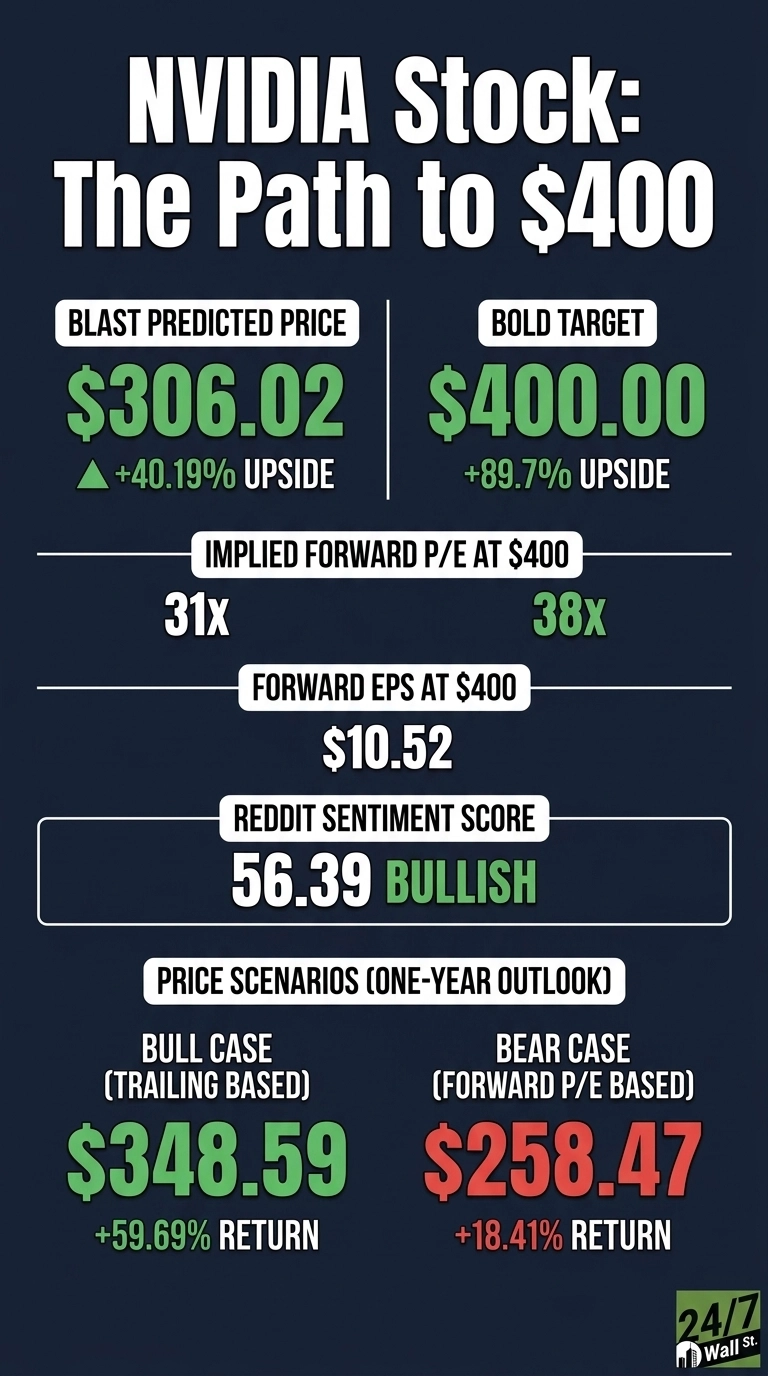
Path to $400 Per Share
Reaching $400 from today’s price of $210.85 would require a gain of 89.7%. With forward EPS of $10.52, a price of $400 implies a forward P/E of 38x. Our base case of $306.02 already implies 31x, meaning the bold target requires additional multiple expansion.
That sounds like a lot until you consider fiscal 2028 EPS consensus is $15.52, so today’s implied forward P/E against next year’s earnings is roughly 26x, hardly stretched for a company growing 70%.
The catalysts are real: Vera Rubin is already in production with purchase orders from every major hyperscaler, hyperscaler capex is on track for $1.3 trillion in 2027, and OpenAI’s commitments alone represent approximately 12 gigawatts of NVIDIA compute.
Huang added: “The AI infrastructure buildout is at full steam. Vera Rubin, now in full production, was built to power exactly this moment.” The primary risk is a hyperscaler digestion phase that turns those $279 billion in supply commitments into stranded inventory.

Where NVIDIA Trades Today vs Its Earnings Power
At $210.85 against forward EPS of $10.52, NVDA carries a forward P/E of 20x. That is remarkably reasonable for a business with 75% gross margins, 60% operating margins, and revenue that more than doubled year over year.
Shares sit between the 52-week low of $163.90 and high of $236. Zoom out and the 10-year return is 14,254.68%. Long-term holders know what compounding on this scale looks like.
Is $400 Realistic? Here’s My Verdict
$400 requires an 89.7% gain and a forward P/E of 38x.
That is a stretch, but a defensible one if three things go right: Vera Rubin ramps as the fastest product in company history, fiscal 2028 EPS lands closer to the $18.75 high estimate than the average, and hyperscaler capex holds at the $1.3 trillion guidepost.
A meaningful capex pause from even one hyperscaler would derail it. Returns at this level shouldn’t be expected every year, but we’ve outlined the blueprint for how NVIDIA could reach $400 in 2027.
Contact [email protected] for any questions or corrections.
Vandita Jadeja is a financial publisher with over a decade of experience writing about financial topics, including investment, savings, retirement, insurance and banking. Vandita is a Chartered Accountant who loves to debunk financial concepts for readers.
Her work has appeared on sites that include The Motley Fool, InvestorPlace, and Benzinga. She covers investing and focuses on stock picks and price prediction for 24/7 Wall St.
When not looking for the next stock investment opportunity, she can be found traveling, reading, chasing sunsets and enjoying her iced latte.