Microsoft Vs. Oracle: Same 2-Pronged AI Strategy, Very Different Outcomes
Microsoft and Oracle are chasing the same AI opportunity with nearly identical backlogs, yet their stocks have moved in opposite directions. The reason comes down to how each company is paying for the race.

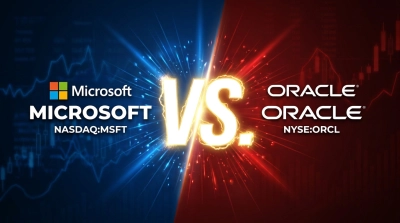
Microsoft (NASDAQ:MSFT | MSFT Price Prediction) and Oracle (NYSE:ORCL) are using the same AI strategy. Each is building hyperscale computing power and putting AI agents inside enterprise software. Both just reported earnings with fast-growing backlogs. They differ in funding: Microsoft pays for its expansion out of profits. Oracle relies on debt, new stock sales and customer prepayments, and that helps explain why the two stocks have moved so differently.
Copilot Seats Lift Microsoft. GPUs Carry Oracle.
Microsoft’s fiscal Q4 revenue rose 17.8% to $90.01B. Azure grew 43% and topped $100B in full-year revenue for the first time, so the infrastructure side is already huge. On the software side, Microsoft 365 Copilot passed 30 million paid seats, and EY rolled out the E7 suite to 400,000 employees. Customers are paying for the apps, and they are paying at scale. CFO Amy Hood also pointed to a constraint: “Customer demand continues to exceed available capacity.”
Oracle’s fiscal Q1 revenue rose 29.6% to $19.35B, and cloud infrastructure revenue jumped 121%. Cloud applications grew just 10%, and software license revenue fell 15%. Most of Oracle’s growth comes from renting out GPUs. Demand for that capacity looks solid. GPU usage reached 97.9%, and when contracts came up for renewal, the capacity was renewed or resold at a 20% premium. That suggests older chips still hold their value.
| Business Driver | Microsoft | Oracle |
|---|---|---|
| Backlog (RPO) | $678B, up 84% | $664B, up $209B |
| Infrastructure Growth | Azure +43% | IaaS +121% |
| App AI Traction | 30M+ Copilot seats | 2,300+ agents in production |
| Quarterly Free Cash Flow | $19.6B | Negative $5.4B |
One Funds It With Cash. One Borrows the Runway.
In fiscal 2026, Microsoft generated $182.94B in operating cash flow, well more than its $115.95B in capex. Hood said most AI spending goes to short-lived CPUs and GPUs, so Microsoft can slow deployment if demand cools. The weak spot is OpenAI. Excluding OpenAI, RPO grew only 25%, which means one customer accounts for much of the total backlog.
Oracle spent $28.5B on capex in a single quarter and finished a $20B at-the-market stock sale. Its interest expense rose 55% to $1.4B. CFO Hilary Maxson said that once projects ramp up, they deliver “a free cash flow conversion ratio of something like 100% to post-tax EBITDA.” Oracle still has not said when free cash flow will turn positive, and that open question troubles me. (The data-center expansion both companies are funding has to be powered, cooled and networked by someone, and we covered seven of those suppliers in a free AI infrastructure report.)
Oracle shares are down 32.14% year to date, while Microsoft is up 10.56%.
December 14 Puts Oracle’s Backlog on Trial
Oracle reports again on December 14. It expects cloud revenue to grow 65%-71% and non-GAAP EPS of $1.85-$1.93. The main question is whether the backlog turns into revenue. Management expects about half of RPO to convert over 36 months. Microsoft’s next earnings report is due imminently. Whether usage-based Copilot billing increases revenue per user is worth watching.
Why I Lean Toward Microsoft for Durability
Microsoft’s funding model looks more durable. Its application business is already bringing in revenue, and its own profits pay for its data centers. If Azure demand cools, Microsoft can slow its spending. I’m not sure Oracle can do the same with financing commitments in place.
Oracle carries more upside potential alongside more financial risk. If the backlog converts and free cash flow turns positive, the stock’s 53% one-year decline could start to look overdone. I would need to see that cash first.
Contact [email protected] for any questions or corrections.
Alex Sirois is a financial writer with experience spanning both retail and institutional investing. He has written for InvestorPlace and held roles at BNY Mellon and Bernstein, giving him a perspective that bridges Main Street portfolios and Wall Street analysis.
Alex holds an MBA from George Washington University and has built his career across multiple industries, including e-commerce, education, and translation — a breadth of experience that informs how he breaks down complex financial topics for everyday investors. His writing is conversational, actionable, and grounded in long-term, buy-and-hold investing principles.
At 247 Wall St., Alex focuses on delivering analysis that is both accessible and useful, with a clear emphasis on helping readers make more informed decisions with their money.