Alphabet’s Profit Machine vs a Sliding Stock: Time to Buy, Sell or Hold?

This post may contain links from our sponsors and affiliates, and Flywheel Publishing may receive compensation for actions taken through them.

Alphabet (NASDAQ:GOOGL | GOOGL Price Prediction) closed most recently at $283.72. The stock keeps falling while the business underlying it speeds up. In February, 24/7 Wall St. named Alphabet the most profitable company in America and built the case on three pillars: Google Cloud, Gemini and Waymo. Shares have fallen 9.8% from that February close.
All three pillars delivered. Google Cloud revenue rose 103%[1] to $30.71 billion in the third quarter. The Gemini app reached a billion users[1], and Waymo passed 500,000 autonomous rides per week[2] in the first quarter. However, the stock went the other way after third-quarter earnings per share (EPS) of $2.12[1] missed the $2.97[3] consensus and ended a 12-quarter run of beats.
Cloud Profits Tripled While a Paper Loss Caused the Miss
Cloud operating income rose to $11.12 billion[1] from $3.59 billion a year earlier. Total revenue grew 24.6%[1] to $127.58 billion. Search query growth hit its fastest pace in five years[1], which eases fears that AI is eating away at Google’s core business. Cloud backlog exceeded $460 billion[2] earlier this year.

Most of the EPS shortfall came from an $8.70 billion[1] loss on equity securities, which cut diluted EPS by $0.55. Operating income still rose 29.93%[3]. The stock trades at a trailing price-to-earnings ratio (P/E) of 15, EV/EBITDA of 11, and a price/earnings-to-growth ratio (PEG) of 1. Berkshire Hathaway (NYSE:BRK.B) kept all 78,791,167 of its shares.
Cash Burn and Dilution Threaten the Profit Story
Capital expenditures (capex) rose 114.4%[1] to $51.36 billion. That pushed free cash flow to negative $9.07 billion[1], following negative $5.86 billion[4] in the second quarter. Alphabet is paying for the build-out with $28.7 billion[3] in new notes and at-the-market sales of $4.3 billion[1] in Class A and $8.1 billion in Class C stock. Another $27.6 billion[1] of share sales remains available. (That spend flows straight to the power, cooling, and networking suppliers behind the data centers, seven of which we profiled in a free AI infrastructure report.)
Analysts are cutting their numbers. The 2026 EPS consensus fell to $19.56 from $20.62 a month earlier, with 45 downward revisions and zero upward. The 2027 consensus is lower still at $14.97.
Volatile Earnings Distort Alphabet’s Reported Profit
Equity marks distort Alphabet’s reported profit. A $99.0 billion[4] gain added $6.26 to second-quarter EPS before the third-quarter loss. Operating income leveled off at $40.58 billion against $40.77 billion the prior quarter, while R&D rose to $20.64 billion[1]. Gemini has reached huge scale, but Alphabet has yet to show how much subscription revenue it brings in. Fourth-quarter EPS, with a consensus of $3.20, and the free cash flow trend are the next tests.
Alphabet Lags the S&P 500 Despite 41% Upside to Targets

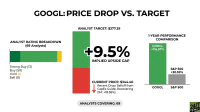
The analysts are overwhelmingly positive. Their consensus target price of $400.37 implies 41.2% upside. (Targets offer no guarantee.)
Alphabet fell 17.6% over the past month, while the S&P 500 slipped 3.2%. Year to date, the stock is down 9.4% against an 8.3% gain for the index. Over one year, it rose 2.6% versus 10.1% for the index. Shares trade near the $272.11 52-week low and below both the 50-day ($328.19) and 200-day ($338.48) moving averages.

Cloud Profits Outrun the Selloff in Alphabet Stock
Alphabet’s share price reflects fear about cash burn, while the operating data point the other way. Cloud growth sped up from 63%[2] to 82%[4] to 103%[1] across 2026, and Cloud operating income rose every quarter. That path is the key trend to monitor over the next two to four quarters.

Shares trade near the 52-week low despite that growth and a 31.8% operating margin. And the EPS miss came from a non-operating loss on investments.
The bull case weakens if free cash flow remains negative into 2027 while share sales accelerate dilution. Each quarter, track capex, Cloud margins, and the share count. Alphabet’s profit engine is growing faster than its share price suggests, and that gap is worth exploring further.
Contact [email protected] for any questions or corrections.
Trey has been an editor and author at 24/7 Wall St. for more than a decade, where he has published thousands of articles analyzing corporate earnings, dividend stocks, short interest, insider buying, private equity, and market trends. His comprehensive coverage spans the full spectrum of financial markets, from blue-chip stalwarts to emerging growth companies.
Beyond 24/7 Wall St., Trey has created and edited financial content for Benzinga and AOL's BloggingStocks, contributing additional hundreds of articles to the investment community.
Trey's editorial expertise extends across multiple publishing environments. He served as production editor at Dearborn Financial Publishing and development editor at Kaplan, where he helped shape financial education materials. Earlier in his career, he worked as a writer-producer at SVE. His freelance editing portfolio includes work for prestigious clients such as Sage Publications, Rand McNally, the Institute for Supply Management, the American Library Association, Eggplant Literary Productions, and Spiegel.
Outside of financial journalism, Trey writes fiction and has been an active member of the writing community for years, moderating workshop sessions at regional conventions.