$300,000 in Home Depot, IBM and McDonald’s Could Pay Over $8,500 a Year
Three household names have paid dividends for decades, and a closer look at their current yields reveals how much passive income a fixed lump sum can quietly generate each quarter without selling a single share.

This post may contain links from our sponsors and affiliates, and Flywheel Publishing may receive compensation for actions taken through them.
For anyone at or near retirement, the useful question about a portfolio comes down to the cash it pays each quarter without selling a single share. Household-name companies with decades of continuous dividends give a clear answer, and you can check the math line by line.
A $100,000 stake in each of these three dividend payers would produce the following. Spread across Home Depot (NYSE:HD | HD Price Prediction), IBM (NYSE:IBM) and McDonald’s (NYSE:MCD), a total of $300,000 yields over $8,500 in income each year at current forward yields. All three companies pay quarterly, and each has raised its payout over time.
IBM: A Dividend Streak Dating to 1916
- Stock #3: IBM
- Forward Yield: 2.67%
- Shares for $100,000: 394.9
- Annual Passive Income: ~$2,669.62
IBM sells software, infrastructure, and consulting to large enterprises, and Red Hat and its data business support a recurring revenue base that grew 8% to $24.9 billion. The yield comes from a mature, cash-heavy business that pays out a large share of its profits, with the forward dividend at $6.76 per share and the stock at $253.22.
The payout appears well covered. The dividend uses about 58% of trailing EPS of $11.72. IBM generated about $8 billion of free cash flow through nine months and paid out $4.8 billion in dividends, around 60% of that cash. Management lifted the full-year free cash flow growth outlook to more than $1 billion, and IBM has paid quarterly dividends every year since 1916. The main risk is leverage: total debt reached $63.8 billion after $11.4 billion in acquisitions so far in 2026.
Home Depot: Dividend Growth Despite a Frozen Housing Market
- Stock #2: Home Depot
- Forward Yield: 2.93%
- Shares for $100,000: 314.9
- Annual Passive Income: ~$2,934.88
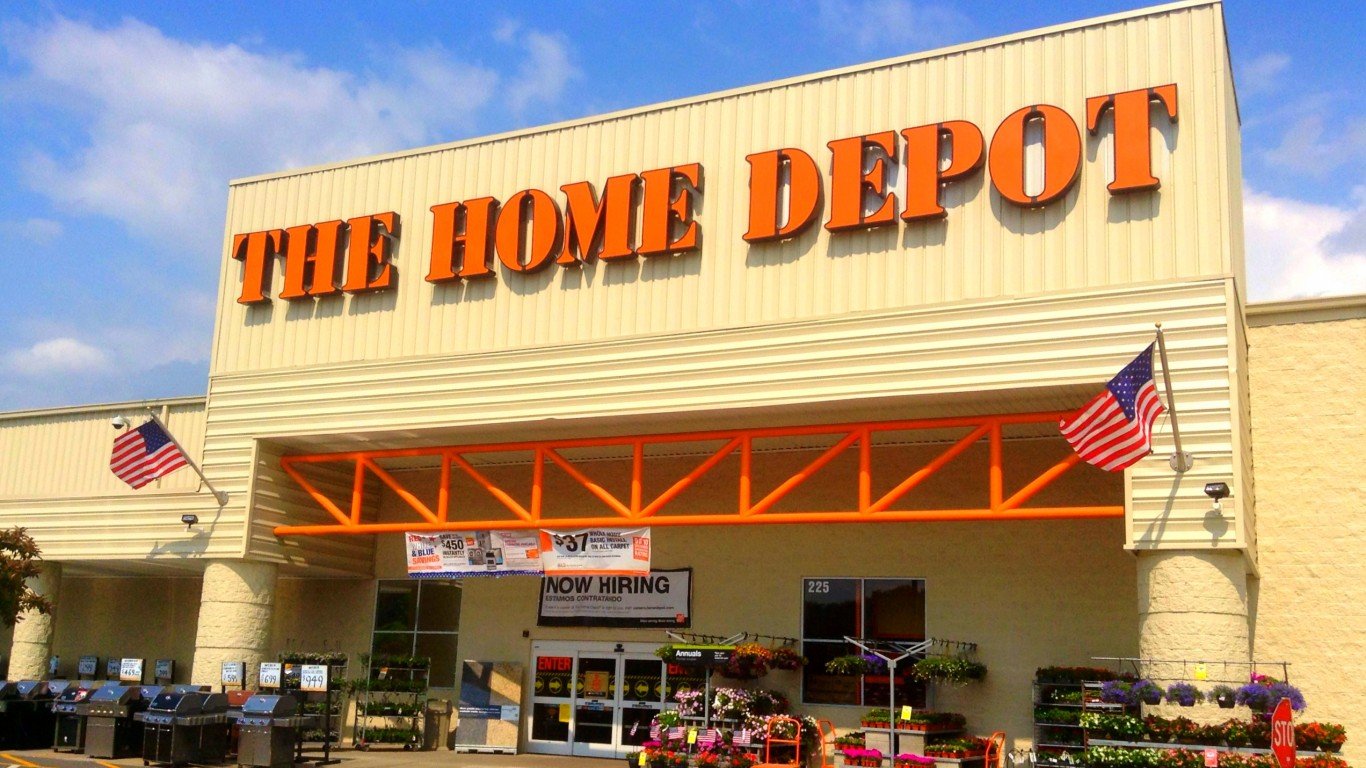
Home Depot is the largest home improvement retailer in the U.S., and it also supplies contractors through SRS Distribution’s 1,340+ locations. Its yield sits near 3% because the stock trades at $317.56, well below its 52-week high of $389.18, while the forward payout stands at $9.32 per share.
The dividend takes about 65% of trailing EPS of $14.29. Home Depot paid approximately $2.3 billion in dividends in its second quarter, and the quarterly rate rose from $2.25 in 2024 to $2.30 in 2025 and $2.33 in 2026. The risk is housing. Chief financial officer Richard McPhail said on the August call, “there’s just no sign of an inflection point at this moment,” and full-year EPS guidance calls for flat to 4% growth.
McDonald’s: A Freshly Raised Payout Leads the Group
- Stock #1: McDonald’s
- Forward Yield: 3.08%
- Shares for $100,000: 399.2
- Annual Passive Income: ~$3,081.84
McDonald’s makes most of its money collecting rent and royalties from franchisees, with franchised revenue of $4.39 billion in the second quarter. That model produces a trailing operating margin of 46.5%. The forward yield rose because the board lifted the quarterly dividend to $1.93 from $1.86, a 3.8% raise, while shares at $250.50 trail the 52-week high of $335.18.
The $7.72 forward dividend uses about 62% of trailing EPS of $12.36, and the company still bought back 3.0M shares for $858M in the second quarter. The risk is U.S. traffic: domestic comparable sales rose just 0.8%, and management said July turned slightly negative.
How the $300,000 Portfolio Pays Out
| Name | Forward Yield | Annual Dividend Income |
|---|---|---|
| IBM | 2.67% | $2,669.62 |
| Home Depot | 2.93% | $2,934.88 |
| McDonald’s | 3.08% | $3,081.84 |
| Total | 2.90% | $8,686.33 |
Together, these 3 positions yield $8,686.33 in income each year on a $300,000 investment, a combined yield of 2.90%. McDonald’s contributes $3,081.84, Home Depot adds $2,934.88, and IBM chips in $2,669.62.
All three companies have raised their payouts over the years, so this income can grow without any new money going in. For a retiree, that matters as much as the starting yield: a check that rises faster than prices helps protect spending power, and reinvesting even part of it buys more shares that pay their own dividends (that compounding, without ever selling a share, is the whole point of the dividend ladder we laid out in a free guide here).
Contact [email protected] for any questions or corrections.
Chris Lange is a financial and geopolitical writer with more than a decade of experience covering a myriad of topics. He has published thousands of articles for 24/7 Wall St., with past coverage focused heavily on stocks, IPOs, healthcare, defense, global affairs, and technology.
His work has been quoted, or referenced by a number of outlets including Business Insider, USA Today, Yahoo Finance, MSN, The Motley Fool, and many other publications. A graduate of Southwestern University, he studied business with a focus on investments and has previous experience in banking and startups.
When not reading or writing the news, he is following his passion for Lacrosse, playing chess, or building solar projects with his dad.