Home Depot vs. Lowe’s: One Dividend Looks Much Stronger Under the Hood
Home Depot and Lowe's both just paid shareholders, but the headline yield on one of them masks a coverage story that points in a very uncomfortable direction for income investors counting on future raises.

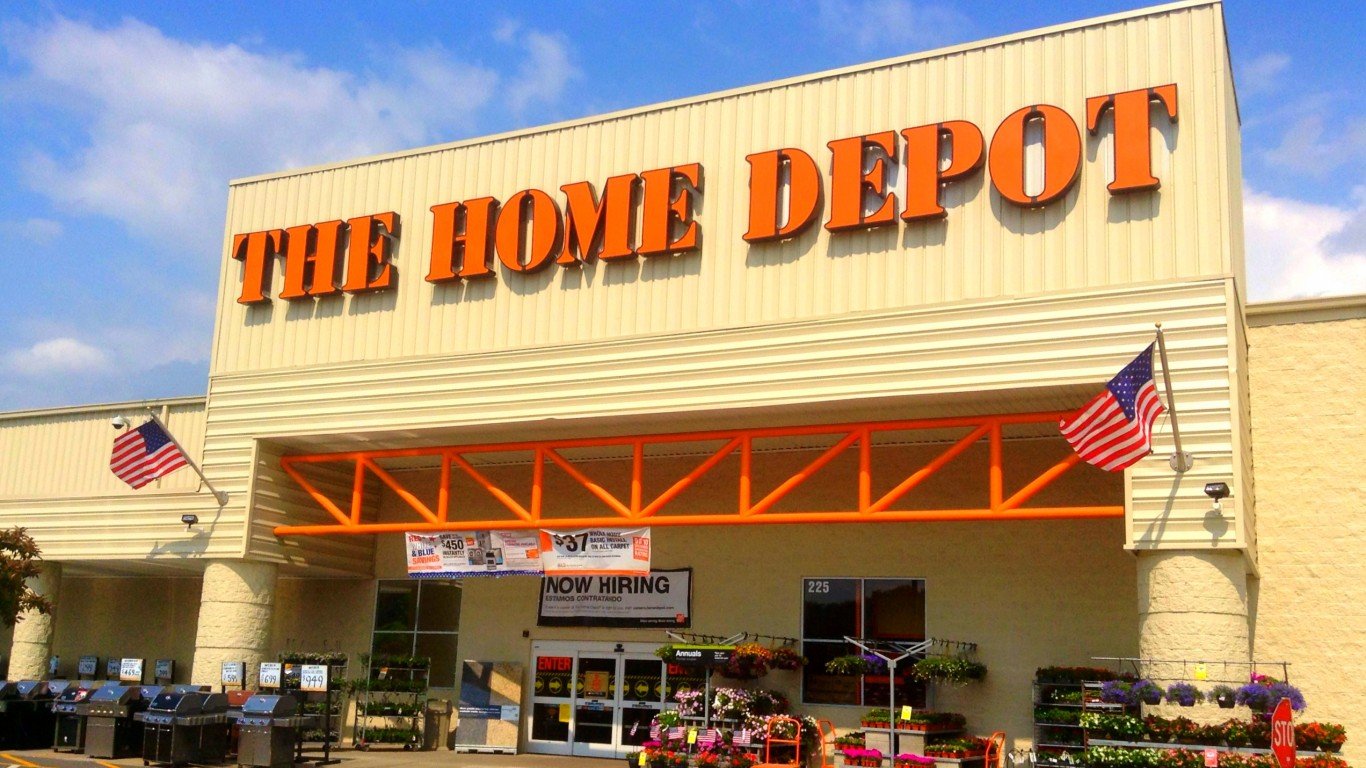
Home improvement’s dividend heavyweights just wrote checks to shareholders, and the scorecards tell very different stories. Home Depot (NYSE:HD | HD Price Prediction) offers the fatter yield and the bigger absolute payout, while Lowe’s (NYSE:LOW) counters with a longer growth streak, a leaner payout ratio, and free cash flow that towers over its distribution. With both stocks trading well off last year’s highs, the dividend math matters more than usual.
Home Depot’s Latest Payment: Higher Yield, Slower Raise
Home Depot’s board declared a $2.33 quarterly dividend on August 20, 2026, with an ex-dividend date of September 3, 2026 and a payment date of September 17, 2026. That matches the prior two quarters and works out to an annualized rate of $9.32 per share.
The reset earlier this year lifted the payout from $2.30 to $2.33, a roughly 1.3% bump that ranks as one of Home Depot’s most restrained raises in years. For context, the quarterly amount stood at $1.65 as recently as 2021 and $1.03 in 2018.
At a recent price of $319.64, the yield sits around 2.87%, comfortably above Lowe’s. Home Depot has now paid a cash dividend for its 156th consecutive quarter, nearly 39 years without interruption. Coverage is adequate but not luxurious: the $9.32 annualized payout consumes roughly 63% of fiscal 2025 adjusted EPS of $14.69, and management guided fiscal 2026 EPS to approximately flat to 4% growth versus fiscal 2025.

Lowe’s Latest Payment: Smaller Check, Bigger Raise
Lowe’s went the other way. The company paid $1.25 per share on August 5, 2026, up from $1.20 the prior quarter. That is a full 4% hike, more than triple Home Depot’s percentage raise, and it pushes the annualized forward dividend to $5.00.
On the Q2 earnings call, CFO commentary framed the payment as reinforcing Lowe’s “commitment to returning capital to shareholders and our status as a dividend aristocrat.” The company has raised its payout for more than 60 straight years, putting it in the rarefied Dividend King club that Home Depot cannot claim.
At $201.37, the yield lands near 2.35%. That is thinner than Home Depot’s on the surface, but the coverage picture is meaningfully stronger. Lowe’s fiscal 2026 adjusted EPS guidance of approximately $12.25 implies a payout ratio near 41%, well below Home Depot’s 63%.

Free Cash Flow: Where Lowe’s Pulls Away
Cash generation widens the gap further. Lowe’s produced $3.1 billion in free cash flow in Q2 alone against $673 million in dividends paid, a coverage ratio north of four times. For the trailing fiscal year, operating cash flow reached $9.86 billion against dividend payouts of $2.64 billion.
Home Depot’s dividend bill is larger in absolute terms. Management disclosed approximately $2.3 billion in dividends paid during Q2 alone, alongside $880 million in capital expenditures. Return on invested capital slipped to 24.8% from 27.2% a year earlier, while Lowe’s posted 25.5% ROIC and management targeted 2.75 times adjusted debt-to-EBITDA by mid-2027.
Scorecard Verdict
Both stocks have been punished by the housing slowdown. Home Depot is down 19.28% over the past year, and Lowe’s has slid 20.9%. Home Depot trades near 22 times earnings, while Lowe’s sits closer to 17 times, giving income investors a cheaper entry point on the smaller check.
Home Depot wins on yield and payment longevity. Lowe’s wins on growth streak, dividend growth rate this cycle, payout ratio, free cash flow coverage, and valuation. Grading strictly on the dividend itself, Lowe’s earns the higher scorecard mark. Investors who prioritize current income today may still prefer Home Depot’s 2.87% yield, but the safer, faster-growing payout, the one better positioned to keep compounding through the housing cycle, belongs to Lowe’s.
Contact [email protected] for any questions or corrections.
Chris Lange is a financial and geopolitical writer with more than a decade of experience covering a myriad of topics. He has published thousands of articles for 24/7 Wall St., with past coverage focused heavily on stocks, IPOs, healthcare, defense, global affairs, and technology.
His work has been quoted, or referenced by a number of outlets including Business Insider, USA Today, Yahoo Finance, MSN, The Motley Fool, and many other publications. A graduate of Southwestern University, he studied business with a focus on investments and has previous experience in banking and startups.
When not reading or writing the news, he is following his passion for Lacrosse, playing chess, or building solar projects with his dad.