4 Stocks Where Rising Yields Come From Bigger Dividend Checks, Not Falling Prices
Not every rising dividend yield signals good news, but four familiar companies just handed shareholders bigger checks while their stock prices climbed. The distinction separating these raisers from the rest is worth understanding before you buy.

A dividend yield can rise for two reasons. The share price can drop while the payout stays the same, which usually signals trouble ahead. Or the company can raise the payout faster than the stock rises, putting more cash in your account while your principal holds up. The second kind is the focus here. Visa (NYSE: V) gave the clearest example recently, raising its quarterly dividend by 16%. Visa and the three names below all raised their payouts while their shares finished the past year higher. Their starting yields are low, so the appeal is a payout that grows every year.
Visa Keeps Writing Bigger Checks as the Stock Climbs
Visa runs one of the world’s largest electronic payments networks, connecting consumers, merchants and banks across more than 200 countries and territories. It makes its revenue by collecting fees on the transactions that run over its network.
The new quarterly dividend is $0.78 per share, up from $0.67, for an annualized forward payout of $3.12. At $415 a share, that works out to a forward yield of about 0.75%. The starting yield is small. The growth is what matters: Visa’s dividend record shows a higher quarterly rate every year since 2016, when it paid $0.14 a quarter. Since the $0.375 rate declared in 2021, the payout has risen 108%. Over the past year, the stock returned 22.57%, so the yield rose entirely because the dividend did.
Coverage is wide. Trailing dividends of $2.79 come to about 22.6% of trailing earnings of $12.32 per share. In fiscal 2026, operating cash flow of $23.728 billion less capital spending of $1.671 billion left roughly $22.06 billion of free cash flow. That was enough to fund $20.5 billion of buybacks on top of the dividend, and Visa still has $24.4 billion left under its repurchase authorization.
The case for more increases comes straight from the income statement. Fiscal 2026 revenue rose 14.76% to $45.903 billion, and processed transactions reached 74.2 billion in the fourth quarter. The chief executive called fiscal 2026 “a milestone year”. The risk to watch is the ongoing interchange multidistrict litigation, which already has significant provisions and could drain cash otherwise headed to shareholders.
JPMorgan Chase Turns Record Profits Into Steady Raises
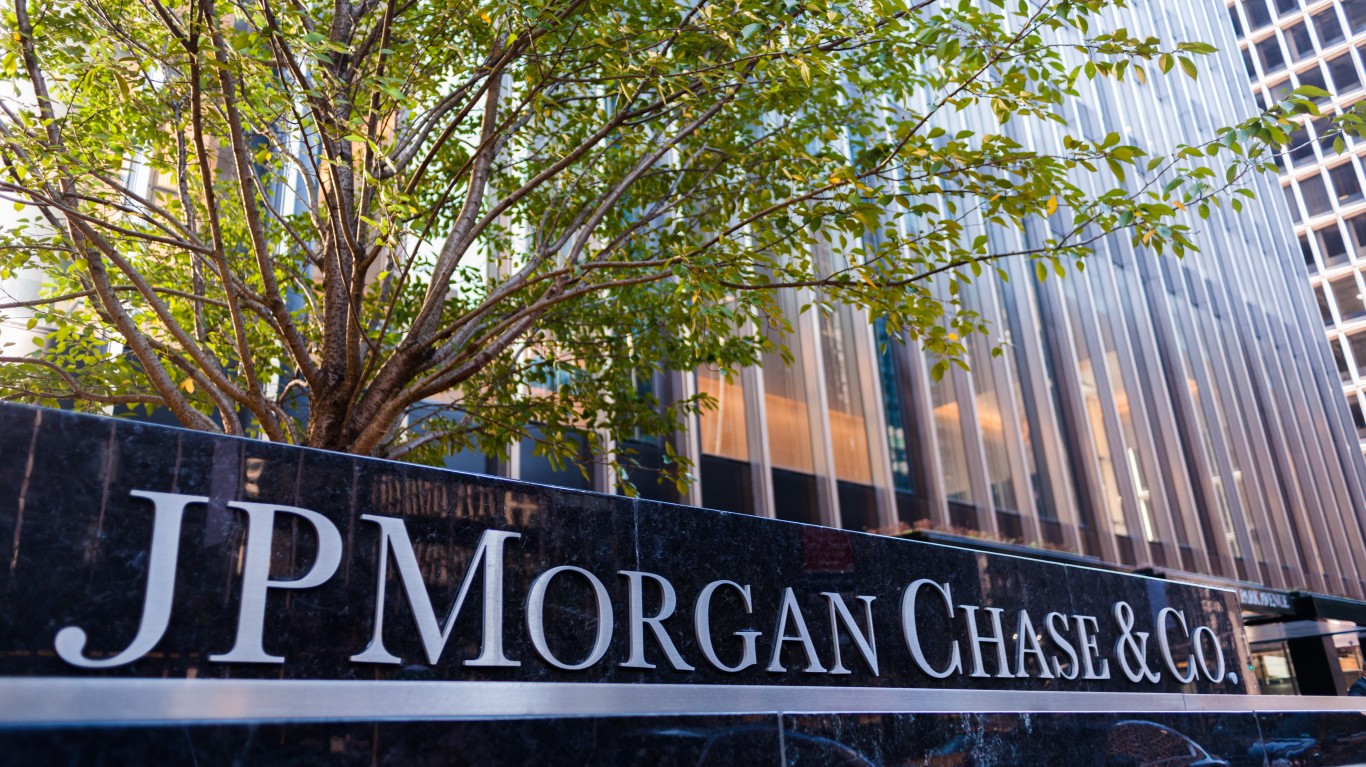
JPMorgan Chase (NYSE: JPM | JPM Price Prediction) is the largest U.S. bank, with $5.0 trillion in assets spread across consumer banking under the Chase brand, investment banking, and asset management.
The bank’s latest quarterly dividend is $1.65, a 10% increase from $1.50. The annualized forward payout is $6.60, which, at $345.44 a share, comes to a forward yield of about 1.91%, the highest on this list. The dividend has increased six times since the $1.00 quarterly rate in early 2023, for a cumulative gain of 65%. The shares rose 15.23% over the past year, so the payout beat a rising stock.
The safety read is solid. Trailing dividends of $6.15 equal about 25.8% of trailing earnings of $23.84 per share. For a bank, capital is the better test: JPMorgan reported a CET1 ratio of 14.3% and authorized a new $50 billion buyback program. Excluding one-time gains, second-quarter adjusted EPS was $6.14, up 13% year over year, with a 23% return on tangible common equity.
For income investors, the bull case is breadth. Investment banking fees jumped 30% and net interest income rose 10%, so the dividend draws on several profit drivers at once. The catch is credit. The card net charge-off rate stood at 3.33%, and the allowance for credit losses rose 12% to $31.4 billion. Jamie Dimon, the CEO at the time of the release, warned that risks are “shifting below the surface like tectonic plates.”
Unlike Broadcom, Walmart Extends a Decades-Long Habit of Higher Payouts
For contrast, consider Broadcom (NASDAQ: AVGO). Broadcom’s quarterly dividend has held at $0.65 for four straight payments while its shares fell 13.52% over the past year, so its yield is rising from the price side.
Walmart (NASDAQ: WMT) runs more than 10,900 stores in 19 countries, serving about 280 million customers a week. Its quarterly dividend rose to $0.2475 from $0.235, a 5.3% increase, for a forward annual payout of $0.99. At $121.25, that is a yield of about 0.82%. The dividend record shows a higher quarterly rate every year from 2000 through 2023. After a 3-for-1 stock split that took effect in February 2024, the split-adjusted rate rose from $0.2075 to $0.235, and today it is higher still. The stock gained 19.33% over the past year.
Coverage is comfortable. The trailing payout of $0.9775 equals about 35.4% of trailing earnings of $2.76 per share. Walmart’s free cash flow yield of 1.55% sits above its dividend yield. The debt-to-equity ratio is 0.67, interest coverage is 10.66 times, and the company still has $25.1 billion left on a $30 billion buyback authorization.
The bull case is a retailer becoming a higher-margin platform. Second-quarter revenue rose 5.9% to $187.94 billion, global e-commerce grew 23%, and advertising rose 38%. Management raised its full-year adjusted EPS outlook to $2.80 to $2.87. The risk is spending. Capital expenditures of $6.7 billion drove first-quarter free cash flow to negative $1.9 billion, and at that time capex guidance was raised to about 4.0% of net sales.
Caterpillar Lifts the Payout While Orders Stack Up
Caterpillar (NYSE: CAT) makes construction and mining equipment, drivers, industrial gas turbines and locomotives, and it finances customers through Cat Financial. Its quarterly dividend rose to $1.63 from $1.51, a 7.9% raise, for a forward annual payout of $6.52. At $634, the forward yield is about 1.03%. Over the long run, the quarterly rate has risen from $0.42 in the 2009 and 2010 records to today’s level.
The shares are up 9.21% over the past year and 11.62% year to date, but they dropped 23.12% over the past month as the stock slid after its third-quarter report. Part of the latest bump in yield therefore comes from the pullback. Over the full year, the dividend increase drove most of the gain.
Coverage leaves plenty of room. Trailing dividends of $6.28 equal about 27.0% of trailing earnings of $23.23 per share. In the third quarter, operating cash flow of $4.4 billion covered $0.7 billion of dividends and $1.2 billion of buybacks, and the company ended the period with $7.929 billion in cash.
The bull case is demand. Third-quarter revenue rose 17.3% to $20.682 billion, and Power Generation sales jumped 30% on turbines and drivers for data centers. The CEO cited “strong order rates and a record backlog.” The risk is trade policy: tariffs are lifting material costs, and Caterpillar operates in a cyclical industry where a slowdown would squeeze the cash that funds increases.
Who These Four Dividend Raisers Suit Best
Visa, JPMorgan Chase, Walmart, and Caterpillar all pay out well under half of their earnings and keep raising the dividend while their stocks finish the year higher. That profile tends to match investors with a long horizon who want growing income and can accept starting yields at or below 2%. Investors focused on high current income may find these yields too low. Investors building a paycheck for the next decade may want to research these names further (we ranked ten long-tenured dividend growers by valuation in a free Dividend Kings report, here).
Contact [email protected] for any questions or corrections.
Lee Jackson has covered Wall Street analysts' equity and debt research and equity strategy daily for 24/7 Wall St. since 2012. His broad, diverse career, including a stint as creative services director at an NBC affiliate in Austin, Texas, gives him unique insight into the financial industry.
Lee Jackson's journey in the financial industry spans more than 30 years, including nearly two decades as an institutional equity salesperson at Bear Stearns, Lehman Brothers, and Morgan Stanley. His career spanned pivotal sell-side Wall Street events, from the dot-com rise and bubble to the Long-Term Capital Management debacle, 9/11, and the Great Recession of 2008. This reflects his resilience and adaptability amid market volatility.
Lee Jackson’s practical financial industry experience, gained through a career at some of the biggest banks and brokerage firms, is complemented by a lifetime of writing across various platforms. This unique combination allows him to shed light on the intricacies of Wall Street in a way only someone with deep insider experience and knowledge can. Moreover, his extensive network across Wall Street continues to provide direct access for him and 24/7 Wall St., a privilege few firms enjoy.
Since 2012, Jackson’s work for 24/7 Wall St. has been featured in Barron’s, Yahoo Finance, MarketWatch, Business Insider, TradingView, Real Money, The Street, Seeking Alpha, Benzinga, and other media outlets. He attended the prestigious Cranbrook Schools in Bloomfield Hills, Michigan, and has a degree in broadcasting from the Specs Howard School of Media Arts.