Regeneron Surges 12% as Sanofi Dupixent Windfall and Eylea HD Power Earnings Beat; Moderna Slides 2%, Merck Edges Higher, Pfizer Ticks Up
Regeneron just posted numbers that sent its stock surging while the rest of the market struggled, and the reason behind the windfall has less to do with Regeneron's own drugs than most investors realize.


A strong third quarter has made Regeneron Pharmaceuticals (NASDAQ:REGN | REGN Price Prediction) a standout healthcare gainer on a day when tech stocks are selling off. In morning trading, Regeneron stock has climbed to $919.58, up 12%. That’s a sharp jump from its $818.77 close on October 29.
The company’s Q3 2026 revenue rose 36% year over year to $5.1 billion, exceeding the S&P analysts’ consensus of $4.6 billion. Adjusted earnings per share (EPS) climbed 70% to $20.07, exceeding the S&P analysts’ consensus of $16.25. Healthcare is acting as a relative safe haven, with the NASDAQ Composite having closed more than 1% lower on October 29 amid worries about artificial intelligence (AI) spending.
Sanofi Profits Become Regeneron’s Biggest Engine
Sanofi (NASDAQ:SNY) sells Dupixent worldwide and splits the profits with Regeneron, and that arrangement powered the quarter. Dupixent’s global net sales, as recorded by Sanofi, rose 35% to $6.5 billion. Regeneron’s Sanofi collaboration revenue jumped 68% to $2,724 million.
Until recently, Sanofi recovered a development balance, money it had advanced for shared research, out of Regeneron’s profit share. That repayment wrapped up at the end of Q2 2026, so it no longer reduces what Regeneron books. Think of it as a paid-off loan that frees up income for retirement-minded readers.
In October, Regeneron expanded its Sanofi alliance to add four next-generation, long-acting antibodies. Under the deal, the company expects to book a $1 billion up-front payment as collaboration revenue in Q4 2026, with up to an additional $7 billion in potential milestones.
Eylea HD and Libtayo Hit Records for Regeneron
Regeneron’s U.S. Eylea HD net sales grew 62% to $699 million as patients switched from the original Eylea. Over the same period, original Eylea U.S. sales fell 41% to $400 million amid competition, leaving combined U.S. sales down 1% at $1.1 billion. Libtayo’s global net sales rose 51% to $550 million, while the company’s Bayer collaboration revenue declined 23%.
Chief executive Leonard S. Schleifer noted that Regeneron has about 50 product candidates in clinical development. Schleifer declared, “This was an outstanding quarter for Regeneron, with Dupixent, EYLEA HD, and Libtayo each achieving record net sales.”
Guidance and Pipeline Give Regeneron More Runway
Regeneron raised its full-year 2026 adjusted gross margin guidance on net product sales to approximately 86%, up from 84% to 85%. Management also lifted its research spending outlook and trimmed its selling, general and administrative expense guidance. Over the first nine months, the company bought back $2.3 billion of stock, and it ended September with $18.86 billion in cash and marketable securities. A $0.94 quarterly dividend is payable December 3.

Food and Drug Administration (FDA) action on cemdisiran for generalized myasthenia gravis is expected in November, according to Regeneron. Phase 3 programs span multiple myeloma, lymphoma, anticoagulation and obesity, and Pasatru recently won FDA approval for fibrodysplasia ossificans progressiva.
Moderna Slides While Merck and Pfizer Inch Up
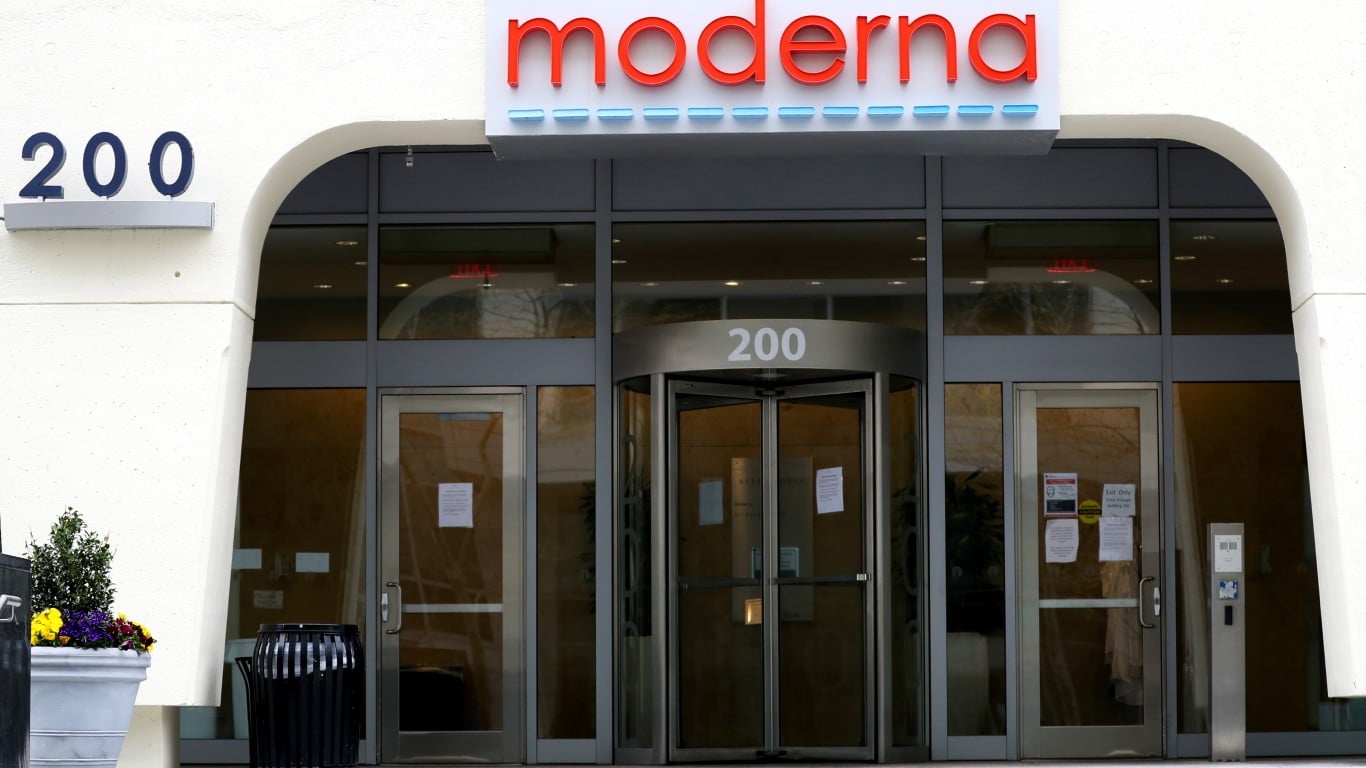
Moderna (NASDAQ:MRNA) stock is at $219.20, down 2%. Even so, the messenger RNA (mRNA) vaccine maker remains up 643% year to date (YTD).
Meanwhile, Merck (NYSE:MRK) stock is at $148.23, up 1%, following its October 29 quarterly report that beat expectations and raised its profit outlook. That leaves the drugmaker up 44% YTD. In its third-quarter results, Merck reported $830 million in sales from its new subcutaneous Keytruda Qlex.
Additionally, Pfizer (NYSE:PFE) stock is at $30.16, up 0.7%. Its most recent quarterly report came out on August 4, well before Regeneron and Merck posted theirs.
How Regeneron’s Model Differs From Big Pharma and Vaccine Makers
Regeneron pairs its own eye and cancer franchises with profit shares on partner-sold drugs, led by Dupixent through Sanofi. Moderna is a loss-making mRNA company still resetting after the pandemic, with a cancer vaccine partnership with Merck at the center of its shift. Big pharma names Merck and Pfizer are diversified giants, with Merck built around by Keytruda and Pfizer spread across vaccines, oncology, cardiovascular drugs and an emerging obesity program.
What Comes Next for Regeneron’s Rally
Regeneron now awaits the FDA’s November decision on whether to clear cemdisiran. Beyond that, Sanofi collaboration revenue, Eylea HD uptake and obesity program progress could show whether the quarter’s strength can last. On the bullish side, a full Dupixent profit share gives the company a stronger earnings base.
Regeneron also carries real risks. Biosimilar competition is pressuring the original Eylea, Eylea HD faces lower net pricing, and drug-pricing rules, tariffs and pending Justice Department civil proceedings remain concerns. Heavy reliance on Sanofi and Bayer adds concentration risk. Investors may want to stay cautious while the FDA’s cemdisiran decision is pending.
Contact [email protected] for any questions or corrections.
David Moadel is financial writer specializing in stocks, ETFs, options, precious metals, and Bitcoin. David has written well over 1,000 articles for leading online publications, helping investors understand markets, income strategies, and risk.His work has appeared in The Motley Fool, InvestorPlace, U.S. News & World Report, TipRanks, ValueWalk, Benzinga, Market Realist, TalkMarkets, Finmasters, 24/7 Wall St., and others.With a master’s degree in education, David has taught at the elementary, high school, and college levels. That teaching background shapes his writing style: clear, educational, and practical. David has also built a loyal social-media audience by providing trustworthy financial content on YouTube, X/Twitter, and StockTwits.