AMD Is Chasing Nvidia in AI, but Investors Could Win Either Way
AMD's Data Center revenue just doubled and Helios is shipping ahead of schedule, but the path to $1,000 a share by 2027 depends on a few critical variables that could make or break the entire thesis.


When AMD (NASDAQ:AMD | AMD Price Prediction) reported its second quarter, Data Center revenue came in at $6.72B, up 107%. That segment now makes up 58% of total revenue. CEO Lisa Su said AMD heads into the second half “with strong momentum as EPYC demand accelerates, Instinct deployments scale and Helios begins to ramp.” Investors have responded.
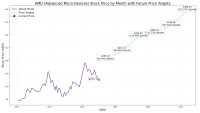
Shares are up 164.77% year-to-date at $567.04, even after a 10.08% decline over the past month. Helios racks are shipping and AMD has gigawatt-scale deals with OpenAI, Meta Platforms (NASDAQ:META) and Anthropic. Let’s look at what AMD needs to do to hit $1,000 per share in 2027.

Wall Street’s Target Lags Fast-Rising Estimates
The average analyst price target of $637.61 suggests 12% of upside. That gap is small because the stock has run so far, but the forecasts behind it are aggressive. Analysts expect 2026 EPS of $7.5884 to rise to $15.7629 in 2027, growth of 108%. Revenue is projected to climb 75%.
The 2027 EPS consensus stood at $13.4921 three months ago, meaning estimates have climbed 17% in a single quarter. AMD has also beaten EPS and revenue estimates in each of its last four quarters. That streak suggests 2027 results could come in above forecasts.

Here’s What It Takes for AMD to Reach $1,000
At today’s price, AMD trades at 36x 2027 estimates. The stock commands a premium to the S&P 500’s forward multiple of roughly 21x to 23x, which makes sense for earnings expected to more than double.
At $1,000, the multiple would be 63x. The multiple is steep, but Su told analysts AMD expects to significantly exceed its prior $20 annual EPS target. If 2027 earnings reach the high estimate of $20.25, $1,000 works out to about 49x.

What Could Push AMD to $1,000?
- Helios ramp: Customer demand is tracking ahead of AMD’s initial forecast. Anthropic’s first gigawatt deployment begins in the first half of 2027.
- Data center doubling: Management expects Data Center revenue to more than double year-over-year in 2027, with server revenue growing more than 70%.
- Bigger market: AMD raised its forecast for the data center AI accelerator market to $1.4 trillion by 2030.
- Overflow demand: NVIDIA (NASDAQ:NVDA) chief Jensen Huang said in August, “Our demand is much higher than 70%. Our supply allows us to confidently deliver 70%.” Demand that NVIDIA’s supply can’t cover gives AMD room to grow.

AMD’s History Says $1,000 Is Possible
Reaching $1,000 requires a 76% gain. Since 2000, AMD has beaten that mark in eight calendar years. Shares rose 348% in 2009. Shares also rose 295% in 2016, 148% in 2019 and 128% in 2023 (we studied what the biggest tech winners looked like before those runs and put the pattern in a free playbook here).
With a market cap near $925.8B, gains like that get harder to repeat. Still, 2026 has already delivered more than double the needed return.
$1,000 Is a Stretch, but the Blueprint Exists
Reaching $1,000 would take a 76% gain in 2027. The pieces are in place. Estimates are climbing quickly, there is a four-quarter beat streak and a Helios ramp that management says is running ahead of plan.
The main hurdles are Helios yields, data center power availability and export controls. A 63x multiple would also leave little margin if the broader market turns down. The incumbent offers a useful valuation comparison.
NVIDIA trades at 23x fiscal 2027 estimates and 14x fiscal 2028 estimates, so both stocks benefit if AI spending remains strong. Returns at this level shouldn’t be expected every year, but we’ve outlined the plan for how AMD could see outsized returns in 2027.
Contact [email protected] for any questions or corrections.
Vandita Jadeja is a financial publisher with over a decade of experience writing about financial topics, including investment, savings, retirement, insurance and banking. Vandita is a Chartered Accountant who loves to debunk financial concepts for readers.
Her work has appeared on sites that include The Motley Fool, InvestorPlace, and Benzinga. She covers investing and focuses on stock picks and price prediction for 24/7 Wall St.
When not looking for the next stock investment opportunity, she can be found traveling, reading, chasing sunsets and enjoying her iced latte.