Inflation Is Running Above 3%. These 3 Dividend Stocks Have the Pricing Power to Keep Up.
When inflation eats into your dividend's buying power, pricing power becomes the one trait separating stocks that keep up from those that quietly fall behind. Three consumer giants are charging more and still selling more, and the gap between them…

Pricing power means a company can charge more for what it sells and its customers keep buying. When ingredients, packaging and freight get more expensive, a company with pricing power passes those costs on, protects its margins and keeps enough profit coming in to raise its dividend. Consumer prices rose 3.7% year over year in the latest CPI reading, and any income stream that stays flat loses buying power while inflation stays that high. Colgate-Palmolive (NYSE: CL) | CL Price Prediction, Coca-Cola (NYSE: KO), and Procter & Gamble (NYSE: PG) all raised prices in their most recent quarter, and shoppers kept filling their carts. Each one also supports its payout with a long record of dividend increases you can check.
Colgate-Palmolive: Higher Prices and More Units Sold
Colgate sells everyday basics to households worldwide: Colgate toothpaste, Palmolive and Irish Spring soap, Speed Stick deodorant, Fabuloso cleaner, Tom’s of Maine, and Hill’s pet food. People buy these cheap items repeatedly as part of their daily routine. That gives the company room to raise prices a little at a time.
Evidence of pricing power: Organic sales rose 3.6% in the third quarter. Pricing added 2.0% and volume added 1.7%, so Colgate charged more and sold more units in the same quarter. Base Business gross margin expanded 90 bps to 60.3%, which means the price increases more than covered higher costs. Net sales in Latin America grew 12.5%. Adjusted EPS came in at $0.97, ahead of the $0.93 estimate. Management also raised its full-year Base Business EPS growth outlook to 5% to 7%.
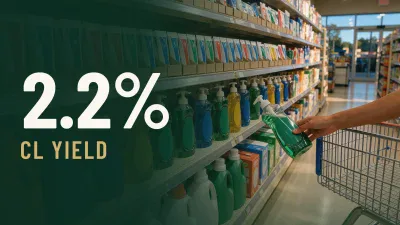
Yield and dividend record: Colgate yields 2.2% on an annual dividend of $2.10 per share. The quarterly payment went up to $0.53 from $0.52 this year. The quarterly rate has risen every year since 2014, when the payment was $0.34, and regular quarterly payments go back to 1999.
Coverage: Trailing diluted EPS is $2.63 against that $2.10 dividend, a smaller buffer than either of the other two stocks here has. Restructuring charges of $327 million so far this year are holding down GAAP earnings. That explains the gap between the trailing P/E of 37 and the forward P/E of 23. The year is now expected to bring double-digit GAAP EPS growth, and EBITDA stands at $5.041 billion. The company had $1.53 billion in cash at quarter-end.
Bull case: Colgate is growing global volume, expanding its margins, and raising guidance all at once. Those are the conditions that usually come before another dividend increase.
Risk: North American volume fell 3.7% in the quarter. In its home market, price increases are carrying the sales growth while unit sales shrink. That is a classic sign that shoppers may be moving to store brands. If the trend spreads to other regions, pricing power declines.
Coca-Cola: Brand Strength That Raises Prices and Sells More
Coca-Cola sells beverage concentrates and syrups to its bottling partners. The bottlers turn them into Coca-Cola, Coca-Cola Zero Sugar, Diet Coke, Sprite, fairlife, Powerade, and many other drinks sold in stores and restaurants worldwide. This model keeps Coca-Cola’s own costs low and supports a gross margin of 61.6%.
Evidence of pricing power: In the third quarter, unit case volume grew 5%, and organic revenue grew 7%. Price increases added four points, but three points of negative mix offset most of that, leaving price/mix at 1%. Comparable gross margin expanded about 170 basis points, and comparable operating margin reached 32.9%. Coca-Cola also gained value share for the 22nd consecutive quarter. On the earnings call, CEO Henrique Braun said the company “got pricing in line with inflation” and that “the brands have the equity and the right to take price.” North American volume was flat while revenue grew, so prices did the work there.
Yield and dividend record: Coca-Cola yields 2.15%. The quarterly dividend is $0.53, up from $0.51 last year and $0.485 the year before. The quarterly rate has risen every year since 2013, when it was $0.28.
Coverage: Trailing diluted EPS of $3.39 covers the $2.10 annual dividend well. Full-year free cash flow guidance was raised to at least $13.0 billion, up from $12.4 billion. The balance sheet is solid: $13.45 billion in cash, net debt/EBITDA of 2.49 and interest coverage of 8.32. Stock buybacks so far this year total $900 million.
Bull case: Coca-Cola is growing because people are buying more drinks, especially in India, China, Mexico and Brazil, and it still has room to raise prices. Coca-Cola Zero Sugar grew 16%. Growth driven by volume, with steady price increases on top, is the most durable kind of pricing power an income investor can own.
Risk: Coca-Cola is still fighting a tax case with the IRS. If it loses, it could owe a large cash payment, and that money would compete with dividend growth for a stretch.
Procter & Gamble: Seven Decades of Raises Backed by Cash Flow
P&G has the brands in nearly every bathroom and laundry room: Tide, Pampers, Gillette, Crest, Oral-B, Olay, Head & Shoulders, Dawn, Bounty, Charmin, SK-II and Thorne. Its five divisions cover Beauty, Grooming, Health Care, Fabric & Home Care, and Baby, Feminine & Family Care.
Evidence of pricing power: Organic sales rose 4% in the first quarter of fiscal 2027, and all five divisions grew. Beauty, Grooming and Fabric & Home Care each posted 5% organic growth. P&G raised prices on the back of new products in Hair Care, Grooming and Health Care, and mix added 1%. Core EPS of $2.00 beat the $1.89 estimate.
Yield and dividend record: P&G yields 2.66%. The quarterly dividend is $1.0885, up from $1.0568 earlier this year. This marks its 70th consecutive year of dividend increases and 136th consecutive year of dividend payments, which well makes it a Dividend King.
Coverage: First-quarter operating cash flow was $5.77 billion, and free cash flow rose 4.6% to $4.40 billion. P&G plans to pay more than $10 billion in dividends and buy back about $5 billion of stock this fiscal year. Trailing EPS of $6.64 covers the $4.291 annual dividend, and management guides core EPS to $6.89 to $7.11. Shareholders’ equity is $55.3 billion, and the stock trades at a forward P/E of 23.
Bull case: P&G has the widest spread of brands, every division is growing, and its practice of charging more for new products gives it a reliable way to grow the dividend.
Risk: P&G expects an after-tax commodity cost headwind of about $1.4 billion this fiscal year, and core gross margin fell 150 bps from a year earlier. Its price increases are currently falling short of rising input costs so that earnings growth will lean on productivity savings.
Who These Pricing-Power Payers Suit Best
With inflation at 3.7%, these three companies share the quality that keeps a dividend growing: brands people buy every week, even after a price increase. Their yields run from 2.15% to 2.66%, which puts them firmly in steady-compounder territory. Their profile tends to attract retirees and near-retirees who want income that rises with the cost of living. Coca-Cola brings the strongest volume growth, P&G the longest verified record of increases, and Colgate a newly raised earnings outlook.
Contact [email protected] for any questions or corrections.
Lee Jackson has covered Wall Street analysts' equity and debt research and equity strategy daily for 24/7 Wall St. since 2012. His broad, diverse career, including a stint as creative services director at an NBC affiliate in Austin, Texas, gives him unique insight into the financial industry.
Lee Jackson's journey in the financial industry spans more than 30 years, including nearly two decades as an institutional equity salesperson at Bear Stearns, Lehman Brothers, and Morgan Stanley. His career spanned pivotal sell-side Wall Street events, from the dot-com rise and bubble to the Long-Term Capital Management debacle, 9/11, and the Great Recession of 2008. This reflects his resilience and adaptability amid market volatility.
Lee Jackson’s practical financial industry experience, gained through a career at some of the biggest banks and brokerage firms, is complemented by a lifetime of writing across various platforms. This unique combination allows him to shed light on the intricacies of Wall Street in a way only someone with deep insider experience and knowledge can. Moreover, his extensive network across Wall Street continues to provide direct access for him and 24/7 Wall St., a privilege few firms enjoy.
Since 2012, Jackson’s work for 24/7 Wall St. has been featured in Barron’s, Yahoo Finance, MarketWatch, Business Insider, TradingView, Real Money, The Street, Seeking Alpha, Benzinga, and other media outlets. He attended the prestigious Cranbrook Schools in Bloomfield Hills, Michigan, and has a degree in broadcasting from the Specs Howard School of Media Arts.