This is How Much Monthly Income $50,000 Buys in These 4 Monthly Dividend Payers
Most dividend stocks pay four times a year, but your bills arrive every single month. Four investments cover that gap while targeting a yield that could turn a $200,000 portfolio into a steady monthly paycheck.

This post may contain links from our sponsors and affiliates, and Flywheel Publishing may receive compensation for actions taken through them.
Rent, utilities, insurance premiums, and groceries all come due every month, but most dividend stocks pay only four times a year. If you live off a portfolio, that gap means holding extra cash or selling shares to cover the months with no payment. Monthly-paying stocks line up payments with bills.
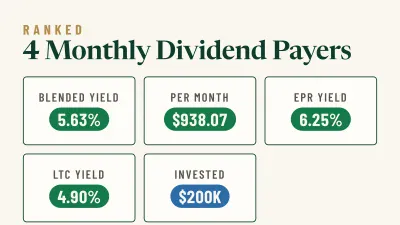
Here is what investing $50,000 in each of these four monthly payers would produce. Across $200,000 invested, the group generates about $11,256.83 in annual income, or roughly $938.07 a month, based on forward yields at current share prices. Three of the four are real estate investment trusts, and one is a business development company, so each profile starts with what that structure means for the payout.
LTC Properties
- Stock #4: LTC Properties (NYSE: LTC)
- Yield: 4.90%
- Shares for $50,000: 1,074.81
- Annual Passive Income: ~$2,450.56 (about $204.21 monthly)
LTC is a healthcare REIT that owns seniors housing and skilled nursing properties. It is moving toward a Seniors Housing Operating Portfolio (SHOP) model, which means it keeps the operating results of those communities directly. The yield comes from the REIT rule requiring it to pay out at least 90% of taxable income, funded by triple-net leases, mortgage loans, and SHOP income.
Earnings comfortably cover the payout. Full-year 2026 Core FAD guidance of $2.83 to $2.85 per share sits above the $2.28 annualized dividend. The $0.19 monthly payment has held steady through 2024, 2025, and 2026. One key risk is that LTC has made about $950M of SHOP acquisitions so far this year. That ties more of its income to occupancy and labor costs, which move around more than fixed rent does. The shares are up 42.03% year to date.
Realty Income
- Stock #3: Realty Income (NYSE: O)
- Yield: 5.61%
- Shares for $50,000: 860.59
- Annual Passive Income: ~$2,803.79 (about $233.65 monthly)
Realty Income is a net lease REIT that collects rent from more than 15,600 properties, and its portfolio is 98.8% occupied. Its yield reflects the 90% payout requirement and long leases where tenants cover most property costs.
Dividend coverage looks strong. 2026 AFFO guidance was raised to $4.45 to $4.46 per share, compared with an annualized dividend of $3.258. The October declaration was its 676th consecutive monthly dividend, and the company announced its 116th consecutive quarterly increase in September. A key risk is that growth at this size depends on putting money to work: Realty Income confirmed a $10.0B full-year investment target, and higher borrowing costs narrow the profit on each new deal.
Main Street Capital
- Stock #2: Main Street Capital (NYSE: MAIN | MAIN Price Prediction)
- Distribution Rate (regular monthly only): 5.75%
- Shares for $50,000: 887.63
- Annual Passive Income: ~$2,875.91 (about $239.66 monthly)
Main Street is an internally managed BDC that lends to private companies and takes equity stakes, typically in businesses with annual revenue of $10 million to $150 million. Owning it works differently from owning an average dividend stock. It passes through interest from loans to below-investment-grade borrowers, so payouts depend on how well that loan book performs. The rate shown uses the regular $0.27 monthly dividend that starts in January 2027. It leaves out supplemental dividends, including a $0.30 payment due in December.
Second-quarter distributable net investment income before taxes was $1.08 per share, while regular monthly payments in that quarter were $0.26 each. Net asset value reached a record $33.92 per share. The main risk is credit: loans that have stopped paying interest (non-accruals) made up 1.1% of the portfolio at fair value and 4.0% at cost.
EPR Properties
- Stock #1: EPR Properties (NYSE: EPR)
- Yield: 6.25%
- Shares for $50,000: 840.48
- Annual Passive Income: ~$3,126.58 (about $260.55 monthly)
EPR, the only ultra-high-yield name in this group, is a REIT that owns places people go for experiences: theatres, Topgolf venues, attractions, ski resorts, and Life Time fitness centers. These properties earn higher returns than established real estate. Its third-quarter investments carried an initial cash yield of about 8.3%.
On the October 29 earnings call, the chief financial officer said: “Our common dividend continues to be very well-covered with an AFFO payout ratio of 60% for the third quarter.” EPR raised its monthly dividend to $0.31 from $0.295 starting in March 2026. The main risk is tenant concentration: its top 10 customers account for 68.0% of base rent, and theatres make up 34%.
Monthly Income at a Glance
| Name | Yield or Distribution Rate | Annual Dividend Income |
|---|
| LTC Properties | 4.90% | $2,450.56 | |
| Realty Income | 5.61% | $2,803.79 | |
| Main Street Capital | 5.75% | $2,875.91 | |
| EPR Properties | 6.25% | $3,126.58 | |
| Total | 5.63% | $11,256.83 | |
Combined, these four holdings throw off $11,256.83 in annual income on a $200,000 investment, a blended yield of 5.63%. EPR contributes $3,126.58, Main Street brings $2,875.91, Realty Income brings $2,803.79, and LTC rounds out the group with $2,450.56.
This mix suits a retiree or near-retiree who wants a monthly payment and can live with the price swings that come with REITs and a BDC. It spreads income across retail property, senior care, leisure, and private lending, so trouble in one area does not shut off the whole stream. A steady monthly payment makes household budgeting easier and helps you avoid selling shares at a bad time to pay bills.
Contact [email protected] for any questions or corrections.
Lee Jackson has covered Wall Street analysts' equity and debt research and equity strategy daily for 24/7 Wall St. since 2012. His broad, diverse career, including a stint as creative services director at an NBC affiliate in Austin, Texas, gives him unique insight into the financial industry.
Lee Jackson's journey in the financial industry spans more than 30 years, including nearly two decades as an institutional equity salesperson at Bear Stearns, Lehman Brothers, and Morgan Stanley. His career spanned pivotal sell-side Wall Street events, from the dot-com rise and bubble to the Long-Term Capital Management debacle, 9/11, and the Great Recession of 2008. This reflects his resilience and adaptability amid market volatility.
Lee Jackson’s practical financial industry experience, gained through a career at some of the biggest banks and brokerage firms, is complemented by a lifetime of writing across various platforms. This unique combination allows him to shed light on the intricacies of Wall Street in a way only someone with deep insider experience and knowledge can. Moreover, his extensive network across Wall Street continues to provide direct access for him and 24/7 Wall St., a privilege few firms enjoy.
Since 2012, Jackson’s work for 24/7 Wall St. has been featured in Barron’s, Yahoo Finance, MarketWatch, Business Insider, TradingView, Real Money, The Street, Seeking Alpha, Benzinga, and other media outlets. He attended the prestigious Cranbrook Schools in Bloomfield Hills, Michigan, and has a degree in broadcasting from the Specs Howard School of Media Arts.