Nike Climbs 7% as Dow Rally Lifts Consumer Stocks; Deckers Gains 7%, Lululemon Rises 6%
A broad market rally is dragging battered footwear giants off their lows, but rising margins and cost cuts tell only half the story at Nike, where the company openly warns its biggest market is about to get worse.

Beaten-down footwear and apparel names are leading a broad rally in consumer stocks. Nike (NYSE:NKE | NKE Price Prediction) stands near the front of the pack. Nike stock is trading at $41.02 in afternoon trading, up 7%. The gain arrives in the middle of a turnaround that Nike’s leadership has said will take time.
Broad market strength is doing much of the work. The SPDR Dow Jones Industrial Average ETF (NYSEARCA:DIA) is up 3%, a sharp move for a fund that tracks the Dow’s blue chips. Even after the gain, Nike stock is down 34% year to date (YTD), so the rebound starts from a deep hole.
Dow Rally Pulls Money Into Consumer Names
Stocks rose on November 4 as Democrats switched control of Congress, and world markets rallied on expectations of more political certainty. That kind of broad risk appetite can favor stocks that were sold hard, and consumer names like Nike fit the profile.
Server makers tied to artificial intelligence are moving the other way. The split fits a rotation out of artificial intelligence hardware and into battered consumer names such as Nike, and sector rotation looks like the best-supported explanation, and it can reverse quickly.
How Deckers Outdoor and Lululemon Compare With Nike
Deckers Outdoor (NYSE:DECK) stock is at $90.39, up 7%. In its October 22 report, the HOKA and UGG owner posted 6.8% growth in HOKA net sales and raised its full-year earnings guidance. That outlook includes a $0.52 benefit from tariff refunds already received, so part of the lift at Deckers Outdoor comes from a one-time source.
At the same time, Lululemon Athletica (NASDAQ:LULU) stock is at $113.52, up 6%. That gain still leaves Lululemon stock down 45% YTD, a deeper slump than Nike’s. On September 3, the company cut its full-year revenue outlook as its Americas comparable sales fell 12%. Swiss running brand On Holding (NYSE:ONON) is another premium rival in the running category.
Nike’s Margin Gains Meet a Shrinking Top Line
The latest quarter showed both sides of Nike’s turnaround. In its Q1 FY2027 results released October 1, Nike’s gross margin reached 42.8%, up 60 basis points from a year earlier. Sales at Nike still fell 4.3% year over year to $11.21 billion, and Nike’s Greater China revenue dropped 26% on a currency-neutral basis. Nike set its fiscal 2027 adjusted earnings per share guidance at $1.15 to $1.35.
Speaking on the October 1 call, Nike CFO Dave Denton said, “Our results are below both our expectations and our potential, and we are focused on closing this gap.”. Wall Street’s read on the company is divided.
Bank of America carries an Underperform rating after cutting its Nike target to $24, while BTIG trimmed its target to $50 and kept a Buy rating. Barclays raised its target to $45, and Bernstein repeated a $45 target with an Outperform rating on November 3.

Where Nike’s Business Model Differs From Its Rivals
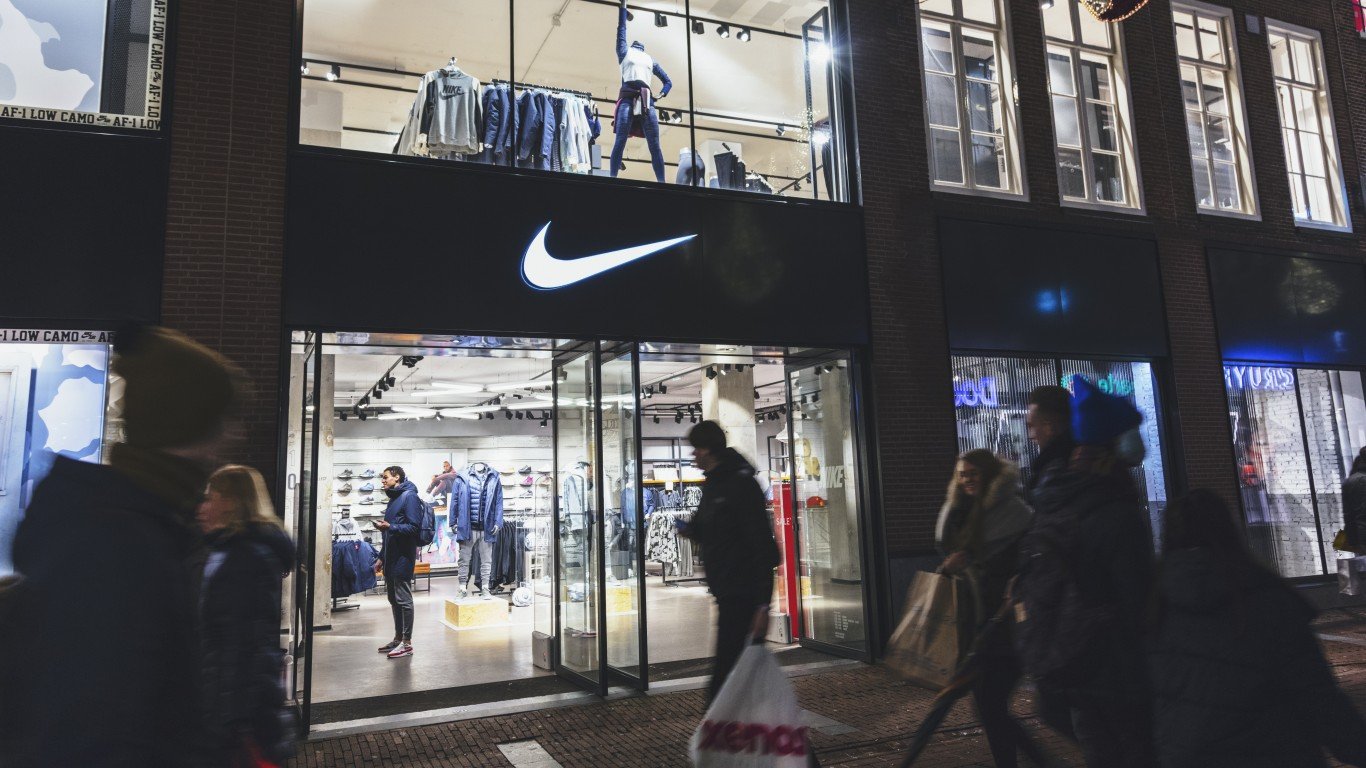
Scale sets Nike apart, with footwear, apparel and equipment sold under the Nike, Jordan and Converse brands through wholesale partners, owned stores and digital channels. Deckers Outdoor is a narrower brand house built on HOKA running shoes and UGG lifestyle footwear, and Lululemon focuses on premium technical apparel sold through its own stores and e-commerce.
On Holding, a younger Swiss brand, is scaling its premium running line globally. Nike’s range gives it more options to pull, though trouble in China, Jordan and sportswear can swamp gains elsewhere. Smaller rivals carry more concentrated brand risk, with fewer categories to cushion a slowdown.
What Comes Next for the Nike Rebound
Nike’s November investor day will show whether management can lay out a credible path back to growth. Denton noted on the October 1 call that the event would cover strategic priorities, investments, and long-term financial objectives.
Rising margins and the Pace restructuring program give the bulls something to point to, with Nike expecting approximately $2.5 billion in savings through fiscal 2031. On the other side, the bears note that the company expects its fiscal 2027 revenue to decline by a high-single-digit percentage, and its guidance assumes China revenue “actually gets worse” for the rest of the year. Waiting for clarity may be a wise strategy while the debate over Nike’s turnaround remains open.
Contact [email protected] for any questions or corrections.
David Moadel is financial writer specializing in stocks, ETFs, options, precious metals, and Bitcoin. David has written well over 1,000 articles for leading online publications, helping investors understand markets, income strategies, and risk.His work has appeared in The Motley Fool, InvestorPlace, U.S. News & World Report, TipRanks, ValueWalk, Benzinga, Market Realist, TalkMarkets, Finmasters, 24/7 Wall St., and others.With a master’s degree in education, David has taught at the elementary, high school, and college levels. That teaching background shapes his writing style: clear, educational, and practical. David has also built a loyal social-media audience by providing trustworthy financial content on YouTube, X/Twitter, and StockTwits.