America’s Imports Just Hit $426.6 Billion. A Hidden $13 Billion Surge Explains Part of Why.
Record imports masked a lopsided shift inside one monthly trade report, and a surprising country now tops America's deficit list. The AI buildout may be sending far more money overseas than anyone sees on the construction site.

This post may contain links from our sponsors and affiliates, and Flywheel Publishing may receive compensation for actions taken through them.

The Bureau of Economic Analysis reported yesterday that America bought a record $426.6 billion of goods and services from abroad in September. Total imports rose $5.2 billion from August. That headline figure downplays what happened inside the report.
Imports of computers rose $7.6 billion in the month. Computer accessories added another $5.7 billion. Together those two lines rose about $13.3 billion, more than twice the gain in total imports. Declines in other categories offset the rest.
For everyday Americans, the takeaway is simple. The data center boom is being built on U.S. soil, and the equipment inside it is shipped in from overseas.
Record Imports, Yet a Smaller Deficit
| September Trade Development | Change From August |
|---|---|
| Total imports | +$5.2 billion |
| Computer imports | +$7.6 billion |
| Computer accessories | +$5.7 billion |
| Total exports | +$5.8 billion |
| Overall trade deficit | -$0.7 billion |
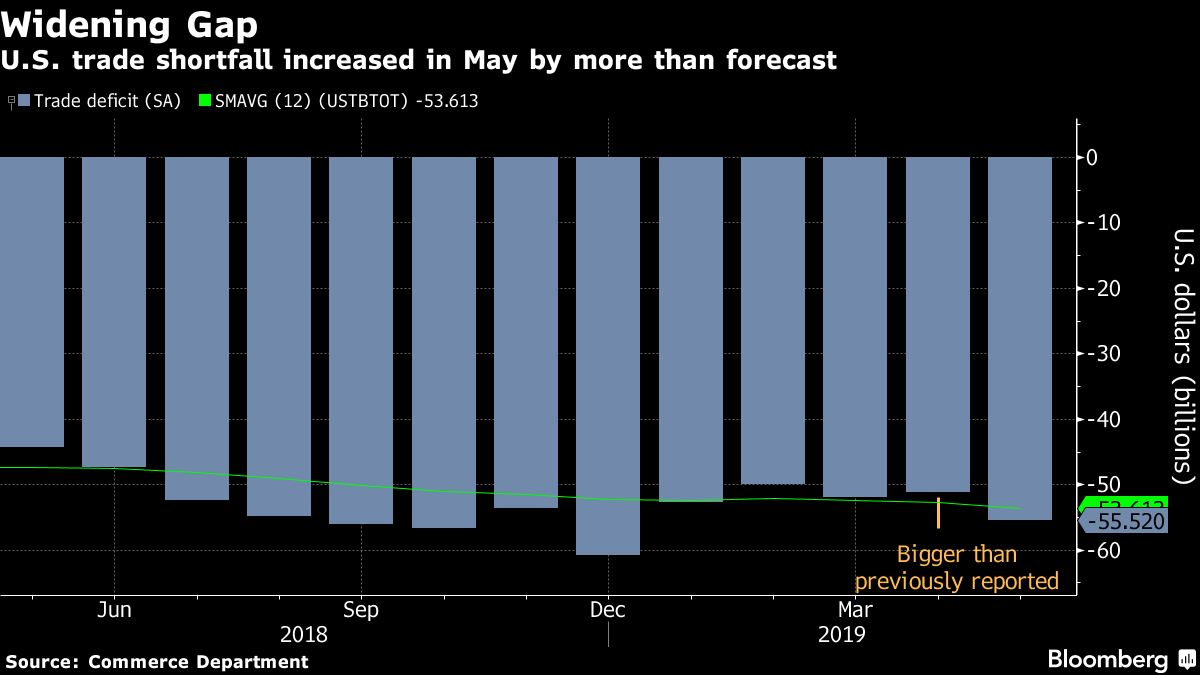
Exports grew a little faster than imports, so the trade deficit narrowed slightly to $105.0 billion. That small improvement masks a sharp decline since spring. The monthly gap stood at $52.9 billion in April. It then widened to $71.2 billion in June, $92.8 billion in July and $105.7 billion in August, the largest reading of the past year.
These figures are seasonally adjusted dollar values and are not adjusted for inflation. The BEA also does not break out how much of the computer surge went to AI facilities. Even so, a $13.3 billion one-month jump in computing hardware is large enough to move the national trade balance. Few buyers outside the companies racing to build AI capacity purchase servers at that volume.
Taiwan Now Outranks China on the Deficit Ledger
The country breakdown points the same way. America’s monthly deficit with Taiwan widened $3.6 billion to $21.9 billion, larger than the $17.9 billion gap with China. Taiwan’s trade promotion agency said its own record September exports were built on servers, computers and other tech products.
Supply chain concentration explains a lot of this. In 2024, China accounted for 30% of global semiconductor value added and Taiwan for 22%, compared with 19% for the United States, according to the National Science Board. The CHIPS and Science Act allocated $52.7 billion to rebuild domestic chipmaking. Much of the finished hardware that fills American data centers, however, still comes from Taiwanese contract manufacturers. The trade data alone cannot prove that AI purchases are why Taiwan now ranks above China, since years of tariffs on Chinese goods have also changed where companies buy.
Why Domestic Spending Leaks Abroad
This changes how Americans should think about the infrastructure boom. Construction crews, electricians, and grid upgrades stay local. The most expensive hardware inside the building often does not. In GDP accounting, an imported server counts as business investment and is then subtracted as an import, so its net contribution to growth is close to zero. A boom in capital spending does not automatically produce a matching boom in American factories.
The effects reach well beyond Silicon Valley: semiconductor suppliers, equipment makers, freight and logistics firms, and any business that depends on Asian supply chains. Any tariff on Taiwanese electronics would hit data center budgets directly. The suppliers that stand to benefit most are often the ones outside the chip names everyone already tracks (we highlighted seven of them, from power to cooling to networking, in a free report you can grab here).
What to Watch in the October Report
The next trade release will show whether September was a one-time delivery spike or a new normal. Two figures matter most: whether computer and accessory imports stay near September’s level, and whether the deficit with Taiwan remains larger than the one with China. If both hold, AI capital spending has become one of the biggest forces influencing America’s trade balance. Any policy aimed at reducing the deficit would then run straight into the industry Washington most wants to grow.
Contact [email protected] for any questions or corrections.
After two decades of patrolling the dark corners of suburbia as a police officer, Rich Duprey hung up his badge and gun to begin writing full time about stocks and investing. For the past 20 years, he’s been cruising the markets looking for companies to lock up as long-term holdings in a portfolio while writing extensively on the broad sectors of consumer goods, technology, and industrials. Because his experience isn’t from the typical financial analyst track, Rich is able to break down complex topics into understandable and useful action points for the average investor. His writings have appeared on The Motley Fool, InvestorPlace, Yahoo! Finance, Money Morning, and, of course, 24/7 Wall St. He has been featured in both U.S. and international publications, including MarketWatch, Financial Times, Forbes, Fast Company, and USA Today.