Cathie Wood Sells $12.8 Million Of Alphabet, Days After The Stock Suffered Its Worst Day Since Its 2004 IPO, Losing Nearly Half A Trillion Dollars In Market Value
ARK quietly trimmed Alphabet right after the stock's historic rout, and gave no reason. The trades, a search slowdown, and one costly AI Mode problem raise a question about what Cathie Wood's team sees that the market doesn't.

This post may contain links from our sponsors and affiliates, and Flywheel Publishing may receive compensation for actions taken through them.
Cathie Wood’s ARK Invest reduced its stake in Alphabet (NASDAQ:GOOGL | GOOGL Price Prediction) on Wednesday, Nov. 4. According to CoinCentral’s report of ARK’s daily trades, the firm sold 46,164 shares worth $12.8 million through the ARK Innovation ETF (CBOE:ARKK) and the ARK Autonomous Technology & Robotics ETF (CBOE:ARKQ). A smaller sale came one session earlier. TipRanks reported that ARK sold 12,530 Alphabet shares for about $3.5 million on Nov. 3. ARK did not give a reason for either trade.
Alphabet’s Record Selloff Came First
Both cuts landed in the week after the worst session in Alphabet’s history as a public company. On Thursday, Oct. 29, the day after its third-quarter report, Class A shares fell 12.64% to close at $283.82. Class C shares fell 12.29%. ARY News, citing Yahoo Finance’s calculation, put Alphabet’s lost market value at about $482 billion. That made it the worst day since the 2004 listing and the company’s largest one-day dollar loss, well past the previous record of about $275 billion on July 23, 2026, per ARY News. Several outlets put the loss near half a trillion dollars. ARY News placed it second among U.S.-listed companies, behind the AI chip leader’s loss of about $593 billion on Jan. 27, 2025.
At 1:38 PM ET on Nov. 5, intraday, GOOGL traded at $283.27. That was down 1.96% on the day and 12.81% below the Oct. 28 close of $324.89, which leaves the stock under its Oct. 29 close.
Why a 25% Revenue Quarter Hit Alphabet Stock
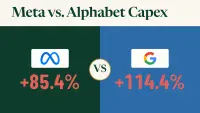
Search was the weak spot. Per ARY News, search revenue rose 12% to about $63 billion, below Wall Street’s estimate of $65 billion. TipRanks reported that total revenue rose 25% to $127.6 billion, missing forecasts, while Google Cloud grew 103% to $30.71 billion. Also per TipRanks, free cash flow went negative by $9.1 billion on heavy infrastructure spending, and planned 2026 capital spending stands at $195 billion to $205 billion. GAAP EPS of $2.12 missed the $2.97 consensus. An $8.70 billion loss on equity securities cut diluted EPS by $0.55, and the miss ended a 12-quarter beat streak.

That $195-$205 billion capex plan is the tell: the AI trade is also a power, cooling, and networking trade, and we wrote up seven suppliers riding that spend in a free report on the companies behind the buildout.
On the earnings call, Google executive Philipp Schindler called foreign exchange “the single largest driver of Search deceleration relative to Q2”. Schindler also highlighted “the lower monetization we were seeing in AI Mode.” Analysts disagree on what that means. Per Trending Topics citing Yahoo Finance, Pivotal Research’s Jeffrey Wlodarczak sees AI as a threat to search, while CFRA’s Angelo Zino called the drop a likely buying opportunity. Wealth Club’s Susannah Streeter told the Daily Mail: “The AI opportunity remains enormous, but the market is no longer prepared to give companies a blank check to pursue it.”
ARK Also Sold Eli Lilly and Amazon and Bought Nurix
Per CoinCentral, ARK also sold 8,551 Eli Lilly (NYSE:LLY) shares for $12.1 million through ARKK, along with 15,750 Amazon shares for $4.2 million. Lilly is up 29.69% this year and recently raised its 2026 revenue guidance to $91-$92B.
On the buy side, CoinCentral reported that ARK picked up 350,410 Nurix Therapeutics (NASDAQ:NRIX) shares for $9.0 million through the ARK Genomic Revolution ETF. One report cited by CoinCentral showed Nurix down 38.23% that day. The biotech has cash runway into H2 2029, and its Phase 3 DAYBreak trial is the next major catalyst. Reports conflict on the day’s largest trade, 348,406 SpaceX shares, per CoinCentral: one says ARK sold them for $49.2 million, and the other says ARK bought them for $47.3 million.
How Big ARK’s Alphabet Trims Really Are
ARKK’s most recent SEC portfolio filing shows that as of July 31, 2026, the fund held 332,338 Class C shares (2.13% of net assets) and 75,789 Class A shares (0.49%). Those July figures precede this week’s sales. ARK has traded Alphabet in both directions this year, including buying ahead of an earnings report in April.
What Alphabet and ARK Holders Should Watch Next
A disclosed trade shows a position change and leaves out the reasoning, and ARK gave none here. As of Nov. 5, Alphabet had not recovered its Oct. 29 losses. Management expects a somewhat larger foreign-exchange headwind in the fourth quarter, a meaningful revenue ramp in 2027 from TPU system sales, and capital spending that will increase significantly in 2027. How much ad revenue AI Mode generates per query will shape the next earnings report, and ARK’s daily trade disclosures will show whether this week’s cuts keep going.
Contact [email protected] for any questions or corrections.
AJ spent 10 years writing about financial markets at The Motley Fool. His coverage centers on technology stocks and the broader macroeconomic trends, from interest rates to geopolitics, that shape where markets are headed next. AJ is drawn to the stories where big-picture economics and individual companies collide.