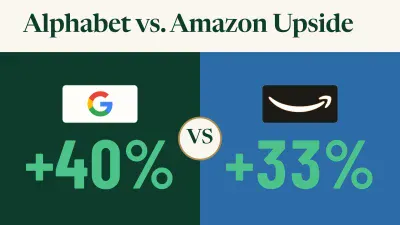
If Nvidia’s Earnings Show Tightness, Alphabet and Amazon Could Rise 40% and 33% By The End of 2026, Respectively

This post may contain links from our sponsors and affiliates, and Flywheel Publishing may receive compensation for actions taken through them.
Alphabet (NASDAQ:GOOGL | GOOGL Price Prediction) and Amazon (NASDAQ:AMZN) both missed third-quarter EPS estimates in late October, even as their cloud businesses grew faster. NVIDIA (NASDAQ:NVDA) reports on Nov. 17. If it confirms that GPU supply will stay tight, attention moves to the two hyperscalers that design their own AI chips.
Cloud Doubles at Google as AWS Hits a Five-Year High
Google Cloud revenue reached $30.71 billion, up 103%[1]. Very few businesses this large double in a single year. CEO Sundar Pichai cited “strong demand for our TPU systems across a wide range of customers.”[1] Search also held up, with year-over-year query growth at its highest in five years. GAAP EPS of $2.12[1] missed the $2.97 consensus. However, an $8.7 billion[1] loss on equity securities cut $0.55 from diluted EPS. The core business looks intact.
At Amazon, AWS revenue rose 39% to $45.98 billion[2], its fastest growth in nearly five years. AWS backlog reached $578 billion[3], which gives management a clear view of future demand. Retail also added: grocery grew about three times faster[2] than the rest of the store, and operating margin hit a record 13.9%. EPS of $1.89[2] missed the $1.96 consensus.
| Business Driver | Alphabet | Amazon |
|---|---|---|
| Cloud Growth | 103%[1] | 39%[2] |
| Custom Silicon | TPU systems sold to customers | Trainium runs most of Bedrock |
| Consumer Anchor | Gemini app, one billion users[1] | Grocery and same-day Prime delivery |
| Q3 Capex | $51.36 billion[1] | $77.26 billion[2] |
Google Sells the Silicon While Amazon Sells the Platform
Alphabet records TPU system sales as Cloud product revenue. The Gemini app’s one billion users[1] also give its models a consumer reach that few rivals can match.
Andy Jassy called AWS “a long-term platform strategy,”[3] and most Bedrock workloads already run on Trainium. Amazon plans to start selling its chips to outside customers in late 2027[3], so its silicon push is moving more slowly than Google’s.
Both companies are spending heavily to build out AI capacity. Alphabet posted free cash flow of negative $9.07 billion[1]. It also sold 12 million Class A and 24 million Class C shares[4] through its at-the-market program, which means selling new stock directly into the market. Amazon still expects 2026 capex of about $220 billion[3]. Because selling new shares dilutes existing holders, Alphabet’s way of paying for the expansion carries more risk for shareholders.
NVIDIA’s Supply Outlook Could Spark a Year-End Rotation
If NVIDIA confirms that supply stays tight into early 2027, the potential upside is 25% to 40% for Alphabet and 20% to 33% for Amazon. With about six weeks left in 2026, reaching the high end would require investors to pay much higher multiples, so I am skeptical. How many new TPU customers Google adds is worth watching. I also want to see whether AI services, which carry lower margins, start to pull down AWS’s 38.7%[3] operating margin.
Why I Lean Toward Alphabet for Upside
Alphabet trades at 13 times earnings, compared with 36 for Amazon. Its shares fell 28.43% over six months, while Amazon slipped only 2.68%. That decline, combined with triple-digit cloud growth, makes Alphabet the more compelling story to me if GPU shortages continue. Amazon fits investors who want steadier execution across retail, ads, and AWS. I would change my view if TPU demand cools or Alphabet speeds up its share sales.
Contact [email protected] for any questions or corrections.
Alex Sirois is a financial writer with experience spanning both retail and institutional investing. He has written for InvestorPlace and held roles at BNY Mellon and Bernstein, giving him a perspective that bridges Main Street portfolios and Wall Street analysis.
Alex holds an MBA from George Washington University and has built his career across multiple industries, including e-commerce, education, and translation — a breadth of experience that informs how he breaks down complex financial topics for everyday investors. His writing is conversational, actionable, and grounded in long-term, buy-and-hold investing principles.
At 247 Wall St., Alex focuses on delivering analysis that is both accessible and useful, with a clear emphasis on helping readers make more informed decisions with their money.