Microsoft Is Executing an Irreproducible Balance-Sheet-Backed Infrastructure Pre-Sale at Scale
Microsoft sells AI capacity years before it exists, then pays for the build with its own cash. One investor keeps buying despite a $170 billion spending plan, and explains why Amazon and Oracle never earn his money.

This post may contain links from our sponsors and affiliates, and Flywheel Publishing may receive compensation for actions taken through them.
Each time I have new cash to invest, I add to Microsoft (NASDAQ:MSFT | MSFT Price Prediction). After the October earnings report, I bought again at $555.80, and I expect to keep buying.
Why I Keep Hitting the Buy Button
Microsoft sells AI and cloud capacity years before it delivers it. Then it pays for the build with its own cash flow. Commercial remaining performance obligation (RPO) is revenue customers have signed for but Microsoft has not yet booked. It rose 73% to $677B. The part of that backlog due after the next 12 months grew 98%. On the call, CFO Amy Hood said, “Customer demand continues to exceed available supply.” Few companies can sell capacity years ahead at that scale and pay for it themselves.
Three Receipts Behind My Conviction
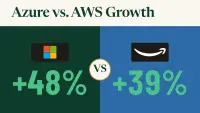
The backlog is becoming revenue. Azure grew 48%, and Microsoft Cloud revenue reached $63.9B, +30% YoY. Management expects Azure to grow 49 to 50% in constant currency next quarter.
The balance sheet bears the load. Operating cash flow hit $58.0B (+28.73% YoY). Operating margin is 46.78%, ROE is 34.04%, and interest coverage is 50.88x. Even during this build, Microsoft returned $10.2B to shareholders.
Earnings and income keep compounding. Non-GAAP EPS of $4.89 beat the $4.72 estimate. That makes six straight quarters of beating the consensus. The quarterly dividend rose to $0.98 from $0.91, and the payment record goes back to 2003. A yield of 0.64% is small. For a retirement account, I care more about how fast the payout grows.
Why My Money Skips Amazon and Oracle
Amazon (NASDAQ:AMZN) grew AWS 39% last quarter. It also reported a TTM free cash outflow of $42.4 billion, and it pays no dividend. Amazon trades near 37 times earnings, versus 31 for Microsoft, and its interest coverage is a lower 35.17x.
Like Microsoft, Oracle (NYSE:ORCL) bears a similar backlog of $664 billion. Oracle covered the cost with free cash flow of negative $5.40 billion and a $20 billion at-the-market equity program, which means selling new shares. Its equity stands at $67.196B, compared with Microsoft’s $470.5B. Oracle needs outside money to fund its build. Microsoft funds its own.
Capex Risk I Refuse to Ignore
Outlays are steep. Capital expenditures reached $39.37B, up 102.99%, after fiscal 2026 capex of $115.95B (+79.62%). Management expects about $170 billion for the calendar year, dollars that flow straight to the power, cooling, and networking sellers behind the data centers (we covered seven of those AI infrastructure suppliers in a free report here). Free cash flow fell 23.19% in Q4 FY26, and the stock trades at 61.62 times free cash flow. Any cooling of AI demand before these assets pay off would hurt the returns.
I still own it, and I still add to it. About three-quarters of the spending goes to short-lived chips matched to contracted demand. Free cash flow also stayed positive at $18.6 billion. CEO Satya Nadella said, “We feel good that the return on every dollar of CapEx we’re spending, we’re confident in that.”
What Keeps My Buy Button Active
Over the next few quarters, I am tracking three things: whether the RPO keeps growing, whether free cash flow stays positive, and whether Azure delivers on its guidance. Microsoft has customer contracts in hand before it spends the money. It also has the cash flow to fund the build and still raise its dividend, and I plan to keep adding shares as long as that holds.
Contact [email protected] for any questions or corrections.
Alex Sirois is a financial writer with experience spanning both retail and institutional investing. He has written for InvestorPlace and held roles at BNY Mellon and Bernstein, giving him a perspective that bridges Main Street portfolios and Wall Street analysis.
Alex holds an MBA from George Washington University and has built his career across multiple industries, including e-commerce, education, and translation — a breadth of experience that informs how he breaks down complex financial topics for everyday investors. His writing is conversational, actionable, and grounded in long-term, buy-and-hold investing principles.
At 247 Wall St., Alex focuses on delivering analysis that is both accessible and useful, with a clear emphasis on helping readers make more informed decisions with their money.