Musk Says “Data Centers In Space Looking Pretty Appealing Right Now” After Voters Sided Against Data Centers In 40 Of 41 Local Ballot Measures, As SpaceX, CoreWeave And Nebius Are Plunging Today
A cryptic 1 AM post from Elon Musk landed after an election that cost him a fortune and handed local voters a near sweep. Three AI infrastructure stocks are sliding, but one of them has no clear link to the…

This post may contain links from our sponsors and affiliates, and Flywheel Publishing may receive compensation for actions taken through them.

Three AI infrastructure stocks fell sharply Thursday morning. As of 11:25 AM ET on November 5, Nebius Group (NASDAQ:NBIS | NBIS Price Prediction) traded at $121.79, down 13.94%. CoreWeave (NASDAQ:CRWV) was at $43.65, down 9.85%, and SpaceX (NASDAQ:SPCX) was at $125.86, down 7.4%. These are intraday figures and could change by the close.
Musk’s Overnight Post Followed a Costly Election
According to 404 Media, Elon Musk ended his Election Day silence on X a little after 1 AM on November 4 with this post: “Data centers in space looking pretty appealing right now.” He was referring to the orbital AI data centers he has pitched for SpaceX. The Next Web says he spent a record $474M backing Republicans and lost both of Texas’s major races. 404 Media put his spending at half a billion dollars.
Voters Backed Limits in 40 of 41 Measures
Fox Business, citing a Ballotpedia analysis and results compiled by CNBC, reported that voters backed restrictions or rejected pro-development measures in 40 of 41 local ballot measures across 10 states. The Next Web says 21 of them were in Ohio. The one exception was Harwood, North Dakota, where voters rejected an extra review of industrial projects, data centers included.
Other tallies differ. 404 Media counted more than 40 races across 13 states, with voters opposing data centers in 38 and counting. Ballotpedia’s full-year page lists at least 50 measures in 2026. Of those, 47 were decided as of November 4, and a majority favored greater limits in 46. Those totals include votes held earlier in the year.
Many margins were wide. Unofficial results reported by Fox Business show Granville, Ohio backing a data center charter amendment 82.45% to 17.55%. Defiance, Ohio approved a charter amendment restricting construction 64.73% to 35.27%. 404 Media counted six cities that banned data centers outright and 12 that capped how many megawatts the buildings can draw. The Data Center Coalition’s Dan Diorio said, “The data center industry is committed to advancing America’s digital infrastructure, supporting energy reliability and affordability, and promoting long-term, responsible economic development.” Even before the vote, S&P Global figures cited by The Washington Post via Fox Business showed more than 145 projects delayed or canceled nationwide through early August.
Texas Upset Puts a Quarter of Planned Capacity in Play
CNBC, as reported by The Next Web, said Gina Hinojosa defeated Governor Greg Abbott after faulting him for how fast the build-out has moved. The Next Web also reports an estimate from Goldman Sachs’ Jan Hatzius: states where Democrats are likely to tighten data center rules account for roughly 45% of planned US capacity, and Texas alone accounts for roughly 25%.
How Much Each Company Depends on US Land and Power
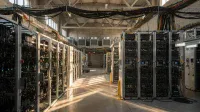
SpaceX: Orbital data centers are still a plan that depends on Starship. In its third-quarter filing, SpaceX reported Super Intelligence segment revenue of $7.60B, up 830%. That segment runs ground-based compute that is expanding to 1.7 GW through COLOSSUS II. A GAO report says the FCC has received three applications for data center clusters since January 2026, with some deployments planned by the mid-2030s. The GAO lists economic viability as a key challenge.
CoreWeave: The company rents out GPU computing and had 1.5 GW of active power at the end of the second quarter. In August, CEO Michael Intrator said moratoriums “are going to impact where this infrastructure gets built” and would leave demand intact.
Nebius: No source links Nebius’s decline to the vote. As an AI cloud provider, it is building US capacity that includes a 1.2 GW AI facility in Pennsylvania, and it spent $8.13B on capex in the first half. The stock is still up 45.5% year to date.
Amazon and Microsoft: The two hyperscalers moved the other way on Wednesday. Per CNBC via The Next Web, Amazon (NASDAQ:AMZN) gained 8% and Microsoft (NASDAQ:MSFT) gained 4%. Amazon has also pledged a $1B “Built Together” investment in US data center communities.
What Investors Should Watch
Three things stand out: new state rules, especially in Texas; more local measures; and whether the selling in AI cloud providers and data center renters continues. The expansion still has to be powered, cooled, and networked by somebody, and we featured seven suppliers riding that wave in a free report on AI infrastructure names that aren’t chipmakers. CoreWeave’s next earnings report will be the next chance to hear how management views local location risk.
Contact [email protected] for any questions or corrections.
AJ spent 10 years writing about financial markets at The Motley Fool. His coverage centers on technology stocks and the broader macroeconomic trends, from interest rates to geopolitics, that shape where markets are headed next. AJ is drawn to the stories where big-picture economics and individual companies collide.