Chip Stocks Just Had Their Second-Worst Day on Record
Chip stocks erased roughly $1.5 trillion in a single session, and nobody agrees on why. Regulation fears, hedge fund profit-taking, and a capex slowdown all compete for blame, and the real culprit decides what happens next.

This post may contain links from our sponsors and affiliates, and Flywheel Publishing may receive compensation for actions taken through them.
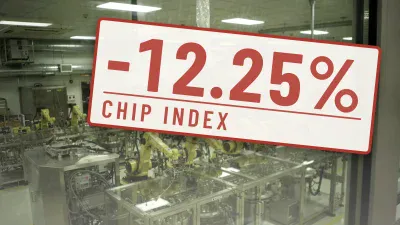
The PHLX Semiconductor Index opened at 9,806.31 on Thursday, November 5, 2026, already well below its Wednesday close of 10,268.65. It kept falling until it settled at 9,011.14, a loss of 1,257.52 points, or 12.25%.
A Reuters markets columnist called it the second-biggest one-day decline on record. It was the index’s largest drop since March 16, 2020, when it fell 15.90% in the COVID crash. It was also the index’s first close below 10,000 since April 28.
The two biggest chip funds fell with it. iShares Semiconductor ETF (NASDAQ:SOXX) closed at $131.90, down $18.24, or 12.15%. That was its worst day since March 2020. VanEck Semiconductor ETF (NASDAQ:SMH) fell $56.54, or 11.21%, to $447.73.
Both funds are still up for 2026. If you own either one, the question is whether November 5 corrected an overheated rally or started a deeper unwind.
Equipment and Memory Names Fell Hardest
Micron Technology (NASDAQ:MU | MU Price Prediction) dropped 17.46% to $656.39. Lam Research (NASDAQ:LRCX) fell 16.36% to $185.20, after an intraday slide of about 36% over the past month. NVIDIA (NASDAQ:NVDA) fell a smaller 9.26% to $181.60.
That split matters because sales of chipmaking equipment and memory depend on what chipmakers and data center owners plan to spend next year. When those stocks fall harder than the company selling into current AI demand, investors are pricing in a capex slowdown (capex is capital spending on plants and equipment) more than any drop in current orders.
By one estimate, chipmakers lost more than $1.5 trillion in market value, out of roughly $3 trillion erased across the S&P 500. The Nasdaq Composite dropped 5.52%, its biggest daily decline in 19 months.
Why SMH Fell Less Than SOXX
SOXX tracks an index of 30 U.S.-listed chip companies and holds $43.89 billion in assets. SMH holds $67.25 billion, and Nvidia is its top position at 20.57%.
Because Nvidia fell less than the equipment and memory names, that heavy weighting cushioned SMH’s drop. The same concentration will hurt SMH if Nvidia disappoints.
Over the week through November 5, SOXX lost 22.99%, and SMH lost 20.29%. Year to date, SOXX is still up 31.62%, and SMH is up 24.32%.
Competing Explanations for the Selloff
Some investors pointed to concerns of tougher AI regulation after Democrats won Congress, including in states where opposition to new data centers has grown. Nomura’s Charlie McElligott said the bigger driver was hedge funds selling the year’s biggest winners to lock in gains, with weaker fundamentals playing a smaller role. Mark Hackett of Nationwide cited weak results from two chip designers, along with heavy institutional selling and hedge funds cutting their borrowing.
Selling driven by crowded positions usually runs its course faster than a real break in demand. Concerns about regulation can last longer, because new rules take months to write. Riding a rally like this year’s chip run works only if you plan the exit in advance (we wrote a free handbook on exactly that, here: The Bubble Survivor’s Handbook).
What SOXX Investors Need to Track After the Selloff
Investors researching SOXX should consider how far the selloff has already run. The index sits 38.4% below its June 22 record close of 14,634.72 after a 21.8% loss over five trading days.
SOXX tends more toward equipment and memory, so it should bounce back harder if the capex concerns are overdone. SMH has shown a steadier profile, because its Nvidia weighting held up better on November 5. In exchange, it would likely capture less of any rebound.
Nvidia’s earnings report is expected Tuesday, November 17, after the close, though the company has not confirmed the date. If the index closes back above 10,000 after that report, November 5 was mostly a wave of position selling. A close below 9,011.14 would point to a real capex unwind.
Contact [email protected] for any questions or corrections.
Omor Ibne Ehsan is a writer at 24/7 Wall St. He is a self-taught investor with a focus on growth, cyclical, and dividend equities that have strong fundamentals, value, and long-term potential. He also has an interest in high-risk, high-reward investments such as penny stocks.