Applied Optoelectronics Says AI Demand Will Outrun Its Capacity Through 2027
Applied Optoelectronics is sold out of 1.6T transceivers, signed a hyperscaler deal worth up to $1.5 billion, and still guided below Wall Street. Is the capacity crunch a growth engine or the excuse behind another letdown?

This post may contain links from our sponsors and affiliates, and Flywheel Publishing may receive compensation for actions taken through them.
Applied Optoelectronics (NASDAQ:AAOI) has more orders than it can build. On its third-quarter call after the close on Thursday, November 5, 2026, CFO Stefan Murry said demand for its 800G and 1.6T data center transceivers will “exceed our production capacity throughout 2027.” In this article, AI demand means demand for those high-speed optical modules.
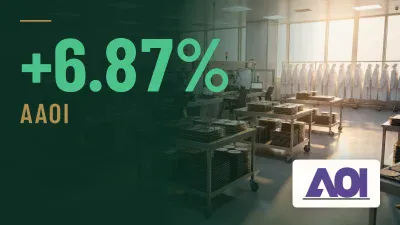
The stock fell 20.89% to $46.89 on Thursday during a sector-wide selloff, before the report. The only move after the report came on Friday, November 6: a 6.87% gain to $50.11, which still left shares about 79% below the 52-week high of $233.67. Coherent (NYSE:COHR | COHR Price Prediction) rose 13.57% and Lumentum (NASDAQ:LITE) gained 5.63% the same day. The open question is whether the capacity limit is a temporary constraint on a growing business or the reason this growth story keeps disappointing.
Record Quarter Meets a Conditional Hyperscaler Deal
Revenue reached $269.9 million, about 128% above the $118.6 million of a year earlier. GAAP net income was $6.3 million, non-GAAP EPS was $0.17, and non-GAAP gross margin was 28.7%. CEO Thompson Lin called it the sixth straight quarter of record revenue and said AI revenue of $47.5 million nearly quadrupled from the prior quarter.

AOI signed the agreement in October with an existing Tier 1 hyperscale customer it did not name. Under it, the customer will buy at least 10% of its 1.6T transceiver needs from AOI from June 2026 through May 2029, subject to conditions that include AOI’s ability to supply.
Management expects $1 billion to $1.5 billion in revenue from the deal, but that is an estimate and could vary significantly with the customer’s actual demand. Prices are fixed with some cuts built in over the term, and the customer committed no capital, so AOI pays for the factories and loses out if market prices rise.
Texas Power Delays Push Revenue Into Late 2027
Monthly capacity is nearing 330,000 units, up from about 200,000 at the end of the second quarter. AOI cut its end-of-2026 target to more than 500,000 units a month from 650,000 but raised its end-of-2027 target to more than 1 million from 930,000. That means revenue grows more slowly at first but should reach a higher level by the end of 2027.
Phase 1 of the Sugar Land, Texas plant is set to start operating in December 2026. Phase 2 has slipped about seven months, mainly because of the time needed to secure electrical power, pushing the $471 million monthly revenue run-rate goal toward the end of 2027.
Fourth-Quarter Guide Trails Consensus
AOI guided to fourth-quarter revenue of $385 million to $420 million, about 200% growth at the midpoint. That includes $270 million to $300 million from data centers. The $402.5 million midpoint is below the $427.26 million consensus, while the non-GAAP EPS range of $0.48 to $0.63 brackets the 56-cent estimate.
Murry said the shortfall came from the deal customer moving from 800G to 1.6T faster than expected, which left AOI short of 1.6T materials. Lin said AOI holds about $450 million of 1.6T orders but can ship only $50 million to $70 million of them in the fourth quarter.
Lin also said the industry may meet less than 80% of customer demand. That claim helps a company that finished a $600 million stock sale in October, and Coherent, Lumentum, InnoLight and Eoptolink are competing for the same orders. The capacity squeeze across optical suppliers is the same story unfolding in power and cooling, which is why we put together a free report on seven companies feeding the AI data-center expansion outside the chipmakers: here.
Analysts Slash AAOI Price Targets After the Report
Analysts cut their price targets on Friday. B. Riley lowered its target to $45 from $92, which is below the close. Rosenblatt’s new target of $115 (from $220) and Raymond James’ $165 (from $178) are both far above it.
Optimism around $50.11 depends on the fourth-quarter shortfall coming from missing parts for already booked orders, and on AOI raising its 2027 capacity target. The main risks are a GAAP operating loss, more dilution, and fixed contract prices.
Management presents at the Raymond James TMT and Consumer Conference on December 9, 2026, and the next earnings call is February 25, 2027. If fourth-quarter revenue comes in below $385 million, or the stock closes under $45, the constraint has likely become the bigger problem, and the bull case weakens.
Contact [email protected] for any questions or corrections.
Omor Ibne Ehsan is a writer at 24/7 Wall St. He is a self-taught investor with a focus on growth, cyclical, and dividend equities that have strong fundamentals, value, and long-term potential. He also has an interest in high-risk, high-reward investments such as penny stocks.