After the Democratic Midterm Sweep: 4 Dividend Stocks Built for Gridlock
When Congress locks up, some dividends barely notice. Four blue chips span power, soap, medicine and banking, and one of them already survived a payout collapse that income investors should not forget before trusting it.

This post may contain links from our sponsors and affiliates, and Flywheel Publishing may receive compensation for actions taken through them.
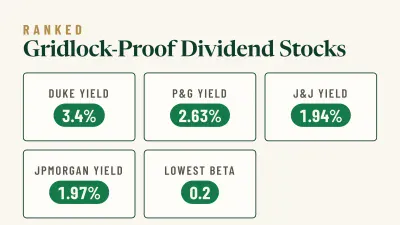
Democrats won control of both the House and the Senate while the White House stays under Republican control (per the post-election landscape). Divided government usually brings legislative gridlock. Major tax revisions, wholesale regulatory reforms and big new spending programs tend to stall, so the status quo becomes the base case. For income investors, that setup favors companies whose cash flows come from electricity demand, laundry detergent, cancer drugs and checking accounts, and whose dividends need nothing from Congress. Duke Energy (NYSE: DUK | DUK Price Prediction), Procter & Gamble (NYSE: PG), Johnson & Johnson (NYSE: JNJ) and JPMorgan Chase (NYSE: JPM) each cover one defensive sector, and the steadiest of the four trades with a beta of just 0.2 (that is Johnson & Johnson). Dividend safety drives this list. Yield comes second.
Duke Energy: State Regulators Set the Paycheck
Duke pays an annualized forward dividend of $4.34 per share. At the latest close of $127.80, that works out to a forward yield of about 3.4%, and the trailing yield is 3.29%. Next up is the $1.085 quarterly payment, scheduled for December 16.
The Washington angle: Duke makes most of its profit on state- and federally regulated rate base investment recovered through rate cases and riders, so state commissions in the Carolinas, Florida and Indiana matter far more than Capitol Hill. The federal links are energy tax credits and grants, such as a $50 million Department of Energy transmission grant. Under gridlock, changing those credits would require agreement between Congress and the president. Chief executive Harry Sideris told analysts Duke has “a track record of working with both sides of the aisle” and said, “We don’t see any changes in that focus or any changes in our ability to work with those who were recently elected.”
Dividend safety: The trailing dividend of $4.28 uses about 62.8% of trailing EPS of $6.82, which sits comfortably in the normal range for a regulated utility. Management narrowed down 2026 adjusted EPS guidance to $6.70 to $6.80 and expects to land near the top end. Utilities fund growth with debt and equity, and free cash flow runs thin while the build is underway. Duke’s protection comes from recovery mechanisms that the CFO said: “support timely recovery, strengthen the balance sheet and minimize cost for customers.” The record shows steady raises, with the quarterly payout climbing from $0.9275 in 2019 to $1.085 today.
Bull case: Duke confirmed 5% to 7% annual adjusted EPS growth through 2030. It also has 5.2 gigawatts of data centers under construction and plans to add 16 GW of capacity by 2031. More rate base means more earnings to support future raises.
Risk: The capital plan totals $103 billion, and higher interest expense already cut $0.04 per share from quarterly results. Rising financing costs could slow dividend growth.
Procter & Gamble: Staples Demand That Ignores Election Results
P&G’s annualized forward dividend of $4.354 yields about 2.63% at the latest close of $165.81. The trailing yield is 2.63%.
The Washington angle: A Democratic Congress can hold oversight hearings on consumer pricing, but changing corporate tax law requires both chambers and the president. For P&G, gridlock will most likely leave the current tax regime in place, which makes cash flow planning easier for a company with global sales.
Dividend safety: The trailing dividend of $4.291 uses about 64.6% of trailing EPS of $6.64. Fiscal first-quarter free cash flow came to $4.40B (up 4.6% YoY) on operating cash flow of $5.77B. For fiscal 2027, the company plans to pay out more than $10B in dividends and buy back about $5B of stock, with core EPS guidance of $6.89 to $7.11. The quarterly payout rose to $1.0885 from $1.0568, and the company’s fiscal fourth-quarter release called it the 70th consecutive year of dividend increases and 136th consecutive year of dividend payments.
Bull case: Core EPS of $2.00 beat the $1.89 estimate, organic sales rose 4%, and all 5 segments posted positive organic growth. With a beta of 0.361, Tide, Pampers and Gillette sales hold up whoever runs Congress.
Risk: P&G expects roughly $1.4B in after-tax commodity cost headwinds, and core gross margin fell 150 bps. That cost pressure could keep dividend growth modest.
Johnson & Johnson: Diversified Health Care With a Rising Payout
J&J’s annualized forward dividend of $5.36 yields about 1.94% at the latest close of $276.22. The yield has contracted because the stock is up 51.06% over the past year.
The Washington angle: Drug pricing is the most policy-sensitive issue on this list. Democratic committee chairs can call hearings and press drugmakers, but a new pricing law would still need the president’s signature. J&J’s MedTech division, which grew 4.5% in the second quarter, also gives it revenue outside pharmaceutical policy.
Dividend safety: Measured against GAAP earnings, the trailing dividend of $5.28 uses about 80.1% of trailing EPS of $6.59. That figure is skewed by a quarter in which earnings fell 95.9% YoY. The trailing P/E of 42 against a forward P/E of 23 shows the market expects earnings to recover. The board raised the quarterly dividend 3.1% to $1.34, which the company said marked its 64th consecutive year of dividend increases. That record continues, with the quarterly payout rising every year from $0.61 in 2012. The company’s profile also mentions a AAA credit rating.
Bull case: Oncology sales grew 17.3%, TREMFYA rose 72.5% to $2.05B, and DARZALEX brought in $4.21B. These are growth businesses that can keep the dividend rising.
Risk: STELARA revenue dropped 55.2% on biosimilar competition. Newer drugs need to keep outgrowing that loss.
JPMorgan Chase: Fortress Capital and the Lowest Payout Ratio
JPMorgan raised its quarterly dividend to $1.65 from $1.50. The $6.60 annualized forward rate yields about 1.97% at the latest close of $334.49, compared with a trailing yield of 1.82%.
The Washington angle: A Democratic Congress will likely bring harder oversight hearings for large banks. Capital rules such as the Basel III endgame and GSIB surcharges, however, are written by the regulators. Chief executive Jamie Dimon said, “I think it is right for the regulators to look at all these things again,” and added that the bank prepares for every scenario “through thick and thin.”
Dividend safety: The trailing dividend of $6.15 uses only about 25.8% of trailing EPS of $23.84, the most coverage in this group. Third-quarter net income was $15.3 billion, with EPS of $5.57, and the standardized CET1 ratio stood at 13.9%. Dimon estimated “probably $30 billion or something of excess capital” and laid out the order of priorities: “After you pay your dividend, which hopefully will be steady, we really like investing in organic growth.” The track record has one break: the quarterly payout fell from $0.38 in 2008 to $0.05 in 2009 to 2011 before the bank rebuilt it.
Bull case: A new $50B buyback authorization and a central case of about $107 billion in 2027 net interest income excluding Markets back further capital returns, with the stock at a forward P/E of 13.
Risk: Credit is the variable to track. Credit card net charge-offs reached 3.33%, and the CFO warned that “there are a lot of pressures building up.”
Gridlock-Proof Income Across Four Sectors
Duke offers the highest yield of the four, P&G and J&J bring the longest raise streaks, and JPMorgan has the widest earnings coverage. All four fund their dividends from businesses that keep running whether Congress passes anything or not. In a divided Washington, that independence from policy is what gives income investors confidence that the payouts will hold.
Contact [email protected] for any questions or corrections.
Lee Jackson has covered Wall Street analysts' equity and debt research and equity strategy daily for 24/7 Wall St. since 2012. His broad, diverse career, including a stint as creative services director at an NBC affiliate in Austin, Texas, gives him unique insight into the financial industry.
Lee Jackson's journey in the financial industry spans more than 30 years, including nearly two decades as an institutional equity salesperson at Bear Stearns, Lehman Brothers, and Morgan Stanley. His career spanned pivotal sell-side Wall Street events, from the dot-com rise and bubble to the Long-Term Capital Management debacle, 9/11, and the Great Recession of 2008. This reflects his resilience and adaptability amid market volatility.
Lee Jackson’s practical financial industry experience, gained through a career at some of the biggest banks and brokerage firms, is complemented by a lifetime of writing across various platforms. This unique combination allows him to shed light on the intricacies of Wall Street in a way only someone with deep insider experience and knowledge can. Moreover, his extensive network across Wall Street continues to provide direct access for him and 24/7 Wall St., a privilege few firms enjoy.
Since 2012, Jackson’s work for 24/7 Wall St. has been featured in Barron’s, Yahoo Finance, MarketWatch, Business Insider, TradingView, Real Money, The Street, Seeking Alpha, Benzinga, and other media outlets. He attended the prestigious Cranbrook Schools in Bloomfield Hills, Michigan, and has a degree in broadcasting from the Specs Howard School of Media Arts.