NVIDIA Falls 5% as Board Probes Jensen Huang’s Ties to Alleged Chinese Spy; AMD Rises 4%, Intel Holds Steady
While NVIDIA absorbs a board investigation into its CEO, rivals are quietly gaining ground. Why is the damage staying so contained, and what could change when the company reports earnings and Huang faces investors?

This post may contain links from our sponsors and affiliates, and Flywheel Publishing may receive compensation for actions taken through them.
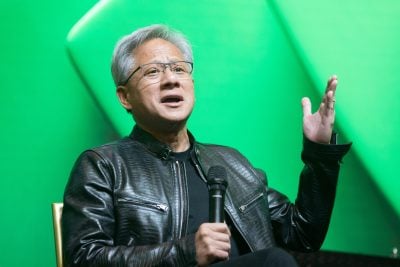
The fallout from a leadership scandal at NVIDIA (NASDAQ:NVDA | NVDA Price Prediction) is hitting one chip stock while its closest rivals hold up. NVIDIA stock is at $176.76 in premarket trading, down 5%. The company’s board said it would investigate the relationship between CEO Jensen Huang and a woman the intelligence community believes could be a Chinese spy.

Rival chipmakers are moving the other way. Advanced Micro Devices (NASDAQ:AMD) stock is at $464.96, up 4%. Intel (NASDAQ:INTC) stock is at $56.50, up 0.4%, a sign that the selling hasn’t spread across the semiconductor group.
Huang’s Memo and Board Review Put Key-Person Risk on NVIDIA
In a November 8 memo to employees, Huang admitted to an extramarital affair, apologized to his family and staff, and promised full cooperation with an independent board review. That puts a spotlight on how much of NVIDIA’s value rests on one executive. Dan Ives of Yorkville Ives put it simply: “Jensen is the core DNA of Nvidia, and its AI success and ambitions are heavily tied to him staying on as CEO. Jensen is not replaceable.”
Beijing pushed back on NVIDIA’s story quickly. Bloomberg reported that China’s Foreign Ministry spokesman Guo Jiakun called the spy allegation “unsubstantiated” and “nothing but smears against China.” Reuters reported that a planned Korea event involving Madison Huang, a senior director at NVIDIA, was canceled due to “unavoidable internal circumstances at Nvidia,” while NVIDIA AI Day Seoul is proceeding.
Some analysts see a near-term concern on NVIDIA and the risk that Huang could ultimately lose the CEO title. The company’s deal flow continues, though. On November 9, NVIDIA announced a partnership with SK Telecom and Korean chip startup Rebellions on sovereign artificial intelligence (AI) infrastructure built on NVLink Fusion.
The geopolitical stakes for NVIDIA are rising too, since Bloomberg reported the episode could complicate the meeting between Xi Jinping and Donald Trump at the Asia-Pacific Economic Cooperation (APEC) summit in Shenzhen next week. Chip stocks are also coming off a broader post-midterm sell-off, and NVIDIA stock is down 26% over the past month.
AMD and Intel Hold Up as Selling Stays Focused on NVIDIA
AMD was extending its gains from the prior session as money rotated away from NVIDIA’s company-specific risk. The chipmaker also had news of its own on November 9, saying its 5th Gen EPYC server processors power the host infrastructure for Alphabet unit Google Cloud’s newest Tensor Processing Unit (TPU) system, the first cloud TPU system with hardware-enforced confidential computing. According to AMD, EPYC is the host central processing unit (CPU) of choice across more than 10 leading hyperscalers and frontier AI labs, including systems built with NVIDIA graphics processing units (GPUs) and custom accelerators.
Steadiness at Intel suggests the selling remains contained to NVIDIA. Broadcom (NASDAQ:AVGO) stock is at $302.58, up 3%. Meanwhile, Taiwan Semiconductor Manufacturing (NYSE:TSM) stock is at $382, up 2%, adding further evidence that the sell-off is NVIDIA-specific.
How NVIDIA, AMD and Intel Compete for AI Spending
NVIDIA sells an integrated platform that pairs its GPUs with networking, full systems and its CUDA software ecosystem, which keeps customers tied to its hardware. AMD is a diverse challenger, selling Instinct AI accelerators and EPYC server CPUs while outsourcing manufacturing to third-party foundries. Intel both designs and manufactures chips, and it’s rebuilding around Xeon data-center processors and Intel Foundry.
Those differences matter when leadership comes into question. NVIDIA’s platform story is closely tied to its co-founder’s vision, so doubts about Huang’s future hit the stock directly. Intel’s management, by contrast, expects the personal computer (PC) slowdown to persist through at least the first half of 2027, a separate concern from leadership.
What Huang’s Review Means for NVIDIA’s Earnings Call
NVIDIA’s upcoming earnings report is reportedly scheduled for November 17, a date the company hasn’t confirmed. Shareholders may press management on the board review and Huang’s role then. NVIDIA’s guidance for Q3 FY2027 called for revenue of $108 billion, plus or minus 2%.

Demand is a clear positive, with Huang stating on the August 26 earnings call that “Our entire supply chain is challenged, and everybody is really running flat out.” That expansion still has to be powered and cooled by somebody, and we featured seven non-chipmaker suppliers riding the same wave in a free report. On the bearish side sit key-person risk, China tensions ahead of the APEC meeting and the chance that NVIDIA’s review drags on. It may make sense to stay cautious until the board’s review of Huang settles.
Contact [email protected] for any questions or corrections.
David Moadel is financial writer specializing in stocks, ETFs, options, precious metals, and Bitcoin. David has written well over 1,000 articles for leading online publications, helping investors understand markets, income strategies, and risk.His work has appeared in The Motley Fool, InvestorPlace, U.S. News & World Report, TipRanks, ValueWalk, Benzinga, Market Realist, TalkMarkets, Finmasters, 24/7 Wall St., and others.With a master’s degree in education, David has taught at the elementary, high school, and college levels. That teaching background shapes his writing style: clear, educational, and practical. David has also built a loyal social-media audience by providing trustworthy financial content on YouTube, X/Twitter, and StockTwits.