Jim Cramer Says the ‘Great Bifurcation’ He’s Been Waiting for Is Finally Here

This post may contain links from our sponsors and affiliates, and Flywheel Publishing may receive compensation for actions taken through them.
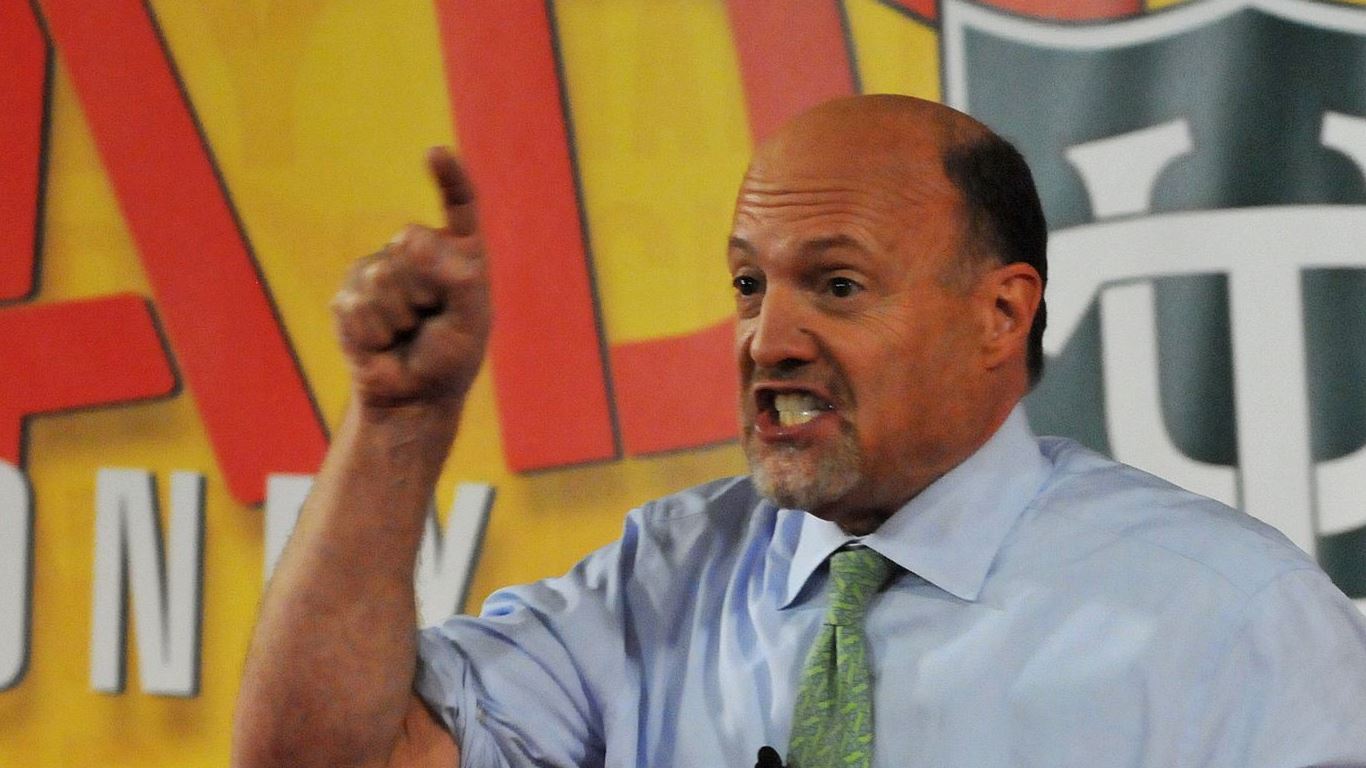
Jim Cramer has reasoned for months that the AI trade would eventually split in two. On the Nov. 24 edition of Mad Money, he said the split had arrived: “We are witnessing the great bifurcation in tech that I have been waiting for.” Heading into 2027, investors in AI stocks face a practical version of that question. Which companies pay for the AI expansion out of their own profits, and which ones depend on Wall Street to keep funding them?
One Mixed Session Exposed the Divide
Tuesday followed a big rally that, according to CNBC, was sparked by Jensen Huang’s reinstatement as Nvidia CEO. The averages went separate ways. The Nasdaq Composite fell 1.5% and the S&P 500 slipped 0.5%, while the Dow rose 0.9%. Shares of NVIDIA (NASDAQ:NVDA | NVDA Price Prediction) fell 6% after rising 31.5% the day before, which was its biggest one-day percentage gain since 2003. Cramer called the decline “an incredibly small amount of profit taking, all things considered.”
The bigger gap showed up further down the AI stack. IREN (NASDAQ:IREN) fell more than 11%. Alphabet (NASDAQ:GOOGL) dipped 1%, and Microsoft (NASDAQ:MSFT) rose slightly. Cramer described money moving out of speculative, heavily indebted AI infrastructure names and back into hyperscalers with more financial staying power (we covered seven of the power, cooling, and networking suppliers behind that expansion in a free report).
Hyperscalers Pay for AI Out of Earnings
Microsoft’s fiscal first-quarter revenue was $92.28B (+18.8% YoY)[1]. Azure grew 48%[1], and net income reached $36.63B. Capex was $39.37B[1], and the commercial remaining performance obligation (signed revenue not yet recognized) rose 73% to $677B. The stock trades at about 27 times earnings and is up 2.76% year to date.
Alphabet’s results show more strain. Google Cloud revenue grew 103% to $30.71B[2], but quarterly capex of $51.36B drove free cash flow to -$9.07B. The company raised $28.7B[2] in senior notes and sold $12.4B of stock through its at-the-market program, so even the hyperscalers are drawing on capital markets. The shares trade at about 12 times earnings.
NVIDIA produced $43.78B[3] of free cash flow on revenue of $115.84B. It guided fourth-quarter revenue to $130.0B +/- 3%[3]. Still, the stock is down 19.12% year to date.
IREN’s Growth Depends on Borrowed Money
IREN’s AI Cloud revenue grew 182% sequentially to $200M[4] once Horizon 1 went into service for Microsoft, and its backlog stands at $20.3B. The same quarterly filing reports a GAAP net loss of $263M[4] and net debt of $4.43B, up from $216M. About $6B[4] of its roughly $15B in remaining fiscal 2027 capex still has to be financed. The shares are down 71.91% over the past year.
Investors Sold Analog Devices Despite a Beat
Cramer also cited the reaction to Analog Devices (NASDAQ:ADI) as a sign of a more selective market. Fourth-quarter revenue rose 42.2% to $4.37B, and adjusted EPS of $4.06 beat the $3.88 estimate. The company guided first-quarter adjusted EPS to $3.82 +/- $0.20. CEO Vincent Roche said “more than two-thirds of our growth in fiscal 2026 came from non-AI-centric market opportunities.”
Cramer said “We are not going to have a sustained rally without some real skepticism,” and he called Analog’s numbers “mostly unremarkable.” The stock is still up 28.73% year to date but has fallen 19.21% over the past month. It trades at about 21 times forward earnings.
Key Dates Ahead for the AI Split
Cramer would rather see a gradual, stair-step recovery than a sharp rebound that could quickly reverse. He also pointed to strength in retail and pharmaceutical stocks as evidence of opportunities outside AI. Specific items to track include:
- IREN’s target of more than $4B ARR operational by January 31, 2027[4], and how it finances the remaining capex.
- Whether NVIDIA meets its fourth-quarter guidance, which assumes no China Data Center compute revenue[3].
- Whether Alphabet’s capex returns it to positive free cash flow.
- Analog Devices’ first-quarter revenue guidance of $4.4B +/- $150M.
For now, Cramer’s framework separates two kinds of AI companies: those that fund the expansion from existing profits, and those that need continued access to outside capital.
Contact [email protected] for any questions or corrections.
After two decades of patrolling the dark corners of suburbia as a police officer, Rich Duprey hung up his badge and gun to begin writing full time about stocks and investing. For the past 20 years, he’s been cruising the markets looking for companies to lock up as long-term holdings in a portfolio while writing extensively on the broad sectors of consumer goods, technology, and industrials. Because his experience isn’t from the typical financial analyst track, Rich is able to break down complex topics into understandable and useful action points for the average investor. His writings have appeared on The Motley Fool, InvestorPlace, Yahoo! Finance, Money Morning, and, of course, 24/7 Wall St. He has been featured in both U.S. and international publications, including MarketWatch, Financial Times, Forbes, Fast Company, and USA Today.