Want Reliable Dividend Income? These 4 High-Yield Stocks Have Balance Sheets Lenders Still Trust
When a dividend gets cut, lenders usually see trouble first. Four payers yielding above 5% span telecom, tobacco, real estate, and logistics, yet one of them runs a coverage cushion so thin that a weak peak season could test it.

This post may contain links from our sponsors and affiliates, and Flywheel Publishing may receive compensation for actions taken through them.
A credit rating is a lender’s grade of a company’s ability to repay what it borrows. Ratings of BBB- and above are investment grade, meaning agencies see a low risk of default. That matters to income investors because bondholders always get paid before shareholders: interest and principal come first, and the dividend gets whatever is left. A company that borrows cheaply can roll over debt, ride out a weak year, and keep dividend checks going.
One that loses its lenders’ confidence usually cuts the dividend first. For example, Fitch gives Realty Income (NYSE: O) an ‘A’ Long-Term Issuer Default Rating with a Stable Outlook. Each of the four names below pays a high yield, and each has a balance sheet that lenders still trust.
Verizon: An Ultra-High Yield Backed by Its Best Cash Flow Quarter in Years
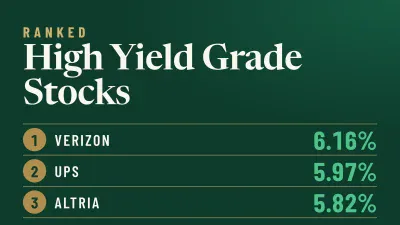
Verizon (NYSE: VZ | VZ Price Prediction) sells wireless, fiber, and fixed wireless broadband service to consumers, businesses, and government agencies. At $45.91, its annualized dividend of $2.83 yields 6.16%. That makes it the only ultra-high-yield name in this group.
Credit and balance sheet: S&P Global Ratings has confirmed Verizon at ‘BBB+’ with a stable outlook. Net unsecured debt was 2.3x adjusted EBITDA at quarter end, a 0.2x improvement from the prior quarter. CEO Dan Schulman told analysts, “We will hit our leverage targets early next year.”
Coverage: Over the first nine months, Verizon produced $18 billion of free cash flow and paid $8.8 billion in dividends. That means the dividend used about 48.9% of free cash flow. Third-quarter free cash flow of $7.8 billion was the highest since 2020, and management raised full-year free cash flow growth guidance to approaching 12%.
Track record: Its quarterly dividend has risen from $0.475 in 2010 to $0.7075 today. Last year’s raise was the company’s 19th consecutive annual increase.
The income case rests on operating momentum. Verizon added 406,000 postpaid phone customers in the quarter, and its adjusted EBITDA margin rose to 40.2%. CFO Tony Skiadas said, “We remain committed to growing the dividend and delivering enhanced returns to our shareholders through share repurchases.”
Risk: Verizon carries $166.2 billion of debt, and interest expense rose 17.2% year over year after the Frontier deal. Every dollar of interest comes ahead of shareholders.
Altria: 61 Dividend Increases and a Fresh Credit Upgrade
Altria (NYSE: MO) sells Marlboro cigarettes, Copenhagen and Skoal smokeless tobacco, and on! nicotine pouches to U.S. adults. At $76.25, the $4.44 annualized dividend yields 5.82%. The yield is lower than it was a year ago because the shares are up 38.66% year to date.
Credit and balance sheet: Fitch upgraded Altria’s Long-Term Issuer Default Rating to ‘BBB+’ from ‘BBB’. Debt-to-EBITDA was 1.9x, in line with the company’s target of about 2x. The company reports negative shareholders’ equity of -$2.23 billion. That reflects decades of share buybacks, which is why lenders focus on cash flow relative to debt.
Coverage: The $4.44 dividend matches 77.9% of the midpoint of raised adjusted EPS guidance of $5.66 to $5.74. In the first nine months, Altria returned $5.3 billion in dividends plus $735 million in buybacks. A company that can fund repurchases after paying its dividend has cash to spare.
Track record: CFO Heather Newman confirmed the quarterly dividend rose 4.7% to $1.11, “our 61st increase in 57 years.” Altria is aiming for mid-single-digit annual DPS growth through 2028.
For income investors, Altria offers pricing power. Adjusted margins in smokeable products came in at 64.5%, and those profits fund the dividend while the company builds out nicotine pouches.
Risk: Domestic cigarette industry volume fell an estimated 5%, and Marlboro’s retail share slipped to 39.5%. Higher prices cannot make up for shrinking volume forever.
Realty Income: An A-Rated Landlord That Pays Every Month
Realty Income owns single-tenant commercial properties leased under long-term net leases, and its occupancy rate is 98.8%. At $59.40, the $3.258 annualized dividend yields 5.48%, paid in monthly installments of $0.2715.
Credit and balance sheet: Realty Income holds the highest rating in this group, the Fitch ‘A’ mentioned above. CFO Jonathan Pong reported about $5.4 billion of available liquidity and net debt of 5.4x annualized pro forma adjusted EBITDA. He also said, “Over 94% of our pro rata debt is fixed rate.”
Coverage: For REITs, AFFO is the cash-flow measure that matters. Realty Income raised its AFFO guidance to $4.45 to $4.46 per share, which puts the dividend at 73.1% of the midpoint. CEO Sumit Roy said the AFFO payout ratio is “among the lowest it has been in the history of Realty Income.”
Track record: It announced its 116th consecutive quarterly dividend increase, its 136th since its 1994 NYSE listing, and it is an S&P 500 Dividend Aristocrat.
Growth is already funded. Realty Income invested $2.6 billion last quarter at a 6.8% initial cash yield, and Roy said the fourth-quarter pipeline is “all prefunded.”
Risk: About $2.9 billion at 2.9% of debt matures next year and will likely be refinanced at higher rates. Quarterly interest expense has already risen to $333.6 million from $294.5 million.
United Parcel Service: A 5.97% Yield With $6.8 Billion in Cash
United Parcel Service (NYSE: UPS) delivers packages and runs logistics operations in more than 200 countries and territories. At $109.80, the $6.56 annualized dividend yields 5.97%.
Credit and balance sheet: UPS ended the quarter with $6.8 billion in cash and no commercial paper outstanding. It issued $1.3 billion of debt during the quarter to refinance a due date and fund a pension contribution, a deal CFO Brian Dykes called “very successful.” Easy access to the bond market shows that lenders still trust the balance sheet.
Coverage: Free cash flow is projected at about $6.1 billion this year against roughly $5.4 billion in dividends so that the dividend will use about 88.5% of free cash flow. That buffer improves next year, when the $1.4 billion Driver Choice cash cost goes away.
Track record: Its quarterly dividend has grown from $0.17 in 2000 to $1.64, and it has stayed at that level for every payment this year.
CEO Carol Tomé put it: “Our dividend is safe and secure.” U.S. Domestic margin rose to 7%, and management is guiding to about 10.5% in the fourth quarter. Wider margins mean more cash for the dividend.
Risk: Coverage is the lowest of the four. Year to date, free cash flow of $4.2 billion just covered $4.1 billion in dividends so that a weak peak season would leave little room.
Who These Four Income Stocks Fit Best
These four names suit retirees and near-retirees who want yields above 5% from companies that lenders still trust. Realty Income and Verizon have the widest cash buffer behind their payouts. Altria offers the most consecutive years of raises, and UPS gives patient holders a high yield that should be better covered as its margins recover. Together, they span telecom, tobacco, real estate, and logistics.
Contact [email protected] for any questions or corrections.
Lee Jackson has covered Wall Street analysts' equity and debt research and equity strategy daily for 24/7 Wall St. since 2012. His broad, diverse career, including a stint as creative services director at an NBC affiliate in Austin, Texas, gives him unique insight into the financial industry.
Lee Jackson's journey in the financial industry spans more than 30 years, including nearly two decades as an institutional equity salesperson at Bear Stearns, Lehman Brothers, and Morgan Stanley. His career spanned pivotal sell-side Wall Street events, from the dot-com rise and bubble to the Long-Term Capital Management debacle, 9/11, and the Great Recession of 2008. This reflects his resilience and adaptability amid market volatility.
Lee Jackson’s practical financial industry experience, gained through a career at some of the biggest banks and brokerage firms, is complemented by a lifetime of writing across various platforms. This unique combination allows him to shed light on the intricacies of Wall Street in a way only someone with deep insider experience and knowledge can. Moreover, his extensive network across Wall Street continues to provide direct access for him and 24/7 Wall St., a privilege few firms enjoy.
Since 2012, Jackson’s work for 24/7 Wall St. has been featured in Barron’s, Yahoo Finance, MarketWatch, Business Insider, TradingView, Real Money, The Street, Seeking Alpha, Benzinga, and other media outlets. He attended the prestigious Cranbrook Schools in Bloomfield Hills, Michigan, and has a degree in broadcasting from the Specs Howard School of Media Arts.