Monster Beverage Has Fallen More Than 10% From Its July High, but $1,000 From Five Years Ago Is Still Worth More Than $1,800

This post may contain links from our sponsors and affiliates, and Flywheel Publishing may receive compensation for actions taken through them.
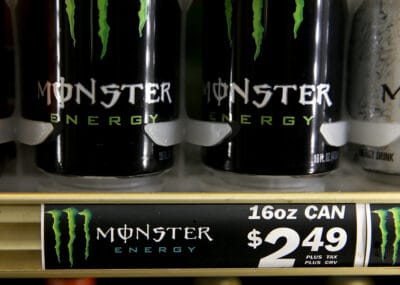
Monster Beverage (NASDAQ:MNST | MNST Price Prediction) closed at $42.59 on Nov. 27, down 12.5% from its July 1 close of $48.68. The stock is still up 11.1% for the year, and $1,000 invested five years ago is now worth about $1,957.

Coke’s Bottlers Turned an Energy Drink Into a Global Brand
Monster’s advantage is distribution. Its broad commercial arrangements with Coca-Cola (NYSE:KO) get its cans into bottler networks worldwide. As part of that relationship, Monster took over Coke’s energy brands, including NOS, Burn and Relentless. It later bought Bang and launched the lower-priced Predator and Fury lines for emerging markets.
That global reach now drives growth. International sales made up about 47%[1] of revenue in the third quarter of 2026, up from 43%[2] a year earlier. Latin America sales rose 48.8%[1], led by Brazil. Full-year 2025 revenue reached $8.29 billion[3].
Going Up Costs Took the Air Out After Summer
Third-quarter sales grew 16.6%[1] to $2.56 billion, but profitability slipped. Gross margin narrowed to 54.7%[1] from 55.7% because aluminum cans and freight cost more. Operating margin fell to 28.0%[1] from 30.7%. Adjusted EPS of $0.30[1] exceeded estimates by only 0.54%, a far smaller margin than the 10.41%[4] beat in the first quarter.

$1,000 Nearly Quadrupled in a Decade
1-Year Return
- Initial Investment: $1,000
- Current Value: $1,135
- Total Return: 13.51%
- S&P 500 (same period): $1,072 (7.16%)
5-Year Return
- Initial Investment: $1,000
- Current Value: $1,957
- Total Return: 95.7%
- Annualized Return: 14.4%
- S&P 500 (same period): $1,587 (58.69%)
10-Year Return
- Initial Investment: $1,000
- Current Value: $3,762
- Total Return: 276.24%
- Annualized Return: 14.2%
- S&P 500 (same period): $3,297 (229.69%)
Monster beat the S&P 500 over each of those periods. The widest gap was over five years, when the stock returned 14.4% a year against 9.7% for the index. Most of that came from steady growth overseas, since Monster pays no dividend. Even the buy date counted: anyone who bought at the July 1 close is down about 12.5%. Monster is the kind of quiet compounder most investors walk right past, the pattern we broke down in a free report on recent winners hiding in plain sight.
What Would Make Monster Worth a Closer Look
Monster Beverage’s case beefs up if aluminum and freight costs level off while sales outside the U.S. keep growing at double-digit rates. The company is debt-free and kept buying back stock at an average price of $43.87[1] last quarter, which suggests management confidence at that level.
Margins shrinking would weaken the case. At about 34x forward earnings, the stock has little room for disappointment. Other risks include Celsius Holdings (NASDAQ:CELH), Red Bull, and C4 competing for shelf space; regulators looking harder at sugary drinks; and an Alcohol Brands segment where sales are down 13.6%[1].
A 12.5% pullback in a company with a 10-year record this strong merits further research, and the next earnings report will show whether gross margin is holding steady.
Contact [email protected] for any questions or corrections.
David Beren has been a Flywheel Publishing contributor since 2022. Writing for 24/7 Wall St. since 2023, David loves to write about topics of all shapes and sizes. As a technology expert, David focuses heavily on consumer electronics brands, automobiles, and general technology. He has previously written for LifeWire, formerly About.com. As a part-time freelance writer, David’s “day job” has been working on and leading social media for multiple Fortune 100 brands. David loves the flexibility of this field and its ability to reach customers exactly where they like to spend their time. Additionally, David previously published his own blog, TmoNews.com, which reached 3 million readers in its first year. In addition to freelance and social media work, David loves to spend time with his family and children and relive the glory days of video game consoles by playing any retro game console he can get his hands on.