5 Dividend Stocks Yielding Over 5% Retirees Should Buy Before December

This post may contain links from our sponsors and affiliates, and Flywheel Publishing may receive compensation for actions taken through them.
Income investors heading into year-end need yields that hold up under scrutiny. Financial adviser Wes Moss warned on The Clark Howard Podcast that stocks yielding above typical sector levels "do get to be a little dangerous because you’re worried about the company having to cut the dividend or the reason it has a high yield is the stock price has fallen dramatically." The five stocks below cover five sectors, with yields from 5.44% to 6.07%. We checked each one for payout coverage, cash flow, balance-sheet strength and dividend history before looking at the yield.
| Company | Yield | Latest Payout | Coverage Check |
|---|---|---|---|
| Verizon Communications (NYSE:VZ | VZ Price Prediction) | 6.07% | $0.7075 quarterly | FY26 adj. EPS guide $5.04 to $5.06[1] |
| Altria Group (NYSE:MO) | 5.44% | $1.11 quarterly | FY26 adj. EPS guide $5.66 to $5.74[2] |
| Realty Income (NYSE:O) | 5.51% | $0.274 monthly | FY26 AFFO guide $4.45 to $4.46 |
| Enterprise Products Partners (NYSE:EPD) | 5.93% | $0.56 quarterly | Distribution coverage 1.9x |
| Main Street Capital (NYSE:MAIN) | 5.55% | $0.265 monthly | Q3 DNII $0.96 per share |
Verizon Communications: Ultra-High Yield Backed by Accelerating Cash Flow
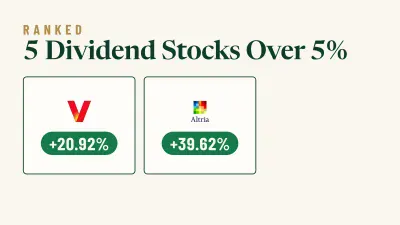
Verizon yields 6.07%. It is the only stock here above 6%, so it is the only one that qualifies as ultra-high-yield. Shares trade at $46.11 and are up 20.92% year to date. That means the yield has stayed high while the stock has risen.
Dividend safety: Verizon produced $7.80 billion[1] of free cash flow in the third quarter, up 13.9%, from $11.52 billion of operating cash flow. Management raised full-year adjusted EPS guidance to $5.04 to $5.06[1], well above the annualized dividend of roughly $2.83. It also expects free cash flow to grow close to 12%[1] this year. Net unsecured debt was 2.5x[3] adjusted EBITDA at the end of the second quarter. The dividend record shows the quarterly payout rising from $0.475 in 2010 to $0.7075 today, with the latest raise from $0.69 taking effect at the April 2026 ex-date.
Bull case: The operating business has picked up. Verizon added 406K postpaid phone subscribers in the third quarter, compared with 44K a year earlier. Adjusted EBITDA margin widened to 40.2% from 37.8%. Chief Executive Dan Schulman called it a "record-breaking quarter." The stock trades at a forward P/E of about 9 and has a beta of 0.26. That gives retirees a large income stream with a stock that moves less than the broader market.
Risk: Debt is the main concern. Verizon carries about $166.2 billion[1] of debt, and interest expense rose 17.2% year over year. Revenue growth is also slow: third-quarter revenue of $34.31 billion[1] missed the $34.85 billion consensus.
Altria Group: Pricing Power Funds a Growing Payout
Altria yields 5.44% at $76.78, and the stock is up 39.62% year to date. In August, the board raised the quarterly dividend to $1.11 from $1.06, an increase of 4.7%[2] that lifts the annualized rate to $4.44.
Dividend safety: Altria raised full-year adjusted EPS guidance to $5.66 to $5.74[2], which covers the $4.44 annual payout. Third-quarter net income rose 6.0%[2] to $2.52 billion, and the company paid $1.7 billion in dividends during the quarter. Altria describes the August raise as its 61st dividend increase in 57 years[2]. Its dividend record shows a higher quarterly payout every year from $0.34 in 2009 to $1.11 today.
Bull case: Altria keeps raising prices faster than volumes fall. Adjusted operating companies income margins in smokeable products are around 64.5%. Equity income from its AB InBev stake rose to $228 million[2] from $123 million. The board also added $1 billion[2] to the buyback, which now runs through December 31, 2027. Retirees get a quarterly dividend that has risen every year since 2009.
Risk: Cigarette volumes are shrinking. Domestic shipments fell 4% on an adjusted basis, Marlboro’s retail share dropped to 39.5%, and on! is losing ground to rival nicotine pouches. Shareholders’ equity is also negative at -$2.23 billion[2], which leaves little balance-sheet cushion.
Realty Income: A Monthly Check With a Wide AFFO Cushion
Realty Income yields 5.51% at $58.27. The next monthly dividend of $0.274 has an ex-dividend date of November 30, 2026 and a payment date of December 15, 2026. The company called that declaration its 137th[4] common stock monthly dividend increase.
Dividend safety: For a REIT, adjusted funds from operations (AFFO) is the right coverage test. Realty Income earned $1.12 of AFFO per share in the third quarter, up 3.7%, and raised full-year AFFO guidance to $4.45 to $4.46. That compares with an annualized dividend of $3.258 as of September 30. Net debt to adjusted EBITDAre was 5.4x[5] in the second quarter, and occupancy was 98.8%. The company reported its 116th consecutive quarterly increase in September. Payment data backs that up: the monthly dividend rose from $0.2635 in late 2024 to $0.274 now.
Bull case: Realty Income invested $2.6 billion in the third quarter at a 6.8% initial cash yield, about 170 bps above its cost of capital on a leverage-neutral basis. It reaffirmed its $10B investment volume target and announced a $6B[5] hyperscale data center joint venture. For retirees, a monthly check that lines up with monthly bills is the main appeal.
Risk: Higher rates hurt net-lease REITs. Interest expense rose to $333.6M from $294.5M, and third-quarter impairments reached $111.6M. Both are worth tracking in each earnings report.
Enterprise Products Partners: Pipeline Income With 1.9x Coverage
Enterprise Products yields 5.93% at $36.35. That is high-yield, just below the ultra-high-yield cutoff. The quarterly distribution is $0.56 per unit, or $2.24 annualized, up 2.8% year over year from $0.545 in the third quarter of 2025.
Dividend safety: Coverage is the strongest on this list. Operational distributable cash flow rose 27% to $2.3 billion in the third quarter. Management said that provided "1.9 times coverage of the partnership’s distribution declared for the quarter and we retained $1.1 billion of distributable cash flow to reinvest in the growth of the partnership, fund buybacks of partnership units and reduce debt." The partnership also repurchased $112 million of units during the quarter. Total debt principal was $34.2 billion as of the first quarter.
Bull case: Enterprise Products has $6.3 billion of growth projects under construction, scheduled to start up through 2028. Permian processing inlet volumes reached a record 4.6 Bcf/d. Two projects, an LPG export terminal expansion and the Athena processing plant, are due in the fourth quarter of 2026. Fee-based pipeline income at a forward P/E of about 12 fits retirees who want energy income with less dependence on commodity prices.
Risk: Enterprise Products is a partnership, so it issues K-1 tax forms. That makes tax filing more complicated and can create problems when the units are held in retirement accounts. Commodity prices still matter as well: the third quarter included a $13 million mark-to-market loss and lower Midland Basin processing margins.
Main Street Capital: Monthly Income Plus a December Supplemental
Main Street Capital yields 5.55% at $55.80. It pays a regular monthly dividend of $0.265 in the fourth quarter, $0.795 for the quarter in total, up 3.9% from a year earlier. A $0.30 supplemental dividend is payable in December 2026, and the next ex-dividend date is December 8, 2026.
Dividend safety: For a business development company, distributable net investment income (DNII) is the coverage test. Main Street Capital earned $0.96 per share of DNII in the third quarter, beating the $0.92 consensus estimate. That compares with $0.795 in regular quarterly payouts. GAAP net investment income was $0.89. Net asset value per share rose to $34.22, and the company has BBB- investment-grade ratings from Fitch and S&P. The track record holds up: management cited its "twenty-first consecutive quarterly supplemental dividend, to go with the 13 increases to our regular monthly dividends declared since the fourth quarter of 2021."
Bull case: Main Street Capital earned an annualized return on equity of 14.7%, and its operating-expense-to-assets ratio improved to 1.2%. The monthly dividend rises again to $0.27 for the first quarter of 2027. Retirees get a monthly check plus a supplemental payout this December (we rounded up seven of our favorite stocks and funds that pay on a monthly schedule in a free report here).
Risk: Credit quality matters most for lenders. Non-accrual loans were 3.5% of the portfolio at cost. Main Street Capital also refinanced 3.00% notes with new 6.55% notes, which will push interest expense higher as falling benchmark rates reduce floating-rate income.
Five Payouts Built to Hold Up Into the New Year
All five stocks yield more than 5%, and each pays a dividend covered by earnings, AFFO, DNII or distributable cash flow. Verizon and Enterprise Products lead on cash coverage, Altria on dividend growth, and Realty Income and Main Street Capital on monthly income timed for December. Together they give a retirement portfolio exposure to five sectors.
Contact [email protected] for any questions or corrections.
Lee Jackson has covered Wall Street analysts' equity and debt research and equity strategy daily for 24/7 Wall St. since 2012. His broad, diverse career, including a stint as creative services director at an NBC affiliate in Austin, Texas, gives him unique insight into the financial industry.
Lee Jackson's journey in the financial industry spans more than 30 years, including nearly two decades as an institutional equity salesperson at Bear Stearns, Lehman Brothers, and Morgan Stanley. His career spanned pivotal sell-side Wall Street events, from the dot-com rise and bubble to the Long-Term Capital Management debacle, 9/11, and the Great Recession of 2008. This reflects his resilience and adaptability amid market volatility.
Lee Jackson’s practical financial industry experience, gained through a career at some of the biggest banks and brokerage firms, is complemented by a lifetime of writing across various platforms. This unique combination allows him to shed light on the intricacies of Wall Street in a way only someone with deep insider experience and knowledge can. Moreover, his extensive network across Wall Street continues to provide direct access for him and 24/7 Wall St., a privilege few firms enjoy.
Since 2012, Jackson’s work for 24/7 Wall St. has been featured in Barron’s, Yahoo Finance, MarketWatch, Business Insider, TradingView, Real Money, The Street, Seeking Alpha, Benzinga, and other media outlets. He attended the prestigious Cranbrook Schools in Bloomfield Hills, Michigan, and has a degree in broadcasting from the Specs Howard School of Media Arts.