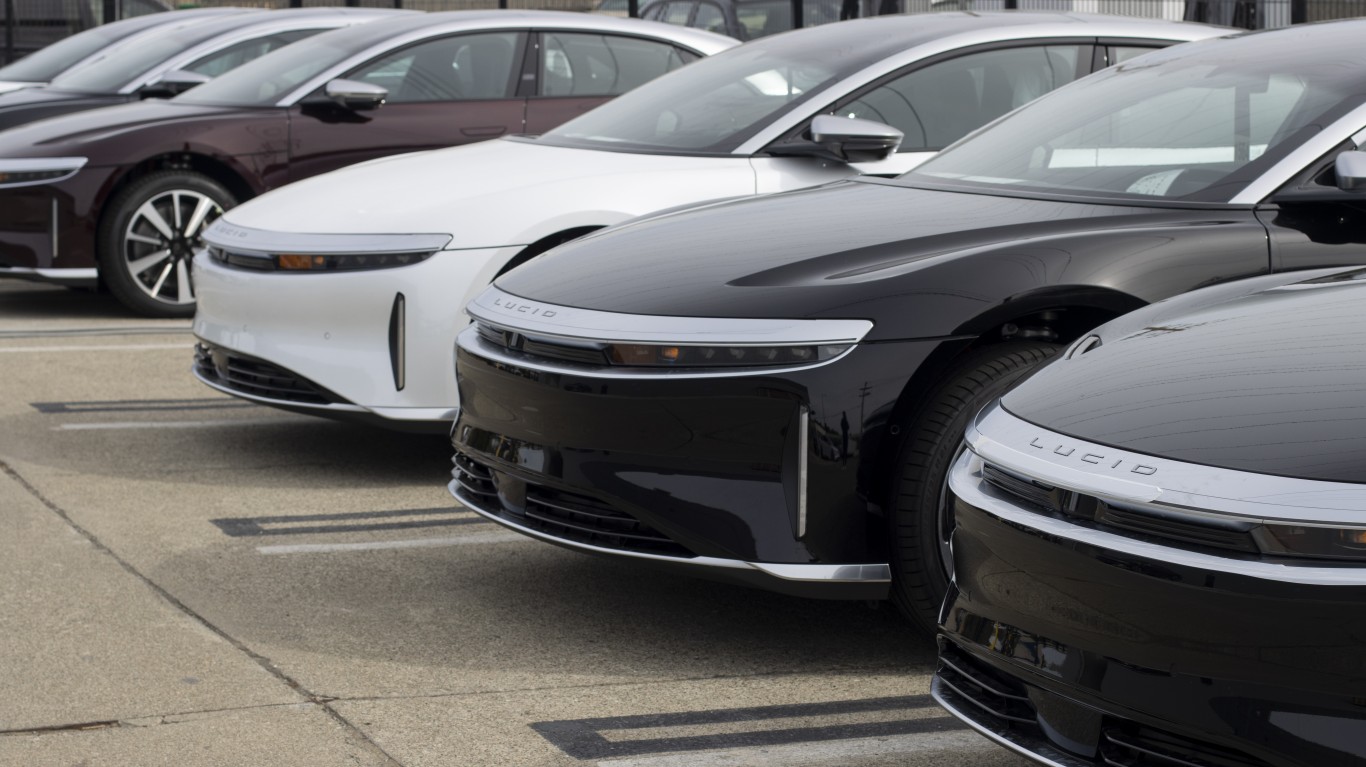
Lucid Jumps 8% on $1.75 Billion Liquidity Boost Despite Q3 Miss; Rivian Dips, Tesla Little Changed

This post may contain links from our sponsors and affiliates, and Flywheel Publishing may receive compensation for actions taken through them.

A bigger cash cushion and slower cash burn are outweighing a quarterly miss at Lucid Group (NASDAQ:LCID | LCID Price Prediction). Lucid stock is at $3.90, up 8% in early trading. The electric vehicle (EV) maker reported its Q3 2026 results after the close on November 9. Alongside them, it announced a $1.75 billion expansion of its delayed-draw term loan (DDTL) with Saudi Arabia’s Public Investment Fund (PIF).
Wall Street wanted more from Lucid on both revenue and adjusted earnings, but the funding news and a sharp drop in cash consumption are giving investors a reason to look past the shortfall. After the jump, Lucid stock is still down 63% year to date.
PIF Backing Stretches Lucid’s Runway Into 2027
The PIF’s larger DDTL lifts Lucid’s pro forma liquidity to $3.75 billion. Management says that runway carries the company into Q4 2027 and through the Midsize production start planned for the second half of 2027. Lucid’s free cash flow consumption fell 30% from the prior quarter to $1.04 billion, and the company has booked $0.8 billion of savings so far under its $1.4 billion Cash Flow Improvement Plan.

Speaking to the results, CEO Silvio Napoli said, “Our transformation is beginning to show progress. We are acting with urgency, strengthening the fundamentals and driving greater discipline, while continuing to invest in the priorities to deliver profitable long-term growth.” Napoli also called out Lucid’s anchor investor. “a solid, thoughtful, and at the same time demanding shareholder.”
Robotaxi work adds to Lucid’s story: its program with Uber Technologies (NYSE:UBER) and Nuro targets a fully driverless commercial launch in the Bay Area in Q1 2027. A new Bolt partnership aims to deploy at least 25,000 autonomous Lucid vehicles. On November 10, Lucid said service wait times fell 20% worldwide in Q3 as it expands its service network.
Lucid’s Q3 Miss Traces Back to Deliberate Production Cuts
Both of Lucid’s headline numbers missed expectations: an adjusted loss of $2.30 per share against the $2.21 consensus, and revenue of $350.32 million against a $399.14 million estimate. The company’s revenue still grew 4.1% year over year. Under generally accepted accounting principles, Lucid’s diluted loss came to $2.74 per share after recording $249.91 million of preferred-stock accretion tied to the PIF.

CFO Alexander De Bock said Lucid deliberately reduced production to release cash from inventory, building 2,954 vehicles while delivering 3,806. Lucid’s deliveries fell 7% year over year. De Bock noted the U.S. battery electric vehicle market shrank 41%, a drop management largely tied to the end of federal EV credits. He expects Q4 2026 deliveries to rise from Q3.
Lucid Moves Apart From Its EV Peers
Meanwhile, Rivian Automotive (NASDAQ:RIVN) stock is at $13.88, down 0.9%. Back on October 29, Rivian reported Q3 revenue of $2.155 billion and an adjusted loss of $0.48 per share, and both exceeded estimates.
At the same time, Tesla (NASDAQ:TSLA) stock is at $376.40, down 0.4%. On October 21, Tesla reported Q3 revenue of $28.05 billion, essentially flat year over year, as research and development spending rose to $2.76 billion.
Lucid’s gain is company-specific, tied to its funding and cash-burn news while both peers trade slightly lower. October’s consumer price index reading came in hotter than expected, raising the odds of a Federal Reserve rate hike and creating a headwind for cash-hungry growth names such as Lucid.
How Lucid’s Luxury Playbook Differs From Rivian and Tesla
Positioned at the luxury end of the market, Lucid sells premium EVs, including the Gravity SUV, and relies on PIF backing while it develops a midsize platform. Rivian pairs its R1 models and lower-priced R2 SUV with commercial delivery vans and a software and services business anchored by its Volkswagen Group joint venture. Tesla operates at far greater scale, with a profitable auto business, Megapack energy storage, Full Self-Driving subscriptions and robotics programs.
That mix leaves Lucid the most reliant of the three on a single outside backer, while broader revenue streams give Rivian and Tesla more funding options, from partner capital to internally generated cash.
Lucid’s Bigger Cash Cushion Faces Its 2027 Milestones
Lucid’s next hurdle is whether Q4 deliveries rise from Q3, as De Bock expects. Bigger events follow: the AMP-2 opening in Saudi Arabia in early 2027, more detail on Midsize reveal and production timing in Q1, and a mid-term plan with formal targets.
Bulls see a longer runway, falling cash burn and a growing robotaxi pipeline as signs the recovery is gaining traction. Lucid still carries a $2.1 billion stockholders’ deficit, and the bears point to heavy reliance on PIF financing, tariffs and possible cuts to zero-emission vehicle credits. Investors may want to stay small in their position sizes until the debate over Lucid’s cash runway resolves.
Contact [email protected] for any questions or corrections.
David Moadel is financial writer specializing in stocks, ETFs, options, precious metals, and Bitcoin. David has written well over 1,000 articles for leading online publications, helping investors understand markets, income strategies, and risk. His work has appeared in 24/7 Wall St., The Motley Fool, InvestorPlace, U.S. News & World Report, TipRanks, ValueWalk, Benzinga, Market Realist, MarketScreener, TalkMarkets, Finmasters, and others. With a master’s degree in education, David has taught at the elementary, high school, and college levels. That teaching background shapes his writing style: clear, educational, and practical. David has also built a loyal social-media audience by providing trustworthy financial content on YouTube, X/Twitter, and StockTwits.