The Companies That Run Retirement Funds Pay Dividends Too, and $210,000 in These 3 Money Managers Brings In $7,943 a Year

This post may contain links from our sponsors and affiliates, and Flywheel Publishing may receive compensation for actions taken through them.
Look at the fund lineup in a typical 401(k), and the same names keep showing up: T. Rowe Price (NASDAQ:TROW | TROW Price Prediction), Franklin Templeton (NYSE:BEN), Invesco (NYSE:IVZ). Each is an asset manager, a company that runs mutual funds and ETFs for savers and charges a small yearly fee on the money it looks after. That pool of money is called assets under management, or AUM. The firms that run so much retirement money also trade publicly, and all three pay quarterly dividends.
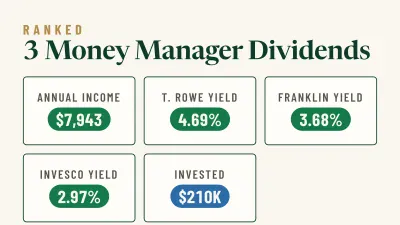
The math below shows the annual income from a $70,000 position in each of these three money managers. Across the group, $210,000 would generate $7,943 a year in dividends, using forward yields and prices from the Nov. 9, 2026 close.
Because fees are charged as a percentage of assets, profits rise with markets and with new money coming in. They fall when markets drop, or clients pull cash out. A downturn hits these firms twice: asset values shrink, and the fees on those assets shrink with them. The longer-term pressure comes from savers moving out of actively managed funds and into cheaper index funds and ETFs. At T. Rowe Price, the effective fee rate excluding performance fees slipped to 37.8 basis points from 39.1 a year earlier (a basis point is one-hundredth of a percentage point).
Invesco
- Stock #3: Invesco
- Price at Nov. 9, 2026 close: $28.91
- Yield: 2.97%
- Shares for $70,000: 2,421.31
- Annual Passive Income: ~$2,082
Invesco ended the third quarter with $2.54 trillion in AUM across active funds, index funds, ETFs, and private markets. Its best-known product is Invesco QQQ (NASDAQ:QQQ), which converted from a unit investment trust to an open-end ETF in December 2025, allowing Invesco to collect management fees on it for the first time. Net long-term inflows reached $35.1 billion in the third quarter of 2026, the 13th consecutive quarter of inflows.
Invesco cut its quarterly dividend in 2020, from $0.31 to $0.155, and has raised it since to $0.215. Third-quarter adjusted diluted EPS of $0.72 covers that payout. Leverage is the clear risk: Invesco bought back $1.5 billion of preferred stock from MassMutual on Oct. 26, 2026, funded with a $1.5 billion five-year floating-rate term loan.
Franklin Templeton
- Stock #2: Franklin Templeton
- Price at Nov. 9, 2026 close: $35.87
- Yield: 3.68%
- Shares for $70,000: 1,951.49
- Annual Passive Income: ~$2,576
The company formerly known as Franklin Resources took the Franklin Templeton corporate name effective Aug. 17, 2026. It manages $1.8 trillion through brands including Franklin Templeton, Western Asset Management and the Canvas custom portfolio platform, and it oversees about $460 billion in retirement assets. Fiscal 2026 brought $84.1 billion in long-term net inflows.
The CFO said on the November earnings call that the company’s dividends “have increased every year since 1981.” The quarterly payout is $0.33, against fiscal 2026 adjusted diluted EPS of $3.07 and a forward annual dividend of $1.32. The bond business carries risk: Western Asset posted $1.1 billion in long-term net outflows in the fiscal third quarter, which also included a $100 million regulatory settlement charge.
T. Rowe Price
- Stock #1: T. Rowe Price
- Price at Nov. 9, 2026 close: $110.82
- Yield: 4.69%
- Shares for $70,000: 631.65
- Annual Passive Income: ~$3,285
T. Rowe Price managed $1.86 trillion as of Sept. 30, 2026, and about two-thirds of it is retirement-related, including its widely used target-date funds. It also runs mutual funds, ETFs, separately managed accounts, and model portfolios.
The regular quarterly dividend rose every year in the available record, from $0.34 in 2012 to $1.30, with a special dividend of $3 paid in 2021. Third-quarter adjusted diluted EPS of $2.86 covered that payout.
Outflows are the clearest risk. Clients pulled a net $28.3 billion in the third quarter of 2026, including $25.6 billion from equities. CEO Rob Sharps said on the Oct. 29 call, “We do expect pressure on active equities and mutual funds to persist.”
How Much All Three Money Managers Pay
| Name | Yield | Annual Dividend Income |
|---|---|---|
| Invesco | 2.97% | $2,082 |
| Franklin Templeton | 3.68% | $2,576 |
| T. Rowe Price | 4.69% | $3,285 |
| Total | 3.78% | $7,943 |
Combined, these three positions generate $7,943 in annual passive income from a $210,000 investment, for a blended yield of 3.78%. T. Rowe Price contributes $3,285, Franklin Templeton adds $2,576, and Invesco rounds out the group with $2,082.
The figure to track each quarter is net flows, the money moving into or out of each company’s funds, because it feeds directly into fee revenue and the earnings behind each payout. None of these dividends is guaranteed. Quarterly checks that come whether markets rise or fall can still smooth out retirement cash flow, and the shares can be sold in a day if plans change.
Contact [email protected] for any questions or corrections.
David Beren has been a Flywheel Publishing contributor since 2022. Writing for 24/7 Wall St. since 2023, David loves to write about topics of all shapes and sizes. As a technology expert, David focuses heavily on consumer electronics brands, automobiles, and general technology. He has previously written for LifeWire, formerly About.com. As a part-time freelance writer, David’s “day job” has been working on and leading social media for multiple Fortune 100 brands. David loves the flexibility of this field and its ability to reach customers exactly where they like to spend their time. Additionally, David previously published his own blog, TmoNews.com, which reached 3 million readers in its first year. In addition to freelance and social media work, David loves to spend time with his family and children and relive the glory days of video game consoles by playing any retro game console he can get his hands on.