4 Dividend Stocks That Can Thrive Under a Democratic Congress

This post may contain links from our sponsors and affiliates, and Flywheel Publishing may receive compensation for actions taken through them.
Democrats won control of both the House and the Senate, while Republicans still control the White House. The result is divided government, which usually brings legislative gridlock. Gridlock tends to reward income investors who own businesses that can fund their dividends without help from Washington. Wholesale tax revisions, big new spending programs, and major regulatory reforms all need both a congressional majority and a presidential signature, so the policy background is likely to remain largely unchanged. The four stocks below cover technology, chemicals, home improvement retail and medical devices, and each one funds its payout from its own cash flow. One of them, Medtronic (NYSE: MDT | MDT Price Prediction), has a dividend record that has now reached 49 consecutive years of dividend increases.
Broadcom: AI Cash Flow Covers the Payout Several Times Over
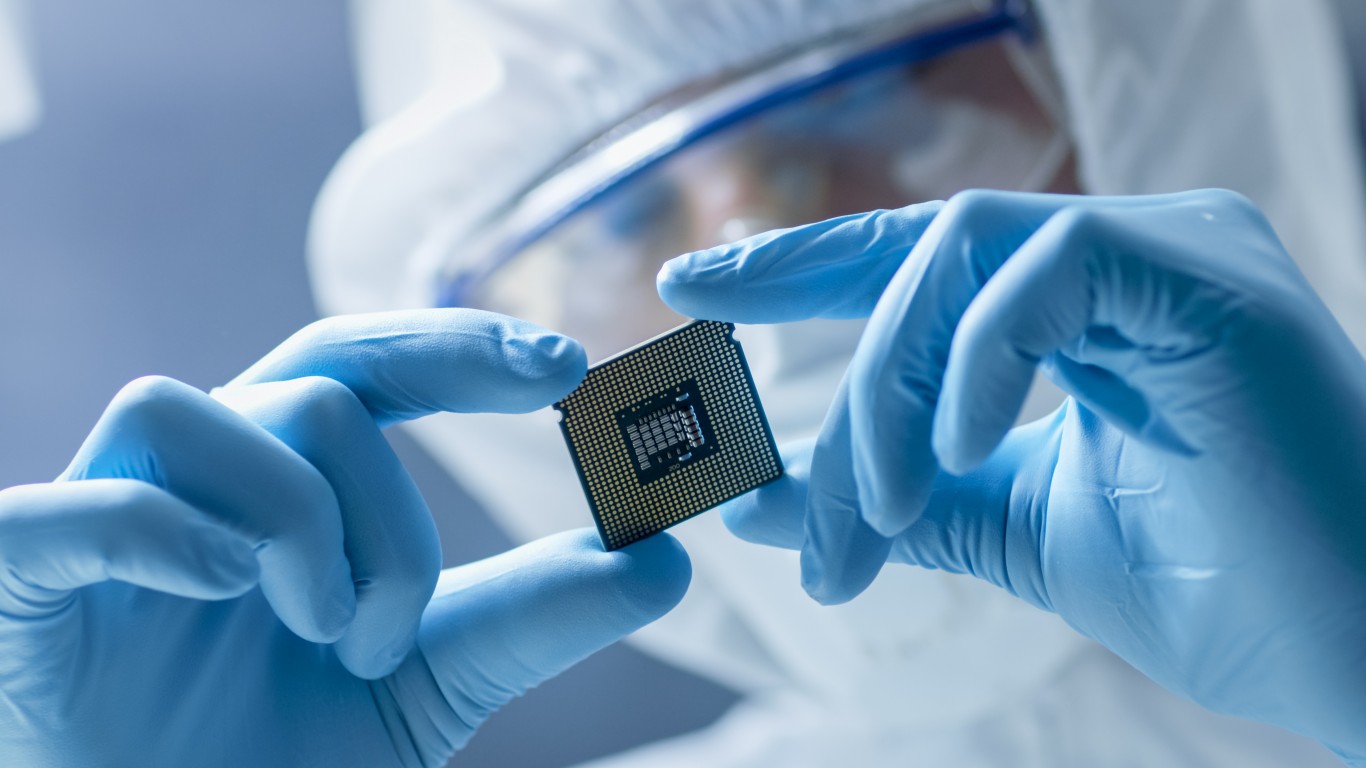
Broadcom (NASDAQ: AVGO) pays a quarterly dividend of $0.65, or $2.60 annualized. Based on a recent price of $345, that works out to a forward yield of about 0.75%. That is the lowest yield in this group. The case for Broadcom rests on how quickly its dividend can grow and how safe it is.
Dividend safety: The payout uses about 33% of trailing GAAP earnings per share of $7.83. Free cash flow gives an even better read. Broadcom generated $13.665 billion of free cash flow in its fiscal third quarter, which was 46% of revenue. The quarterly dividend costs about $3.1 billion, so that one quarter’s free cash flow covered it roughly 4.4 times. Cash stood at $23.975 billion, against $88.458 billion of total liabilities and $99.690 billion of shareholders’ equity. Dividend records go back to 2010, and the most recent raise brought the quarterly rate from $0.59 to $0.65.
What a Democratic Congress means: Democratic-led committees gain subpoena power and control of hearing schedules, so Big Tech and AI could face more oversight. Turning that scrutiny into law would still require a presidential signature. Broadcom’s main growth engine is also largely outside Washington’s reach, because AI chip demand comes from hyperscalers spending their own capital.
Bull case: Revenue rose 85.5% in the third quarter to $29.591 billion, and management forecast fourth-quarter revenue to about $34.8 billion, including $21.7 billion of AI semiconductor sales. The stock’s forward earnings multiple is about 16, well below its trailing multiple of 41. That gap shows how fast earnings are expected to grow.
Risk: Broadcom’s own filing points to customer concentration. A large share of AI revenue comes from a small number of hyperscalers, so a pullback by any one of them would show up quickly.
Dow: A Reset Dividend Now Covered by Cash
Dow (NYSE: DOW) pays $0.35 per quarter, or $1.40 annualized. At $31.51, the forward yield is about 4.44%, the highest in this group. The dividend history includes a cut. The quarterly payout fell from $0.70 to $0.35 starting with the August 29, 2025 ex-dividend date and has held at the lower rate since then.
Dividend safety: The lower payout is now funded by cash. Second-quarter free cash flow of $692 million covered the $253 million paid in dividends about 2.7 times, and third-quarter free cash flow reached $1.1 billion. Dow reported about $14 billion of liquidity and no substantive debt maturities until 2029. The chief financial officer said, “We are prioritizing debt reduction with excess cash, while also taking actions to release working capital and maintain ample liquidity.”
What a Democratic Congress means: Infrastructure, energy and lower-carbon projects get bipartisan attention. Dow pointed to better polyethylene volumes in infrastructure-related pipe applications and rising demand from AI infrastructure. Environmental oversight could increase. The biggest swing factor in Dow’s earnings, its self-help program, is entirely under management’s control.
Bull case: The company expects about $1.3 billion of net self-help benefits in 2027. Chief executive Karen S. Carter said, “$1.3 billion of earnings tailwinds are going to be firmly in our control.” She also noted that each one-cent-per-pound increase in polyethylene prices is worth about $50 million per quarter. The stock has gained 39.3% so far this year.
Risk: Trailing GAAP earnings per share are still negative at -$1.29. That leaves the dividend dependent on a commodity cycle that has already forced one cut.
Home Depot: Decades of Payments From a Housing Heavyweight
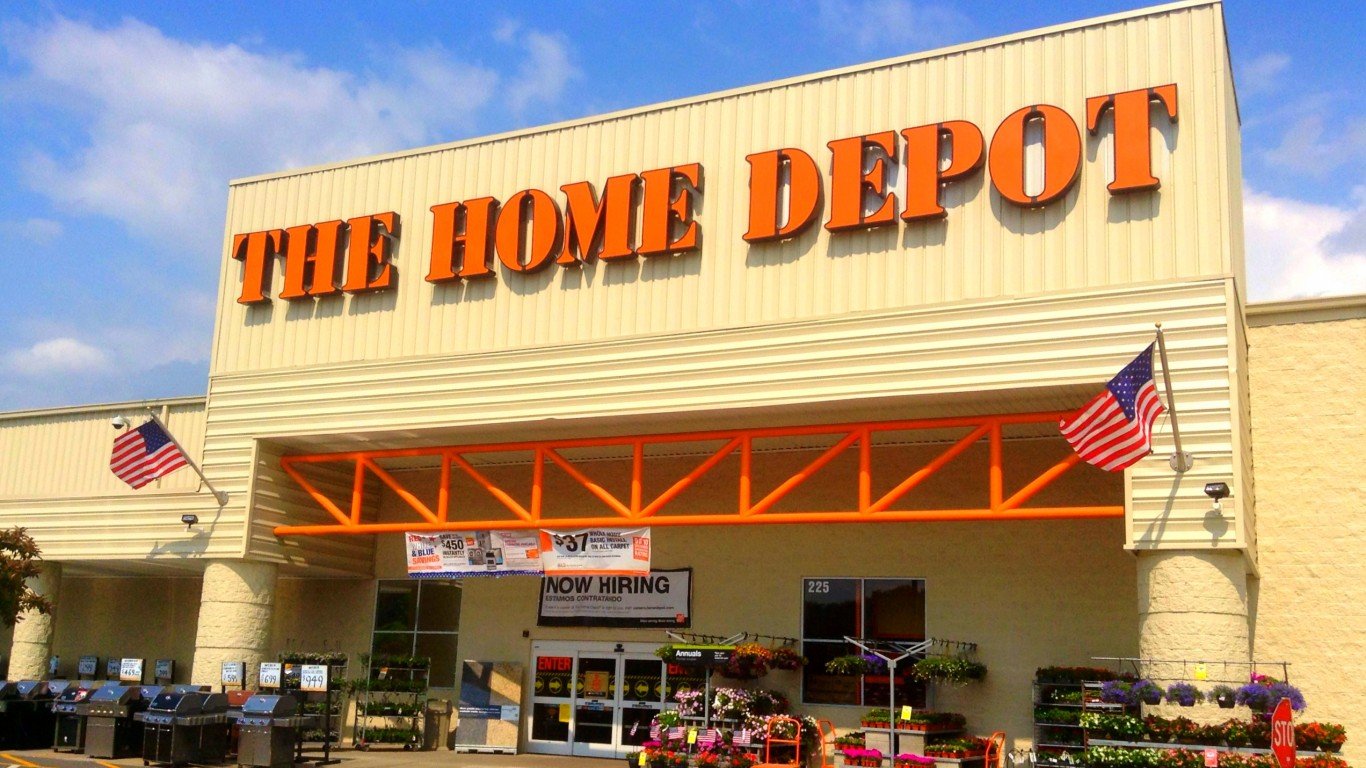
Home Depot (NYSE: HD) pays $2.33 per quarter, or $9.32 annualized. At $347.68, the forward yield is about 2.68%.
Dividend safety: The trailing $9.29 in dividends uses about 65% of trailing EPS of $14.29. That is a full payout ratio, but a manageable one. Operating cash flow was $6.032 billion in the first quarter against $844 million of capital spending. The free cash flow yield is 3.61%. Home Depot uses a lot of leverage: debt-to-equity is 5.10, and net debt is 2.56 times EBITDA. Interest coverage of 8.66 times leaves room to take on that debt. Dividend records go back to 1999 with no apparent gap, and the quarterly rate has risen every year since 2010.
What a Democratic Congress means: Housing affordability draws support from both parties, but any major housing bill still needs to get through divided government. For Home Depot, interest rates matter more than legislation. A recent hot inflation report drove Treasury yields higher, keeping mortgage costs in focus.
Bull case: Second-quarter revenue rose 5.71% to $47.861 billion, and adjusted EPS of $4.92 beat the $4.73 estimate. SRS Distribution, now at more than 1,340 locations, increases the company’s exposure to professional contractors. The stock’s forward earnings multiple is about 22.
Risk: Transactions fell 1.0% in the second quarter. Low housing turnover continues to weigh on store traffic.
Medtronic: A 49-Year Raise Streak Backed by Faster Growth
Medtronic pays $0.72 per quarter, or $2.88 annualized. At $100.29, the forward yield is about 2.87%.
Dividend safety: The current dividend marks the 49th consecutive year of dividend increases, which puts Medtronic one year short of Dividend King status. The annual payout is about 48% of the low end of fiscal 2027 adjusted EPS guidance of $5.94 to $6.00. Free cash flow was $5.426 billion in fiscal 2026. First-quarter free cash flow of $1.290 billion covered $921 million of dividends about 1.4 times. On the earnings call, management said, “Cash conversion is improving… We’ve got a strong balance sheet.”
What a Democratic Congress means: Democratic health care oversight has long focused on drug prices, which hit pharmaceutical companies harder than device makers. Medtronic’s growth depends on coverage decisions. Management cited a national coverage decision for CMS on renal denervation and said commercial payers are now following.
Bull case: First-quarter revenue rose 13.73%, and Cardiac Ablation Solutions grew 88%. Management raised full-year guidance, and the stock’s forward earnings multiple is about 17.
Risk: An extra fiscal week added about $570 million to first-quarter revenue. The planned Diabetes separation also adds execution risk.
Gridlock Favors Self-Funded Income
Divided government makes big policy changes less likely, so dividends depend mostly on what each company earns and how much cash it generates. Broadcom and Medtronic combine better free cash flow coverage with dividend growth. Home Depot brings a long payment record. Dow offers the highest yield of the four, with a payout reset after its cut and now covered by cash flow. All four can fund their dividends from operations without needing new legislation.
Contact [email protected] for any questions or corrections.
Lee Jackson has covered Wall Street analysts' equity and debt research and equity strategy daily for 24/7 Wall St. since 2012. His broad, diverse career, including a stint as creative services director at an NBC affiliate in Austin, Texas, gives him unique insight into the financial industry.
Lee Jackson's journey in the financial industry spans more than 30 years, including nearly two decades as an institutional equity salesperson at Bear Stearns, Lehman Brothers, and Morgan Stanley. His career spanned pivotal sell-side Wall Street events, from the dot-com rise and bubble to the Long-Term Capital Management debacle, 9/11, and the Great Recession of 2008. This reflects his resilience and adaptability amid market volatility.
Lee Jackson’s practical financial industry experience, gained through a career at some of the biggest banks and brokerage firms, is complemented by a lifetime of writing across various platforms. This unique combination allows him to shed light on the intricacies of Wall Street in a way only someone with deep insider experience and knowledge can. Moreover, his extensive network across Wall Street continues to provide direct access for him and 24/7 Wall St., a privilege few firms enjoy.
Since 2012, Jackson’s work for 24/7 Wall St. has been featured in Barron’s, Yahoo Finance, MarketWatch, Business Insider, TradingView, Real Money, The Street, Seeking Alpha, Benzinga, and other media outlets. He attended the prestigious Cranbrook Schools in Bloomfield Hills, Michigan, and has a degree in broadcasting from the Specs Howard School of Media Arts.