Bloom Energy Just Jumped 13% After CoreWeave Calmed AI Data Center Fears. History Says What Usually Comes Next for a Stock That Halved

This post may contain links from our sponsors and affiliates, and Flywheel Publishing may receive compensation for actions taken through them.
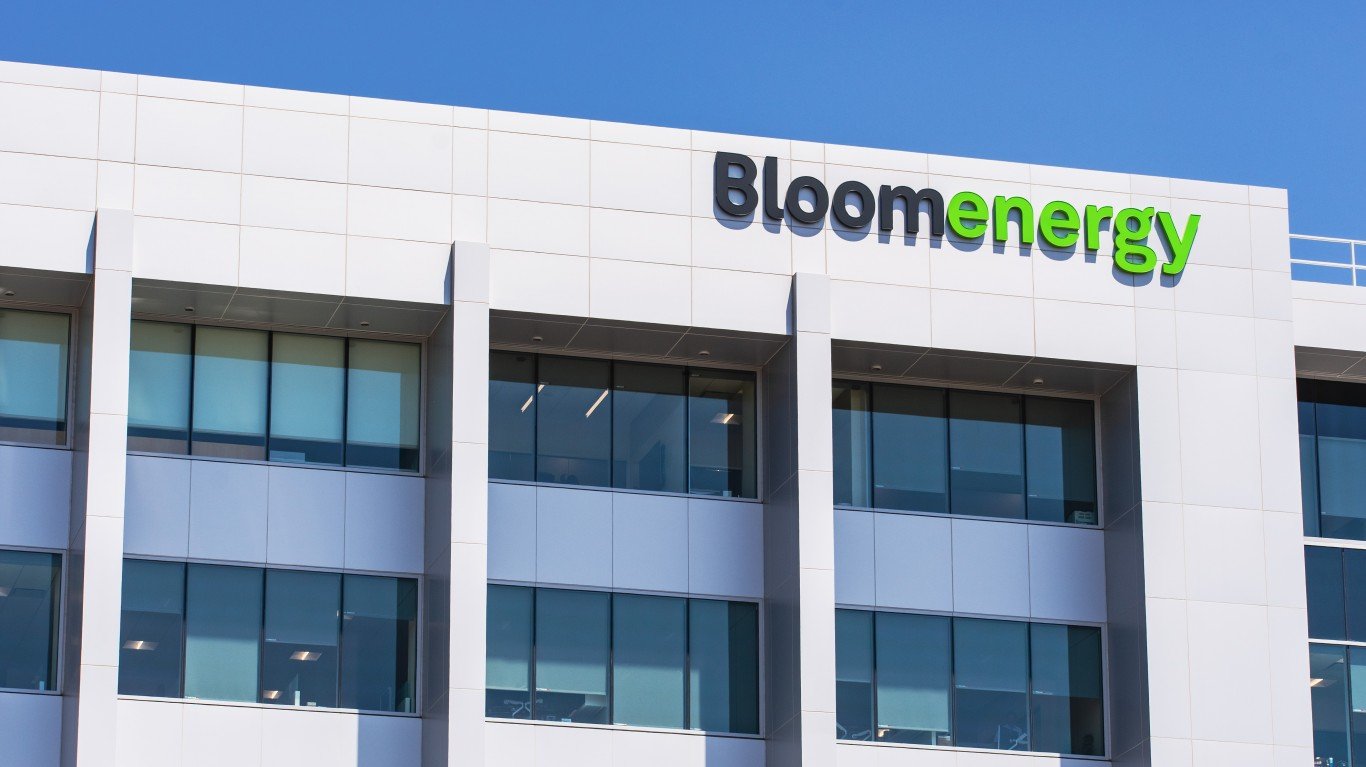
Bloom Energy closed at $209.47 on Wednesday, up $24.05 or 13% in one session, a move that added about $7 billion to the fuel cell maker’s market value after CoreWeave’s third-quarter report eased the fear that AI data center building is about to stall. The stock touched $217.85 during the day, 17% above Tuesday’s close, and 18.3 million shares changed hands. By 6:05 PM Eastern it was trading at $206.76 after hours, 1.3% below the close. The stock’s own record says a jump like this from deep in a drawdown has usually been followed by a higher price six months on, 28 times out of 36, and that the two earlier times Bloom lost half its value the recovery took years.
CoreWeave, which rents AI computing capacity, reported revenue of $3.66 billion for the quarter, up 168% from a year earlier, a backlog of about $132.5 billion, and raised its 2026 revenue forecast to $13 billion to $13.3 billion. It said about $9 billion of customer prepayments will arrive within three months, which is what calmed the market: the money to keep building is coming from customers as well as from lenders. The link to Bloom is those customers. Bloom sells on-site power to the people who build data centers, with Oracle contracted for up to 2.8 gigawatts, Brookfield funding up to $5 billion of installations and NTT Data signing for 900 megawatts last week, so any sign that the building continues is a sign that Bloom’s orders continue. Nebius, another AI cloud company, reports Thursday before the open.
The jump needs its setting. Bloom’s record close was $345.85 on June 22. By the close on November 5, after Texas governor-elect Gina Hinojosa called for a moratorium on data center approvals in a state that holds about 27% of the country’s planned capacity, the stock was down 16% in a day and 52% from the record, which made this the third time since its 2018 IPO that Bloom has lost half its value from a high. Even after four sessions of rebound it sits 39% below June. Bloom’s own record reads as a reason to hold through a bounce like Wednesday’s: six months after 28 of its 36 earlier one-day jumps of 12% or more from deep in a drawdown, the stock was higher, by a median of 57%. The limit of that reading is that both earlier halvings took years to make back, 2.3 years and 4.5 years, and 8 of those bounces were still underwater a year later.
The retiree holding 1,000 shares
Consider a 67-year-old retired power plant engineer in Austin, a scenario built to show what Wednesday did to one household. He and his wife have $1.8 million across an IRA, a Roth and a brokerage account, and in March 2024, when Bloom was a $9 stock, he bought 1,000 shares at $9.03 in the brokerage account because he knew the technology from work. The cost was $9,030. Here is what that position has done, with the rest of the portfolio held at $1.8 million so the stock’s own swings show through.
| Date | Price | 1,000 shares | Share of the household’s money |
|---|---|---|---|
| March 4, 2024 (bought) | $9.03 | $9,030 | 0.5% |
| June 22, 2026 (record close) | $345.85 | $345,850 | 16.1% |
| Nov. 5, 2026 (the moratorium drop) | $167.52 | $167,520 | 8.5% |
| Nov. 11, 2026 (Wednesday’s close) | $209.47 | $209,470 | 10.4% |
Wednesday added $24,050 to his account. Since the November 5 close the position is up $41,950. It is still $136,380 below what it was worth on June 22, and the $9,030 he put in is now $209,470, about 23 times the money, with an unrealized gain of $200,440.
What the stock’s own history says
Bloom has been here before, twice, and the record is worth reading in full.
| Halving | Peak close | Low close | Drop | Time to the low | Time back to the old high |
|---|---|---|---|---|---|
| 2018 to 2021 | $35.80 (Sept. 26, 2018) | $2.67 (Oct. 24, 2019) | 92% | 13 months | 2.3 years |
| 2021 to 2025 | $42.65 (Feb. 8, 2021) | $8.58 (Feb. 23, 2024) | 80% | 36 months | 4.5 years |
| 2026 | $345.85 (June 22, 2026) | $163.75 (July 29, 2026) | 53% | 1 month | not yet |
The earlier halvings went much deeper than this one has, and both ended in new highs. Wednesday’s kind of day is also familiar: counting Wednesday, the stock has jumped 12% or more in a session while sitting at least 35% below its running high 40 times since the IPO. Of the 39 earlier ones, 29 were higher a month later, 28 of 36 were higher six months later, and 27 of 35 were higher a year later, with the median gain a year out at 29% and the best at 862%. The eight that were lower a year later include five from 2021 and 2022, when the stock was in a four-and-a-half-year hole; the worst was 51% lower.
That is history, and it is a volatile history. A stock that has halved three times in eight years can do it again, and a Nov. 5 sized drop from here would take $34,368 off the 1,000-share position in one session. If you are thinking of buying the bounce, that is the size of the swing you are signing up for.
The decision CoreWeave just made harder
The real question for the engineer, and for you if you hold a winner like this, is size. A $9,030 flyer has become 10.4% of everything he and his wife own, and in June it was 16%. Most advisers to retirees put a single stock’s limit at about 5% of a portfolio, and the reason is in the table above: this one position swung the household’s net worth by $178,330 between June 22 and November 5.
Selling half, 500 shares at $209.47, brings in $104,735 with a long-term gain of $100,220. Because the shares were held more than a year, the federal tax is the 15% capital gains rate, $15,033, as long as the couple’s taxable income with the gain stays under the $613,700 top of the 15% band for 2026. With $54,000 of Social Security and $60,000 of IRA withdrawals as their other income, their modified adjusted gross income lands at $214,220, under the $250,000 line where the 3.8% net investment income tax begins, so that tax is zero. Texas has no state income tax. After the sale Bloom is 5.3% of their money, and the $89,702 of after-tax proceeds goes into the index funds that hold the rest.
Selling all 1,000 shares raises $209,470 on a gain of $200,440. The 15% rate costs $30,066, and because the gain pushes their modified adjusted gross income to $314,440, the net investment income tax adds $2,449 on the $64,440 above the line, for $32,515 in total and $176,955 kept. Splitting the sale, 500 shares in December and 500 in January, keeps each year’s income under $250,000 and saves the $2,449. That is the kind of detail you can get right on your own, and the kind that is easy to forget on a day the stock is up 13%. If your shares sit in an IRA instead, none of this tax applies to the sale, and the only question is the size of the bet.
Holding all of it is a bet that the record will repeat, and the record says it has, twice, and that each time took years.
Where the bull case stands
Bloom’s own numbers are the reason the stock trades where it does. Third-quarter revenue was $1.24 billion, up 138% from a year earlier, with a 33.8% gross margin, $225 million of operating income and earnings of 78 cents a share. Cash was $2.49 billion at the end of September. The company raised its 2026 revenue forecast for the third time, to $4.4 billion to $4.6 billion, and expects adjusted earnings of $3.10 to $3.40 a share. It joined the S&P 500 on September 21.
At $209.47 the stock trades at 64 times the midpoint of that earnings forecast and about 14 times the midpoint of the revenue forecast, with a market value of $61.9 billion. The contracted work in the filings is smaller than the headlines: $661 million of unsatisfied performance obligations at the end of September, against a revenue forecast of $4.5 billion, so the company has to keep signing to keep growing. NTT Data’s shipments do not start until 2027, and the Texas question comes back in January, when the new governor takes office and the legislature meets.
The bottom line
Wednesday’s 13% jump was a relief rally on someone else’s numbers. If you own Bloom, that is the first thing to keep in mind. For the engineer with 1,000 shares, the day was worth $24,050, on a position still $136,380 below its June value and still a tenth of his retirement money. His company’s history says bounces like this one have usually been worth holding through, and it also says the two earlier halvings took 2.3 and 4.5 years to make back. The move that fits both readings is to sell 500 shares, pay $15,033 in federal tax, cut the position to 5.3% of the portfolio, and let the other 500 ride out whichever history repeats. Check the price before you act: the numbers above are Wednesday’s close, and a stock that moves 13% in a day will have moved again by the time you read this.
Contact [email protected] for any questions or corrections.
I've been writing about stocks and personal finance for 20+ years. I believe all great companies are tech companies in the long run, and I invest accordingly.