4 REIT Dividend Traps Where Payouts Could Be in Danger

This post may contain links from our sponsors and affiliates, and Flywheel Publishing may receive compensation for actions taken through them.
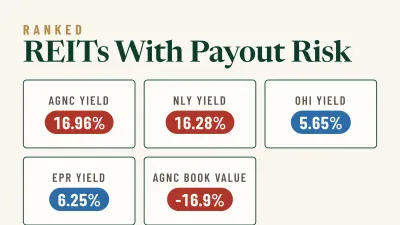
Under federal tax law, a real estate investment trust (REIT) must pay out at least 90% of its REIT taxable income as dividends to keep its tax-advantaged status. That rule leaves REITs with very little cash kept, so their payouts are tight by design. A tight payout becomes an unsafe one when cash coverage thins, debt climbs, or the capital base shrinks. At the top of this list, AGNC Investment (NASDAQ: AGNC) now yields about 16.96% on its forward dividend. A yield that high is only worth it if the company can keep that payout.
How to judge REIT dividend safety: the earnings payout ratio understates coverage, because depreciation drives REIT earnings below the cash a property owner actually generates. For property REITs, compare the dividend with funds from operations (FFO) or adjusted FFO (AFFO). For mortgage REITs, compare it with earnings available for distribution (EAD) and check whether book value is holding up. Then look at leverage.
A mortgage REIT (mREIT) owns mortgage securities bought with borrowed money. That exposes it to interest rate and credit risk that property-owning equity REITs avoid, and two of the four names below are mREITs.
AGNC Investment (AGNC): A Shrinking Book Behind a Fixed Payout
AGNC owns Agency mortgage-backed securities, with a $94.4B portfolio. It pays $0.12 a month, or $1.44 a year, and it has paid that same amount every month since April 2020. A falling share price explains much of the yield. The stock dropped from $11.2536 to $8.7469 between the second- and third-quarter filings, a decline of about 22%, and it is down 11.1% year to date.
Tangible net book value per share fell 16.9% to $7.13 in the third quarter, and the company posted a GAAP net loss of $1.36B. EAD came in at $0.37, just covering the $0.36 paid for the quarter. That works out to about 97% of EAD. Net interest spread narrowed to 1.86% from 2.00%, and leverage stands at 7.9x tangible book. AGNC also sold 97.6M shares through its at-the-market (ATM) program. Keeping the payout flat through all of that is a warning sign.
On the other hand, hedge coverage rose to 90% from 73%, and management says mortgage spreads are near the upper end of their multi-year range. If Treasury volatility settles, book value could rebuild.
Annaly Capital Management (NLY): A Raised Dividend, Then a Rough Quarter
Annaly Capital Management (NYSE: NLY) holds Agency MBS, residential credit and mortgage servicing rights. It raised its quarterly dividend to $0.75 from $0.70, which gives a forward yield near 16.28%. The stock fell about 22.5% between the second- and third-quarter filings.
Tangible book value per share dropped to $17.86 from $20.15, and the third-quarter economic return was negative 7.6%. $4.72B in net investment losses produced a GAAP loss of $1.36 per share, and leverage climbed to 8.0x from 7.4x. Annaly has cut before: the payout fell from $0.88 to $0.65 in 2023.
The bull case is that EAD of $0.80 still covers the dividend, a payout of about 94%. Spread also widened to 1.24%, and the hedge ratio reached 100%. According to the CEO, “we entered the quarter prepared for the volatility.”
Omega Healthcare Investors (OHI): Covered Payout, Shaky Operators
Omega Healthcare Investors (NYSE: OHI) owns skilled nursing and assisted living facilities and leases them to operators. The quarterly dividend of $0.68 yields about 5.65%. After paying $0.67 from 2020 into early 2026, Omega raised the dividend.
Tenant credit is the main risk. Genesis Healthcare is still in Chapter 11 and owes Omega $148.5M in loans. Third-quarter GAAP net income fell 53.77% to $83.1M, and AFFO excludes $59.9M in transition costs and $18.8M in severance. Medicaid and Medicare rates, staffing mandates, and Omega’s move into RIDEA operating structures add further risk.
Measured by AFFO, which is the right yardstick here, coverage looks solid. AFFO of $0.82 per share means a payout of about 83%. Coverage measured by operator EBITDAR stands at 1.67x, and 2026 AFFO guidance was raised to $3.28-$3.30, a range that assumes the $0.68 dividend continues.
EPR Properties (EPR): Heavy Reliance on Theatres and Topgolf
Experiential real estate such as theaters, eat-and-play venues, and education properties make up EPR Properties’ portfolio (NYSE: EPR). It pays $0.31 a month, about a 6.25% yield. Shares are up 25.85% year to date, so this yield holds up even after the share price has risen.
Concerns include tenant concentration and debt. Annualized base rent from the 10 largest tenants comes to 68.0%: Topgolf 14.5%, AMC Entertainment (NYSE: AMC) 14.2% and Regal 10.2%. Theaters account for 34%. The ratio of net borrowings to adjusted EBITDA rose to 5.0x from 4.7x, and $450M of notes come due on December 15, 2026. EPR also has a record of cuts: the monthly payout dropped from $0.3825 in 2020 to $0.25 by 2021.
In EPR’s favor, adjusted FFO (FFOAA) of $1.49 per share covers the quarterly dividend with room to spare, at about 62%. Guidance rose to $5.49 to $5.57, and a new $1.6B credit facility helps with refinancing.
What Income Investors Should Watch Next
For AGNC and Annaly, track tangible book value and EAD every quarter. Steady book erosion has usually come before mREIT cuts. For Omega, follow AFFO coverage and how the Genesis bankruptcy is resolved. For EPR, the key items are the December refinancing and its leverage trend. When a dividend is cut, the share price tends to follow lower, making it important to consider a high yield alongside coverage, book value, and leverage (we broke down the seven warning signs that a big yield is about to be cut in a free report on dividend traps).
Contact [email protected] for any questions or corrections.
Lee Jackson has covered Wall Street analysts' equity and debt research and equity strategy daily for 24/7 Wall St. since 2012. His broad, diverse career, including a stint as creative services director at an NBC affiliate in Austin, Texas, gives him unique insight into the financial industry.
Lee Jackson's journey in the financial industry spans more than 30 years, including nearly two decades as an institutional equity salesperson at Bear Stearns, Lehman Brothers, and Morgan Stanley. His career spanned pivotal sell-side Wall Street events, from the dot-com rise and bubble to the Long-Term Capital Management debacle, 9/11, and the Great Recession of 2008. This reflects his resilience and adaptability amid market volatility.
Lee Jackson’s practical financial industry experience, gained through a career at some of the biggest banks and brokerage firms, is complemented by a lifetime of writing across various platforms. This unique combination allows him to shed light on the intricacies of Wall Street in a way only someone with deep insider experience and knowledge can. Moreover, his extensive network across Wall Street continues to provide direct access for him and 24/7 Wall St., a privilege few firms enjoy.
Since 2012, Jackson’s work for 24/7 Wall St. has been featured in Barron’s, Yahoo Finance, MarketWatch, Business Insider, TradingView, Real Money, The Street, Seeking Alpha, Benzinga, and other media outlets. He attended the prestigious Cranbrook Schools in Bloomfield Hills, Michigan, and has a degree in broadcasting from the Specs Howard School of Media Arts.