A December Rate Hike Looks Likely: Buy These 3 Energy and Materials Dividend Stocks Before the Fed Moves

This post may contain links from our sponsors and affiliates, and Flywheel Publishing may receive compensation for actions taken through them.
Traders expect the Fed to tighten again. On Kalshi, a quarter-point hike at the December meeting trades at $0.92 per contract, which means odds near 92%. That figure shows a market expectation that can shift before the meeting. Rising borrowing costs usually hit the income stocks that depend on cheap debt first.
Energy and materials payers have a different profile. Their cash comes from oil wells, pipelines, copper and iron ore, and those revenues follow commodity prices more than funding costs. We rank the three US-listed stocks below primarily on how well each one covers its payout, with yield as a secondary factor (the same coverage-first lens we used to flag seven dividend warning signs in a free report, here).
The upper bound of the federal funds target is 4.00%. The latest hike lifted it from 3.75%. In the same Kalshi market, a hold trades at $0.04 and a move larger than a quarter point trades at $0.06.
ConocoPhillips: An 11% Dividend Raise Backed by Free Cash Flow
ConocoPhillips (NYSE:COP | COP Price Prediction) yields 2.48%, the lowest in this group, but it has the fastest dividend growth. The quarterly ordinary dividend just went up 11% to $0.93 per share, or $3.72 a year. The prior rate was $0.84.
Dividend safety: Coverage is wide. Third-quarter free cash flow came to $4.039 billion, and ordinary dividends cost $1 billion. That means free cash flow covered the payout about 4 times. The trailing dividend of $3.36 per share is about 35% of trailing EPS of $9.65. The balance sheet is A-rated, according to management. The company holds $10.4 billion of cash and short-term investments, and net debt is 0.5x cash from operations. On the earnings call, management put the pre-dividend free cash flow breakeven at the mid-$40s WTI and expects it to fall to the low $30s over time.
Dividend history: The company has cut before. In 2016 the quarterly payout dropped from $0.74 to $0.25, and it has risen step by step since then to today’s $0.93. The ordinary dividend is fixed, and share buybacks move up or down with oil prices. Management is on track to return 45% of cash from operations to shareholders. Its preliminary outlook for next year also calls for 45%.
Bull case: Management still targets a $7 billion free cash flow growth by 2029, with first oil from Willow in Alaska expected early 2029. On the call, management said: "As we make the CFO pie bigger, there is more for distributions, especially with a low reinvestment rate." Buybacks also retire about 4% to 5% of shares each year, which raises the dividend per share over time. The stock trades at 13 times forward earnings.
Risk: ConocoPhillips does not hedge its oil and LNG exposure. That helped lift realized prices 32% to $61.40 per barrel of oil equivalent. The same exposure works in reverse. If WTI fell toward the breakeven in the mid-$40s, buybacks would shrink first and dividend growth would slow.
Enterprise Products Partners: 1.9x Coverage and Mostly Fixed-Rate Debt
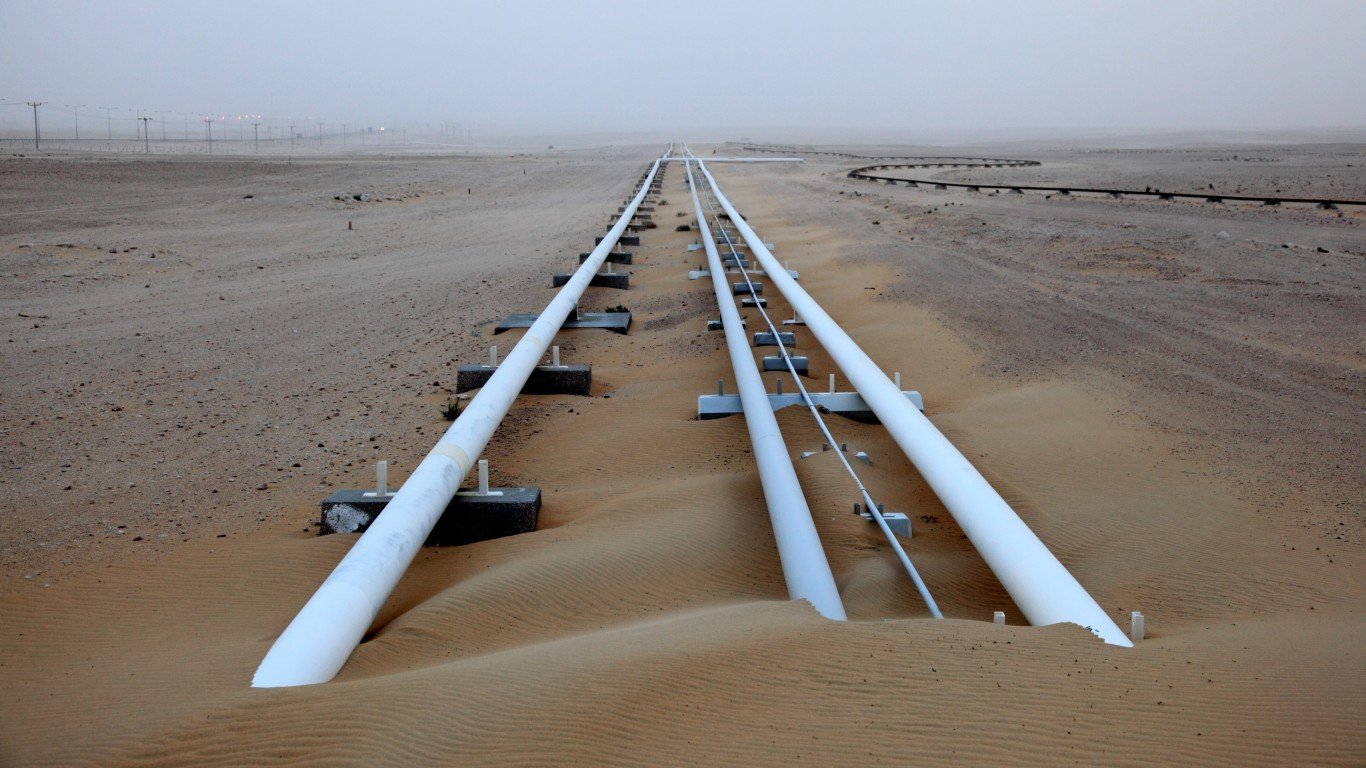
Enterprise Products Partners (NYSE:EPD) yields 5.98%, which makes it a high-yield payer just below the ultra-high-yield line. The quarterly distribution is $0.56 per unit, or $2.24 a year, up 2.8% year over year. Enterprise is a master limited partnership. It pays distributions, and unitholders get a K-1 tax form.
Dividend safety: Operational distributable cash flow was about $2.3 billion, up 27%. That covered the distribution 1.9x and left $1.1 billion of retained cash. Over the trailing 12 months, distributions and buybacks totaled $5.3 billion, or 54% of adjusted cash from operations. That is below the partnership’s 55%-60% framework. Its balance sheet suits a hiking cycle: about 96% of its $33.7 billion in debt carries a fixed rate, at a weighted average cost of 4.7% and an average life of about 17 years. Net leverage of 2.9x is inside the 2.7x to 3.25x target.
Dividend history: The distribution is fixed, and its record holds up. The quarterly payment rose from $0.39 in early 2016 to $0.56, with no reduction anywhere in that series. Through 2020, management held the payout steady at $0.445.
Bull case: Enterprise makes money from volume moving through its pipes and plants, and that volume keeps setting records. The system moved a record 14.8 million barrels per day equivalent, and Permian plant inlet volumes rose 12%. The partnership has $6.3 billion of growth projects under construction. One is a 300,000 barrels a day LPG export expansion, and on the call an executive said of it: "It is full. We have contracted it." The units trade at 12 times forward earnings.
Risk: Growth may slow next year. Management warned that "2027 may be more modest compared to what we’re going to wind up reporting for 2026," and said geopolitical conflicts and related market spreads could affect results. If Permian drilling slows, the volume growth that has driven distribution raises would slow with it.
Rio Tinto: A Variable Payout Riding Copper’s Surge
Rio Tinto (NYSE:RIO) yields 5.5%, so it counts as high-yield. It trades on the NYSE as an ADR and pays semi-annual dividends whose amounts change each time. The interim dividend rose 43% to $2.11 per share, a total of $3.4 billion.
Dividend safety: The payout follows a formula. Board policy pays 40% to 60% of underlying earnings through the cycle, and the interim dividend was set at 50%. The trailing $4.65 per share is about 63% of trailing EPS of $7.38. First-half free cash flow rose 69.5% to $3.834 billion, which covers the new interim payout. However, the same half also paid last year’s $4.2 billion final dividend. The rest of the buffer comes from $8.913 billion in cash and lower net debt. Management is also working to release about $5 billion of cash through portfolio moves.
Track record: Rio has paid out 60% of underlying earnings for 10 consecutive years, but the dollar amount moves with earnings. In 2022 the two payments were $4.79 and $2.67. In 2025 they were $2.25 and $1.48. Holders receive checks that change size each time.
Bull case: Copper is now the main driver. Copper EBITDA jumped 84%, and Rio targets 1 million tonnes of copper by 2030. The productivity program targets a $1.8 billion annual run rate by year-end. Rio’s CEO said: "Up to 70% of the value of materials that goes into a data center comes from our commodities." The shares trade at 10 times forward earnings.
Risk: Iron ore is still the biggest business, with $14.03 billion of first-half revenue. The dividend is a share of earnings, so a drop in iron ore prices would cut the next payment directly. There is no fixed rate to protect it.
What Real-Asset Income Offers Before the December Decision
Every piece in this five-part run before the December meeting has started with coverage and treated yield as secondary. ConocoPhillips adds fixed dividend growth funded by free cash flow, Enterprise adds a steady distribution backed by fixed-rate debt, and Rio Tinto adds a variable payout that grows when metals prices rise. All three pay from barrels, pipelines and copper, so their income depends more on commodity prices than on funding costs if the Fed tightens again.
Contact [email protected] for any questions or corrections.
Lee Jackson has covered Wall Street analysts' equity and debt research and equity strategy daily for 24/7 Wall St. since 2012. His broad, diverse career, including a stint as creative services director at an NBC affiliate in Austin, Texas, gives him unique insight into the financial industry.
Lee Jackson's journey in the financial industry spans more than 30 years, including nearly two decades as an institutional equity salesperson at Bear Stearns, Lehman Brothers, and Morgan Stanley. His career spanned pivotal sell-side Wall Street events, from the dot-com rise and bubble to the Long-Term Capital Management debacle, 9/11, and the Great Recession of 2008. This reflects his resilience and adaptability amid market volatility.
Lee Jackson’s practical financial industry experience, gained through a career at some of the biggest banks and brokerage firms, is complemented by a lifetime of writing across various platforms. This unique combination allows him to shed light on the intricacies of Wall Street in a way only someone with deep insider experience and knowledge can. Moreover, his extensive network across Wall Street continues to provide direct access for him and 24/7 Wall St., a privilege few firms enjoy.
Since 2012, Jackson’s work for 24/7 Wall St. has been featured in Barron’s, Yahoo Finance, MarketWatch, Business Insider, TradingView, Real Money, The Street, Seeking Alpha, Benzinga, and other media outlets. He attended the prestigious Cranbrook Schools in Bloomfield Hills, Michigan, and has a degree in broadcasting from the Specs Howard School of Media Arts.