The 10-Year Treasury Now Pays 5%. These 3 Dividend Stocks Still Pay More

This post may contain links from our sponsors and affiliates, and Flywheel Publishing may receive compensation for actions taken through them.

The Treasury’s Nov. 10 auction set a 5% coupon on the new 10-year note. That gives income investors a risk-free benchmark that every dividend stock now has to clear. The coupon remains fixed for a decade. Dividends can rise every year, and they can also be cut when cash runs short.
All three NYSE names below still yield more than the 10-year, and each one funds its payout in a different way: telecom free cash flow, midstream distributable cash flow coverage and a monthly REIT check with a long record of raises. Safety comes first in each case. A yield above Treasuries only helps you if the payout survives the next downturn.
Verizon: Ultra-High-Yield Income Funded by Rising Free Cash Flow

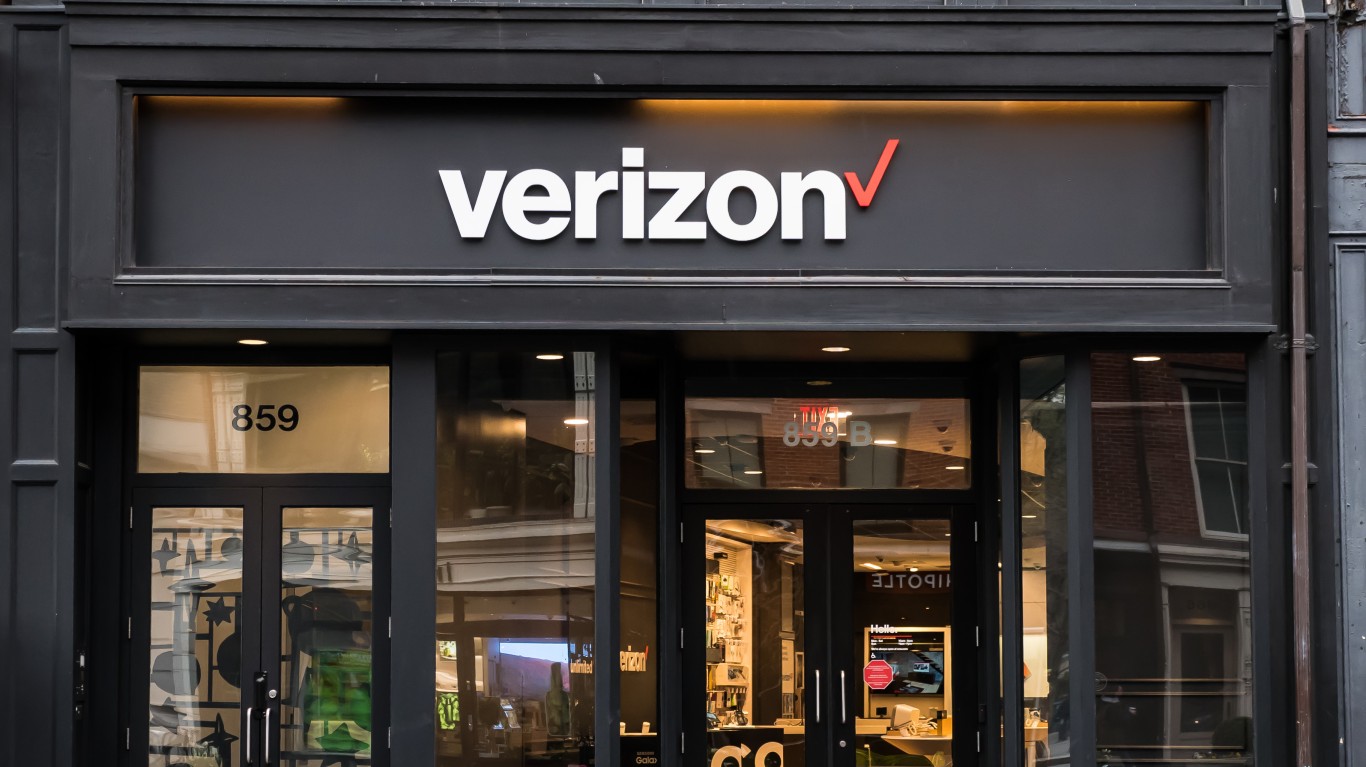
Verizon (NYSE:VZ | VZ Price Prediction) yields 6.09% as of Nov. 21. That is above the 10-year Treasury yield of 5%. The quarterly payout is 70.75 cents per share, and trailing dividends total $2.813 per share.
Coverage is the reason Verizon makes this list. Third-quarter free cash flow reached $7.801 billion[1], up 13.88%, while capital spending fell 15.85% to $3.716 billion. Adjusted EBITDA margin expanded from 37.8%[1] to 40.2%. Full-year adjusted EPS guidance was raised to $5.04 to $5.06[1], with free cash flow growth expected to approach 12%. Next to that EPS range, the $2.813 dividend is fully covered by earnings with room to spare. Verizon also completed $4.0 billion[1] of a buyback worth up to $4.5 billion in the first nine months. That shows the dividend is being paid from surplus cash.
The track record supports this. The quarterly payout has climbed from 48.75 cents in the 2010 to 2011 period to 70.75 cents today. It stepped up every year with no cuts in the record. The latest raise lifted the payment from 69 cents to 70.75 cents, starting with the April 10 ex-dividend date.
For income investors, the bull case is a cheap, low-volatility payer that is growing again. The stock trades at 12x trailing earnings and about 9x forward earnings, with a beta of 0.26. In the third quarter, Verizon added 406,000[1] postpaid phone subscribers and 314,000 broadband customers. Its AWS AI Connect deal also adds a growth angle to a utility-like cash stream. Shares are up 19.56% year to date as the market rewards the stronger cash flow.
The main catch is debt. Verizon has $166.2 billion[1] of debt outstanding, and interest expense rose 17.2% year over year. Net unsecured debt to adjusted EBITDA was 2.5x[2] in Q2, up from 2.2x at the end of 2025. If the 10-year stays above 5%, higher refinancing costs will use up part of the free cash flow growth that pays for future raises.
Enterprise Products Partners: Fortress Coverage Behind an Ultra-High Yield

Enterprise Products Partners (NYSE:EPD) yields 6.25% as of Nov. 21, also above the 5%[3] 10-year. The quarterly distribution is 56[4] cents per unit, or $2.24 annualized. That is up 2.8%[4] from a year earlier.
Coverage is the standout. Distributable cash flow from operations rose 27%[5] to $2.3 billion in Q3. That covered the distribution 1.9x[5] and left $1.1 billion of retained cash. Over the trailing 12 months, distributions plus buybacks came to 54%[5] of adjusted cash flow from operations. Management described its framework as “55%–60% of adjusted cash flow from operations for distributions and buybacks,”[5] and said the mix is still “heavily skewed towards the distributions.”
This is a balance sheet built for a world of 5% rates. About 96%[5] of roughly $33.7 billion of debt is fixed rate, at a weighted average cost of 4.7% and a weighted average life of about 17 years. Net leverage is 2.9x[5], inside the 2.7x to 3.25x target, and liquidity is about $4.8 billion. The quarterly payout has risen from 37 cents in early 2015 to 56 cents today, with an increase in every calendar year of that stretch.
The growth pipeline is contracted and easy to see. Enterprise has $6.3 billion[4] of growth projects under construction through 2028. That includes a fully contracted 300,000[5] barrel-per-day LPG export expansion on the Houston Ship Channel, and LPG capacity is “about 90%” contracted through the end of the decade. Permian plant inlet volumes hit a record 4.6 Bcf per day[5], up 12%. Management explained its strategy this way: “Rather than pursuing acquisitions at top-of-the-cycle M&A multiples, we have been opting for targeted organic growth that historically provided us higher and more consistent returns on capital with fewer surprises.”[5] Units trade at about 12x forward earnings and are up 19.73% year to date.
The catch is the commodity cycle. On the call, Randy Fowler warned that 2027[5] growth could be more modest than this year’s, pointing to geopolitical uncertainty and its effect on spreads across the system. A slower year would cut into retained cash long before it put a distribution covered 1.9x[5] at risk.
Realty Income: Monthly Checks With the Thinnest Edge Over Treasuries
Realty Income (NYSE:O) yields 5.6% as of Nov. 21. That still beats the 10-year’s 5%[3], but the edge is thin. Over the past month the 10-year reached 5.15%[3] on Nov. 13 and fell as low as 4.84% on November 5. If Treasury yields keep climbing while the share price holds steady, Realty Income is the first stock on this list that could lose its edge.
For a REIT, the key coverage measure is adjusted funds from operations (AFFO), and it covers the payout well. Third-quarter AFFO was $1.12 per diluted share, up 3.7%, while monthly dividends paid in the quarter totaled 81.3
The raise streak is the core of the story. Realty Income announced its 116th consecutive quarterly dividend increase in September, which puts it among the Dividend Aristocrats. On November 10[7], it declared its 137th monthly dividend increase, after paying its 676th consecutive monthly dividend. The newest payment of $0.274, payable December 15, is up from $0.2715.
The bull case combines growth with a lower share price. Realty Income invested $2.6 billion in the third quarter at a 6.8% initial cash yield, an investment spread of about 170 basis points. It also reaffirmed $10.0 billion of investment volume for the year. Its $6 billion[6] hyperscale data center joint venture adds a new type of tenant. The stock trades at $57.50, below its 200-day moving average of $61.52 and its 52-week high of $65.93. Its free cash flow yield is 6.97%.
The catch is the cost of borrowing. Quarterly interest expense rose to $333.6 million from $294.5 million. With the 10-year above 5%, new debt costs more. That contracts the investment spread that drives AFFO growth and future raises.
3 Payouts That Can Grow Past a Fixed Coupon
All three stocks yield more than a 10-year note locked at a 5% coupon, and all three have dividends that have risen over time. Enterprise Products Partners pairs an ultra-high yield with 1.9x[5] coverage and mostly fixed-rate debt. Verizon supports its ultra-high yield with double-digit free cash flow growth. Realty Income pays monthly and has the smallest lead over Treasuries, backed by a 116-quarter raise streak. The number to watch is the 10-year itself: every move above 5% raises the bar these dividends have to clear.
Contact [email protected] for any questions or corrections.
Joel South covers large-cap stocks, dividend investing, and major market trends, with a focus on earnings analysis, valuation, and turning complex data into actionable insights for investors.
He brings more than 15 years of experience as an investor and financial journalist, including 12 years at The Motley Fool, where he served as an investment analyst, Bureau Chief, and later led the Fool.com investing news desk. He has also co-hosted an investing podcast and appeared across TV and radio discussing market trends.