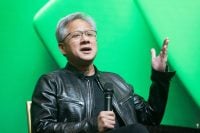
Jensen Huang Resigned and Nvidia Fell 22% in 10 Days. Josh Brown Says the Stock Could Never See $200 Again

This post may contain links from our sponsors and affiliates, and Flywheel Publishing may receive compensation for actions taken through them.
A retiree who held 1,000 Nvidia (NASDAQ: NVDA) shares at the stock’s record close on Oct. 6 had $239,240 in one stock. At Thursday’s close of $166.19, those shares were worth $166,190, $73,050 less.
Josh Brown owns Nvidia too, and on Thursday he said out loud the thing many holders have been afraid to think.
“You could literally put somebody in who does something like what happened at HP or like what happened in Intel, completely get the strategy wrong, and we might never see Nvidia trade at 200 ever again as long as we live,” Brown, the CEO of Ritholtz Wealth Management, said on CNBC’s Halftime Report. Then he said he is keeping his shares.
Part of his reason is his own cost. “My average cost is so low that it almost doesn’t pay for me to sell personally, and I’m not going to,” he said. A low cost basis in a taxable account means a large capital gains bill on any sale, so a long-time holder pays to get out. Inside an IRA there is no tax on selling, and that argument disappears.
Nvidia closed Thursday at $166.19, the day Jensen Huang resigned as CEO and as a member of the board. We covered the resignation and what history says about companies left without a permanent CEO here. It last closed above $200 on Nov. 4, at $200.13, and would need to rise 20.3% from Thursday’s close to get back there.
The case Brown made for not selling
“Nvidia is down 23% in ten days,” Brown said. “This is the worst ten day drop we’ve seen for the stock in four years.”
His numbers hold up. From its Oct. 29 close of $213.66 to Thursday’s close, Nvidia fell 22.2% in 10 trading days. The last time it fell that much in 10 trading days was in December 2022. Nvidia closed at a record $239.24 on Oct. 6 and is now 30.5% below it, about $1.76 trillion of market value gone.
“The argument against selling it right this second today is just simply there’s been so much selling already, even if you want out,” Brown said. He also pushed back on the idea that the stock carried a premium for Huang. “Stock has been selling at a below market multiple for 24 months. There is no premium on the stock,” he said.
The risk he is not dismissing
Brown pointed to two companies whose CEOs left over personal conduct. At Hewlett-Packard, the next leadership made a costly acquisition that the company later wrote down. At Intel, Brian Krzanich left in 2018 after an inappropriate relationship, and Brown said the strategy shift that followed let TSMC pull ahead in chip manufacturing. “Intel never was Intel again,” he said.
“I don’t know that that’s definitely how this is going to go. So I have to stick around and find out,” he said.
Two of his colleagues sold
Not everyone on the set agreed. Malcolm Ethridge, managing partner at Capital Area Planning Group, sold his Nvidia shares in after-hours trading. “The whole reason that I wanted to own the stock in the first place has left the building,” he said. “Everything related to Nvidia left with the CEO.”
Ethridge put it in one line: “You’re supposed to step in and buy broken stocks at moments of weakness, not broken companies. And I see this right now as a broken company.”
Stephanie Link, chief investment strategist at Hightower Advisors, also sold, even though she called the company’s fundamentals very strong. “I do think it’s going to be kind of in a trading range for the next 6 to 12 months,” she said. “I will not have a problem buying the stock back if we get a really amazing leader.”
What a retiree holding Nvidia should weigh
The three of them looked at the same facts and made different calls, and the reasons are the useful part.
Brown’s reason for holding is his cost, and it only applies outside an IRA. Link’s reason for selling is opportunity cost. If the stock goes sideways for 6 to 12 months while the board searches for a CEO, money in it is not working, and she said she would buy back once a strong leader is named.
Ethridge’s reason is the thesis. He owned Nvidia for what Huang built and promised, and with Huang gone, he no longer has the reason he bought it.
For a retiree the first question is size. If Nvidia has grown into a large share of a portfolio, through shares owned directly and through index funds, a 30% drop from the record is a reminder of what one stock can do to a retirement. Trimming back to a size you could hold through a long CEO search is a decision you can make without knowing who the next CEO will be.
Nvidia was at $168.93 in pre-market trading Friday as of 7:35 AM ET. The next real data point arrives Tuesday, Nov. 17, when Nvidia reports quarterly results with Colette Kress as interim CEO. Link said she expects a very good quarter. What holders will be listening for is anything about leadership, China and the search.
Contact [email protected] for any questions or corrections.
I've been writing about stocks and personal finance for 20+ years. I believe all great companies are tech companies in the long run, and I invest accordingly.