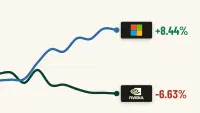
AMD Just Beat Nvidia by the Widest Margin Since 1999

This post may contain links from our sponsors and affiliates, and Flywheel Publishing may receive compensation for actions taken through them.
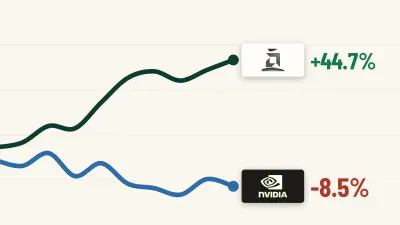
In the five trading days through Thursday, AMD (NASDAQ:AMD | AMD Price Prediction) rose 44.7%, from $404.40 to $585.30. Over the same period, Nvidia (NASDAQ:NVDA) fell 8.5%, from $181.60 to $166.19.
By our calculation, that 53.2-percentage-point gap is the widest five-day spread in AMD’s favor across 6,997 trading days, which covers all 27 years since Nvidia’s January 1999 IPO. AMD had record results and new customer orders, while Nvidia lost its chief executive.
AMD’s Spread Broke a Record Set in 2016
The old high was 50.1 points in the five days to April 22, 2016, when AMD rose 47.8%, and Nvidia fell 2.3%. Nvidia’s fall this time was much steeper than in 2016, so it accounts for more of the gap.
| Five Days Ending | AMD Minus Nvidia |
|---|---|
| Nov. 12, 2026 | 53.2 points |
| Apr. 22, 2016 | 50.1 points |
| Jun. 28, 2002 | 45.1 points |
| Oct. 8, 2025 | 42.6 points |
From Friday to Friday, AMD gained 18.93% from $449.04, and Nvidia lost 12.75% from $186.64. By our calculation, that 31.7-point gap is still the widest since the five days to October 10, 2025.
Record Revenue and Cloud Wins Power AMD
AMD jumped 11.04% on November 6 after third-quarter revenue reached a record $13.4 billion, up 45%. Data center revenue rose about 97%, so the business that competes head-on with Nvidia powered the quarter.
On November 11, AMD added 7.32% to $552.90. That move followed results from CoreWeave (NASDAQ:CRWV), a spot on a preferred chip list from Goldman Sachs (NYSE:GS), and a cloud deal with Alphabet (NASDAQ:GOOG, NASDAQ:GOOGL) unit Google for fifth-generation EPYC chips. CEO Lisa Su said “demand is higher than supply”[1] and guided fourth-quarter revenue to about $17 billion[2] as Helios racks and Venice processors ramp.

Nvidia Lost Its CEO and a Sixth Straight Week
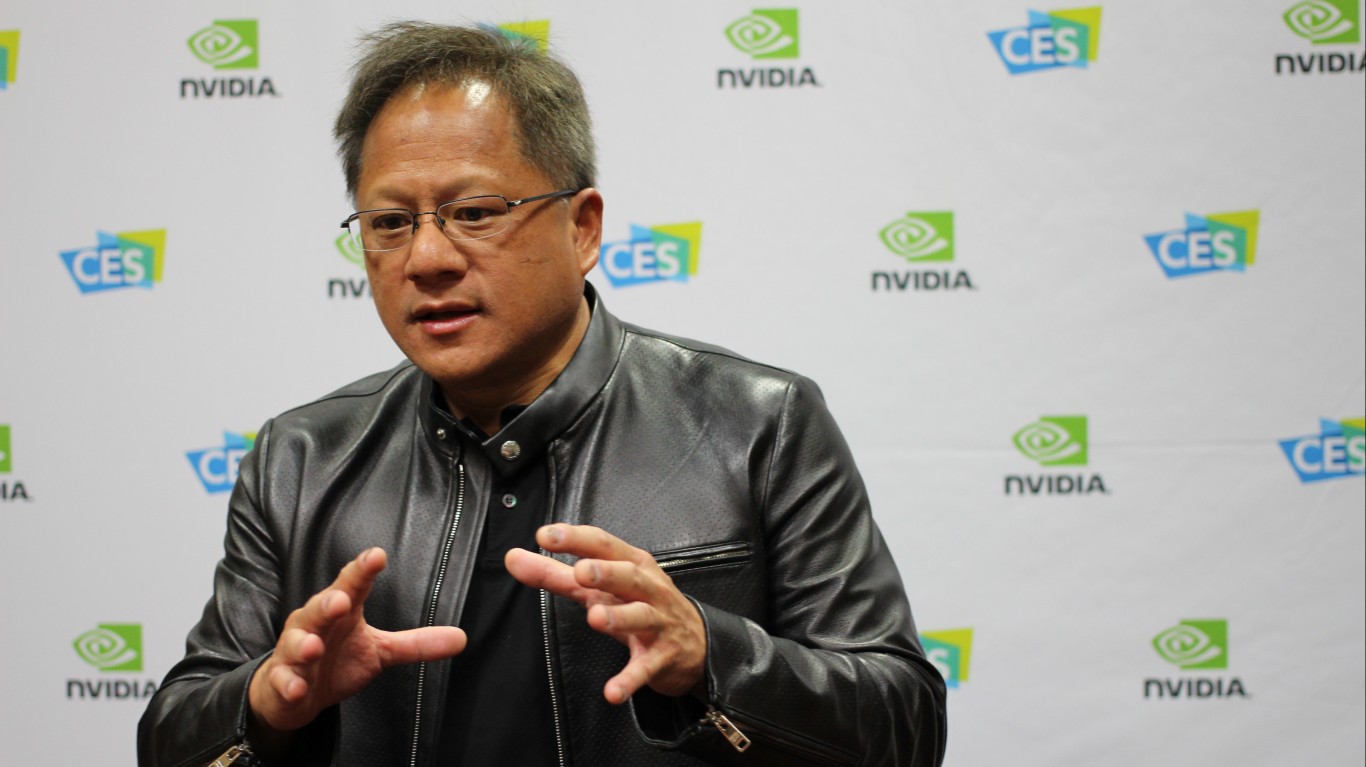
On November 12, Nvidia said Jensen Huang had resigned as president, CEO, and director and named CFO Colette Kress interim CEO. The stock then posted its sixth straight weekly loss.
The market usually absorbs reported results within days, but uncertainty over who leads a company lasts until the board names a permanent replacement. Size also helps explain the gap, because AMD’s $875.9 billion market value takes far less new money to move sharply than Nvidia’s $3.93 trillion. Nvidia still controls its CUDA software platform and reported $96.22 billion in revenue last quarter, so a credible CEO pick could steady the stock.
On Friday, AMD fell 8.75% to $534.06, while Nvidia slipped 2.01% to $162.85. In after-hours trading, AMD changed hands at $521.24 and Nvidia at $161.04.
A one-day drop that steep after a 44.7% run suggests that many late buyers were chasing momentum. AMD is also still about 19% below its 52-week high of $658.52.
AMD’s Growth Outlook Faces a Valuation Test

AMD has the stronger near-term growth case. Management expects 2027 revenue to grow more than 80%[1], with data center making up more than 80% of sales.
The stock swings hard in both directions, and a trailing P/E of 202 leaves little room for a guidance miss. Nvidia’s lower price could draw renewed interest once it names a permanent CEO. Until then, AMD has the clearer growth story, and its reported numbers support it.


Contact [email protected] for any questions or corrections.
Omor Ibne Ehsan is a writer at 24/7 Wall St. He is a self-taught investor with a focus on growth, cyclical, and dividend equities that have strong fundamentals, value, and long-term potential. He also has an interest in high-risk, high-reward investments such as penny stocks.