Dow Already Cut Its Dividend 50%. Its Remaining 4.4% Yield Faces Another Test

This post may contain links from our sponsors and affiliates, and Flywheel Publishing may receive compensation for actions taken through them.
Dow (NYSE:DOW | DOW Price Prediction) pays $0.35 per share each quarter, or $1.40 a year. At the latest price of $31.95, that works out to a yield of about 4.4%. Dow posted a $2.62B GAAP net loss in 2025, so that yield is high for a company in its position. Income investors should also know the payout has already been cut once. Dow paid $0.70 per share quarterly from 2019 into 2025. It has paid $0.35 since the August 29, 2025 ex-dividend date. The question is whether the lower rate can hold.

What Dow Sells and Why Prices Swing
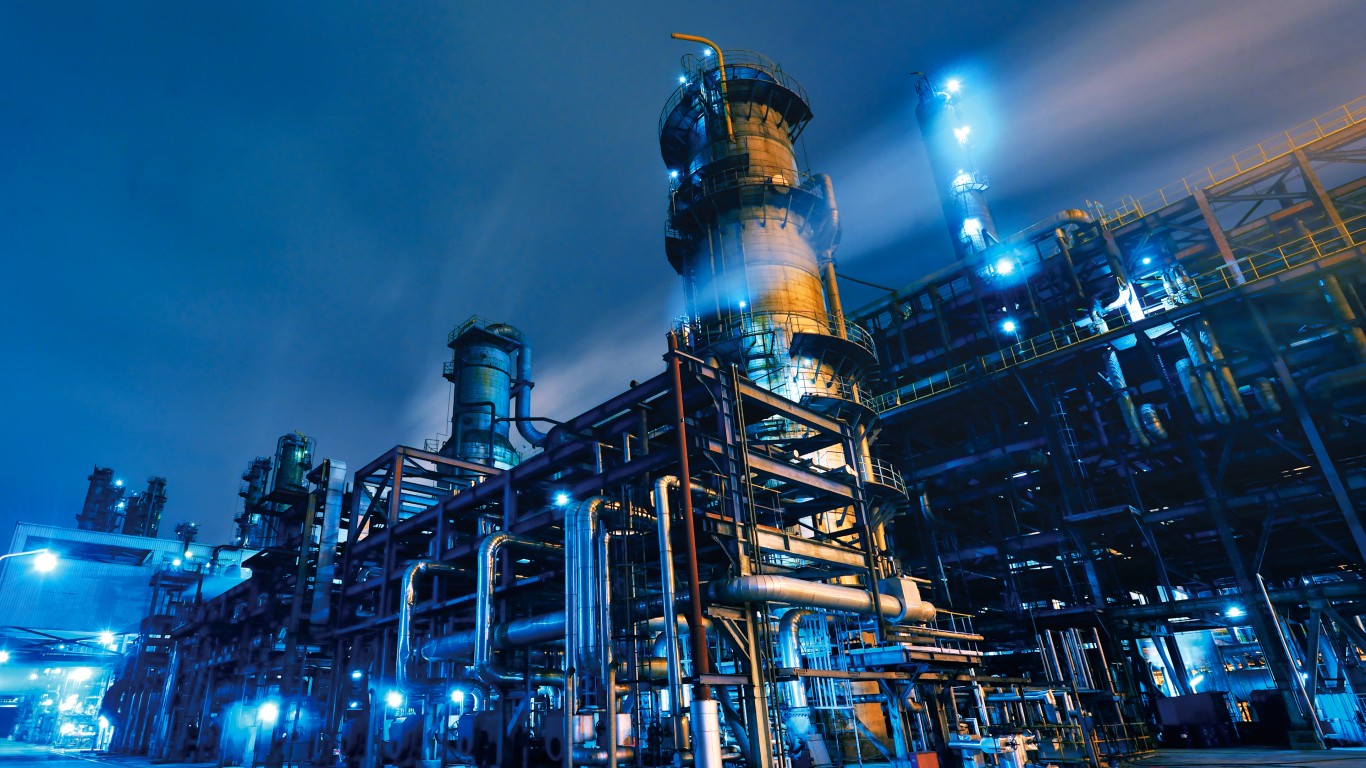
Dow makes polyethylene for packaging, industrial chemicals for construction and energy, and coatings and silicones. When new plants open faster than demand grows, prices fall across the industry. Management said ethylene and polyethylene operating rates sit in the low 80s[1], and that roughly 10% of capacity needs to close before mid-cycle conditions return. Then-CEO Jim Fitterling called 2025 “an unprecedented industry downturn.”[2]
Cash Flow Now Covers the Payout
In 2025, free cash flow came in at -$1.42B[2], so Dow funded the dividend from its balance sheet. In 2026, that turned. Free cash flow reached $621M[3] in Q1, $692M[4] in Q2, and $1.1 billion[1] in Q3. The latest reported quarterly payout of $253M[4] equals about 23% of Q3 free cash flow.

Management is using the extra cash to reduce debt. It cited $14 billion of liquidity[1] and no substantive debt maturities until 2029, and said it plans to pay off about $1.4 billion of debt. CEO Karen S. Carter put it this way:
“Our focus areas around capital allocation are straightforward: strengthen the balance sheet, improve cash flow, and preserve financial flexibility so that we can act as conditions and opportunities evolve.”[1]
Cost cuts are a big part of the cash story. Transform to Outperform includes about 4,500[1] job cuts and targets roughly $1.3 billion in net benefits in 2026 and another $1.3 billion in 2027. Dow also closed the Barry, U.K., siloxanes plant and began shutting European assets. CFO Jeffrey L. Tate said of the 2027 savings, “That will be something that we can control as Team Dow.”[1]
How Dow Stacks Up Against Its Peers
LyondellBasell (NYSE:LYB) kept its $0.69 quarterly dividend, a cost of $224 million per quarter, and generated $1.7 billion of Q3 operating cash flow. Its earnings remain exposed to swings in olefins pricing, so peer cash flow remains linked to the cycle.
Westlake (NYSE:WLK) has raised its dividend for 22 consecutive years. It kept the payout through a Q1 that produced -$303 million of free cash flow. Dow cut instead, and that adjustment is what gives its payout room today.
Two Risks Facing the Payout
The first risk is overcapacity. If closures stall, polyethylene margins could fall away again. The second is the Middle East. Dow has capped its Sadara funding commitment at about $1.3 billion[1], while some joint-venture assets still run at reduced rates. Carter said, “Obviously, the market remains incredibly volatile, but we have the right priorities, and we have the momentum to see it through.”[1]
Is the $1.40 Dividend Safe?
At $0.35 a quarter, the dividend looks sustainable. It takes up a small share of current free cash flow, and Dow has $14 billion of liquidity[1] behind it. Management expects Q4 EBITDA of about $1.5 billion[1]. The stock is up 41.29% year to date but still down 28.1% over five years. Dow’s payout remains exposed to cyclical swings in chemical demand and pricing, the kind of setup that trips up yield seekers, which is why we laid out the seven warning signs of a dividend about to be cut in a free report. A dividend increase looks unlikely while debt reduction remains the priority, so watch the stock around the Q4 earnings report.
Contact [email protected] for any questions or corrections.
Chris Lange is a financial and geopolitical writer with more than a decade of experience covering a myriad of topics. He has published thousands of articles for 24/7 Wall St., with past coverage focused heavily on stocks, IPOs, healthcare, defense, global affairs, and technology.
His work has been quoted, or referenced by a number of outlets including Business Insider, USA Today, Yahoo Finance, MSN, The Motley Fool, and many other publications. A graduate of Southwestern University, he studied business with a focus on investments and has previous experience in banking and startups.
When not reading or writing the news, he is following his passion for Lacrosse, playing chess, or building solar projects with his dad.