How Boomers Can Turn $150,000 Into Passive Income With These 4 Energy Dividend Stocks

This post may contain links from our sponsors and affiliates, and Flywheel Publishing may receive compensation for actions taken through them.

Retirees run into the same math problem sooner or later. Social Security and pension checks rarely stretch as far as a paycheck did, and selling shares to pay bills eats into the principal that has to last for decades. A portfolio that pays cash on a set schedule lets that principal stay invested while the income covers insurance premiums, groceries and travel.
Integrated oil and pipeline companies have filled that role for generations of income investors. Putting $150,000 to work as $37,500 in each of four energy dividend payers would return about $5,700 a year in passive income at current payout rates. Below is what a $37,500 stake in each name would produce, using forward estimates from November 16 closing prices.
Exxon Mobil
- Stock #4: Exxon Mobil (NYSE:XOM | XOM Price Prediction)
- Yield: 2.56%
- Shares for $37,500: 224.73
- Annual Passive Income: ~$961.83
Exxon explores for, produces, refines and sells oil, natural gas and chemicals around the world. It has the lowest yield in this group because the stock is up 42.33% year to date, and management splits cash returns between a growing dividend and buybacks. That includes a $20 billion[1] repurchase target for 2027.
The dividend is well covered. Third-quarter free cash flow of $19.1 billion[1] more than paid for $9.4 billion in total shareholder distributions. The newly declared $1.07 quarterly dividend marks the company’s 44th consecutive year[1] of annual increases. On the earnings call, CEO Darren Woods said, "we’re not going to ever cut our dividend."[2] The main risk is that earnings follow oil prices and refining margins, and the shares fell 6.17% over the past month.
Williams Companies
- Stock #3: Williams Companies (NYSE:WMB)
- Yield: 3.11%
- Shares for $37,500: 554.65
- Annual Passive Income: ~$1,164.77
Williams runs natural gas pipelines, led by Transco, along with gathering, processing and storage assets. Management describes its revenue as "predictable, fee-based, take-or-pay cash flows,"[3] and that contracted revenue is what lets this C-corp pay out so much.
The 2026 guidance midpoint calls for AFFO of $5.15 per share[4], which covers the $2.10 annualized dividend 2.47x. The quarterly payout has gone up every year, from $0.34 in 2018 to $0.525 in 2026. Debt is the risk. Heavy spending on power projects puts expected year-end leverage at around 3.75x[3], close to the company’s internal 4x ceiling.
Kinder Morgan
- Stock #2: Kinder Morgan (NYSE:KMI)
- Yield: 3.79%
- Shares for $37,500: 1,193.51
- Annual Passive Income: ~$1,420.27
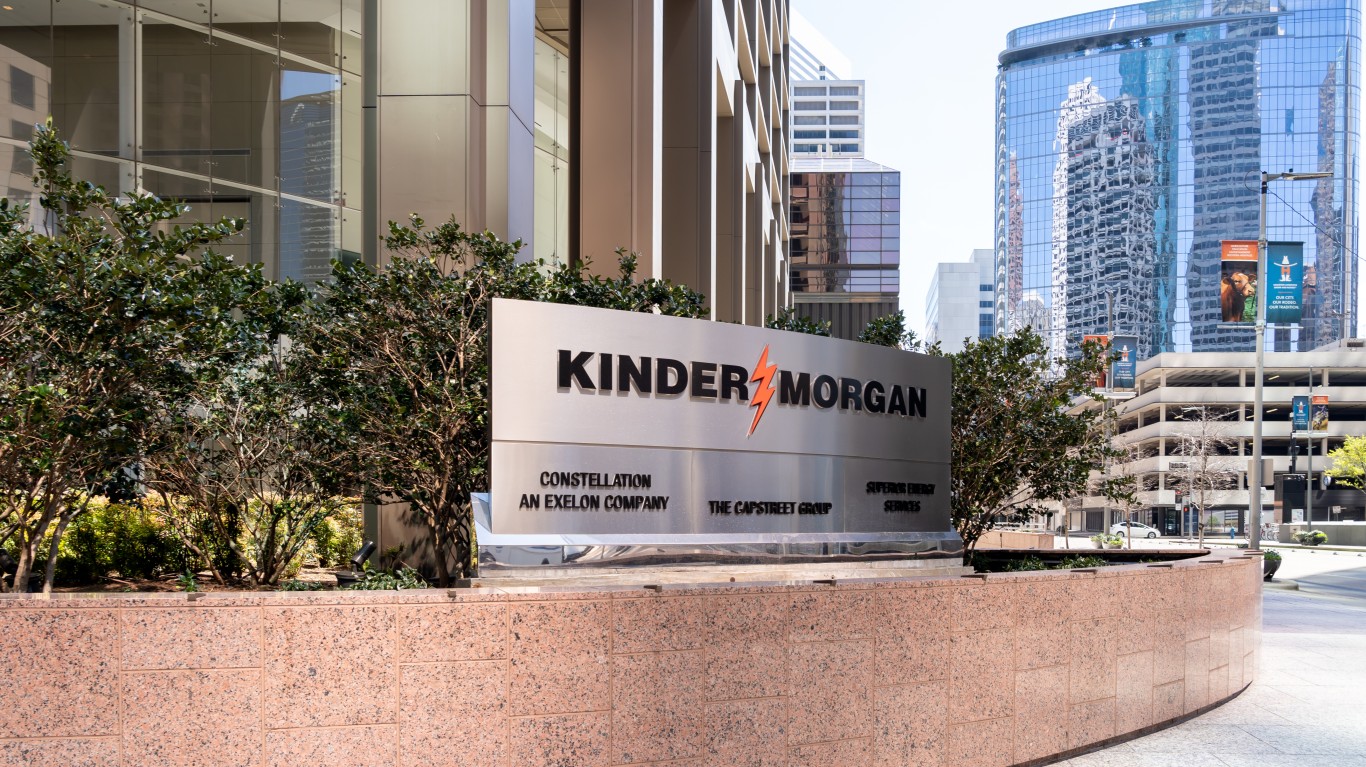
Kinder Morgan moves about 40%[5] of all natural gas in America. Its pipelines run on long-term take-or-pay contracts, which turn that volume into steady fees and pay for a high dividend.
The company’s 2026 guidance calls for adjusted EPS of $1.36, which covers the $1.19 annualized dividend. Management now expects full-year adjusted EPS to come in more than 13%[5] above budget. Net debt ended the quarter at about 3.5x[5] adjusted EBITDA, and the project backlog grew to $14.4 billion. The dividend record has a mark, though. The quarterly payout fell to $0.125 in 2016 from $0.51 in 2015. Management also pointed to about $225 million[5] of 2026 gains that may not repeat.
Enterprise Products Partners
- Stock #1: Enterprise Products Partners (NYSE:EPD)
- Distribution Rate: 5.98%
- Units for $37,500: 1,001.60
- Annual Passive Income: ~$2,243.59
Enterprise runs pipelines, processing plants and export terminals that handle natural gas liquids, crude oil, natural gas and petrochemicals. It is a master limited partnership, so it passes its cash flow through to unitholders instead of paying corporate income tax. That structure is why it has the highest payout in this group.
Third-quarter distributable cash flow of $2.3 billion[6] covered the $0.56 quarterly distribution 1.9x, and net leverage stands at 2.9x. Much of its growth depends on Permian Basin volumes, so a slowdown in drilling there would cut into throughput.
Unitholders get a Schedule K-1 instead of a 1099. The K-1 reports each investor’s share of the partnership’s income and deductions, and it often arrives later than other tax forms. Holding the units in an IRA raises a separate issue. Partnership income can count as unrelated business income, and an IRA with $1,000 or more of it in a year must file Form 990-T.
Four Energy Stocks, One Income Stream
| Name | Yield or Distribution Rate | Annual Dividend Income |
|---|---|---|
| Exxon Mobil | 2.56% | $961.83 |
| Williams Companies | 3.11% | $1,164.77 |
| Kinder Morgan | 3.79% | $1,420.27 |
| Enterprise Products Partners | 5.98% | $2,243.59 |
| Total | 3.86% | $5,790.46 |
These four positions would generate $5,790.46 in annual passive income on a $150,000 investment, a combined yield of 3.86%. Enterprise Products contributes $2,243.59, Kinder Morgan adds $1,420.27, Williams adds $1,164.77 and Exxon contributes $961.83.
These payouts all depend on cash flow and board decisions, and Kinder Morgan’s 2016 cut shows that dividends can shrink and income can stop. All four pay quarterly, though, so the cash comes in through the year without selling a single share (the whole point of a dividend ladder, and we laid out how to build one in a free guide here). That gives retirees a steady stream they can plan their budgets around.
Contact [email protected] for any questions or corrections.
Lee Jackson has covered Wall Street analysts' equity and debt research and equity strategy daily for 24/7 Wall St. since 2012. His broad, diverse career, including a stint as creative services director at an NBC affiliate in Austin, Texas, gives him unique insight into the financial industry.
Lee Jackson's journey in the financial industry spans more than 30 years, including nearly two decades as an institutional equity salesperson at Bear Stearns, Lehman Brothers, and Morgan Stanley. His career spanned pivotal sell-side Wall Street events, from the dot-com rise and bubble to the Long-Term Capital Management debacle, 9/11, and the Great Recession of 2008. This reflects his resilience and adaptability amid market volatility.
Lee Jackson’s practical financial industry experience, gained through a career at some of the biggest banks and brokerage firms, is complemented by a lifetime of writing across various platforms. This unique combination allows him to shed light on the intricacies of Wall Street in a way only someone with deep insider experience and knowledge can. Moreover, his extensive network across Wall Street continues to provide direct access for him and 24/7 Wall St., a privilege few firms enjoy.
Since 2012, Jackson’s work for 24/7 Wall St. has been featured in Barron’s, Yahoo Finance, MarketWatch, Business Insider, TradingView, Real Money, The Street, Seeking Alpha, Benzinga, and other media outlets. He attended the prestigious Cranbrook Schools in Bloomfield Hills, Michigan, and has a degree in broadcasting from the Specs Howard School of Media Arts.