If You Invested $25,000 in These 4 Dividend Stocks, Here’s What They’d Pay You
A pipeline operator, a tower REIT, a chicken giant, and a healthcare conglomerate each get an equal slice of $25,000. One of them cut its dividend by more than 75% a decade ago, and another is about to split in…

This post may contain links from our sponsors and affiliates, and Flywheel Publishing may receive compensation for actions taken through them.

Retirement changes the math on every dollar. Once the paycheck ends, Social Security covers only part of the bill, and the gap has to come from assets that pay on a schedule without forcing a share sale during a bad week for the market. Many retirees handle that by holding a group of dividend payers that send cash every quarter.
A $6,250 stake in each of four high-yield dividend stocks would pay the following in annual income. That is $25,000 in total, split across a pipeline operator, a tower REIT, a protein producer, and a healthcare conglomerate. Together they would produce more than $850 a year. Every yield below is a forward yield, based on the current declared dividend and the most recent share price.
CVS Health: Breakup Plan, Well-Covered Payout
- Stock #4: CVS Health (NYSE:CVS | CVS Price Prediction)
- Yield: 3.29%
- Shares for $6,250: 77.27
- Annual Passive Income: ~$205.55
CVS runs Aetna insurance, the Caremark pharmacy benefit manager, Oak Street Health, and the CVS Pharmacy chain. The yield is high because the share price has barely moved. At $80.88, the stock is up just 1.86% over five years, and it fell 10.08% in a week after management announced a plan to split into two public companies, targeted for completion in the first half of 2028.
Coverage is strong. The $2.66 annualized dividend is about 32% of 2026 adjusted EPS guidance of at least $8.20, and operating cash flow guidance now stands at no less than $15.5 billion. CFO Brian Newman expects both companies after the split to be “solid investment grade with strong free cash flow generation.” The payout has continued at $0.665 per quarter since early 2024, so the income here is steady and flat.
Tyson Foods: Chicken Profits Fund the Dividend
- Stock #3: Tyson Foods (NYSE:TSN)
- Yield: 3.32%
- Shares for $6,250: 101.86
- Annual Passive Income: ~$207.79
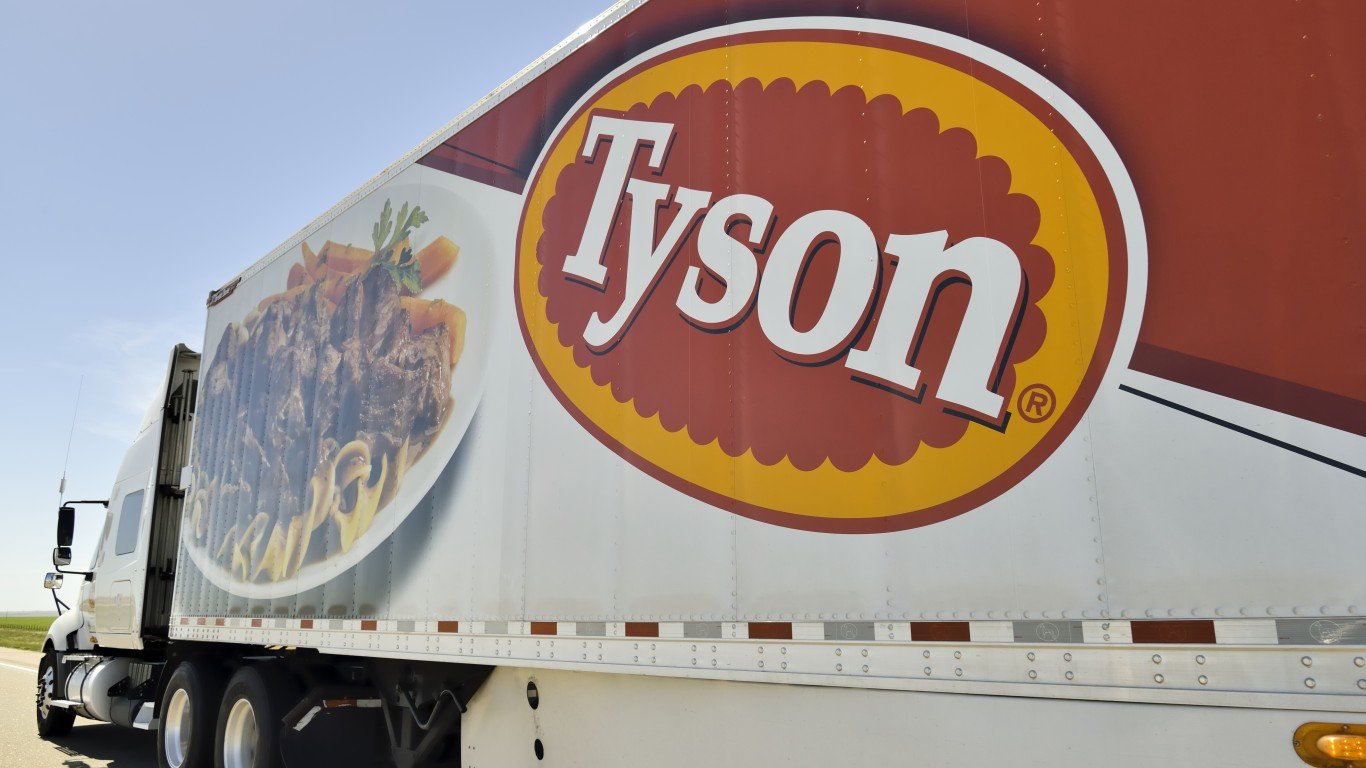
Tyson processes beef, pork, chicken, and prepared foods under brands like Jimmy Dean and Hillshire Farm. The stock is still down 11.81% over five years, even after an 18.66% gain in the past month.
Fiscal Q3 adjusted EPS of $0.99 compares with a $0.51 quarterly dividend. Free cash flow guidance of $1.3 billion to $1.7 billion for fiscal 2026 provides support, and the company paid down $824 million of debt in nine months. Chicken has now grown for seven consecutive quarters, while Beef lost about $138 million on tight cattle supply. That beef loss is the key thing to watch.
American Tower: AFFO Covers the Payout With Room to Spare
- Stock #2: American Tower (NYSE:AMT)
- Yield: 3.61%
- Shares for $6,250: 31.49
- Annual Passive Income: ~$225.45
American Tower leases space on more than 147,000 communications sites, and its CoreSite unit runs data centers. Most of the revenue comes from long-term leases with built-in escalators. Its REIT status requires paying out at least 90% of taxable income, which is why yields run high.
AFFO is the right coverage test. Q3 AFFO per share was $2.87, compared with a $1.79 quarterly dividend, and the $7.16 annualized payout comes to about 65% of the low end of the $11.04 to $11.16 full-year AFFO guidance. Management raised its outlook for the third time this year, Data Centers revenue rose 17.4%, and the board authorized another $2.0 billion in buybacks on October 23, 2026.
Kinder Morgan: Top Yield Backed by Toll-Road Cash Flow
- Stock #1: Kinder Morgan (NYSE:KMI)
- Yield: 3.75%
- Shares for $6,250: 197.10
- Annual Passive Income: ~$234.55
Kinder Morgan runs about 79,000 miles of pipelines and earns fees for moving natural gas through them under long-term contracts, so its revenue acts like tolls. Midstream networks throw off more cash than they need to reinvest, and the surplus goes to shareholders. Kinder Morgan is a C-corp, so IRA holders face no UBTI issue.
The $1.19 dividend is measured against a $1.36 adjusted EPS budget, and management expects to beat that budget by more than 13%. Leverage stands at 3.5 times net debt relative to adjusted EBITDA, and the project backlog grew to $14.4 billion. Kinder Morgan cut its dividend from $0.51 to $0.125 per quarter between 2015 and 2016, so that history belongs in any safety check. Since then, the payout has risen steadily.
Your $25,000 Income Breakdown at a Glance
| Name | Yield | Annual Dividend Income |
|---|---|---|
| Kinder Morgan | 3.75% | $234.55 |
| American Tower | 3.61% | $225.45 |
| Tyson Foods | 3.32% | $207.79 |
| CVS Health | 3.29% | $205.55 |
| Total | 3.49% | $873.34 |
These four positions together would pay $873.34 in annual passive income on a $25,000 investment, a combined yield of 3.49%. Kinder Morgan contributes $234.55, American Tower provides $225.45, Tyson Foods brings in $207.79, and CVS Health accounts for $205.55.
Similar real estate income would mean tenants, repairs, and months of closing paperwork whenever the owner wants out. Dividend shares can be trimmed in a single trade, so an income plan can change as fast as a retiree’s needs do.
Contact [email protected] for any questions or corrections.
Chris Lange is a financial and geopolitical writer with more than a decade of experience covering a myriad of topics. He has published thousands of articles for 24/7 Wall St., with past coverage focused heavily on stocks, IPOs, healthcare, defense, global affairs, and technology.
His work has been quoted, or referenced by a number of outlets including Business Insider, USA Today, Yahoo Finance, MSN, The Motley Fool, and many other publications. A graduate of Southwestern University, he studied business with a focus on investments and has previous experience in banking and startups.
When not reading or writing the news, he is following his passion for Lacrosse, playing chess, or building solar projects with his dad.