If You Can Only Buy One High-Yield Dividend Stock Forever, Make It This One

This post may contain links from our sponsors and affiliates, and Flywheel Publishing may receive compensation for actions taken through them.
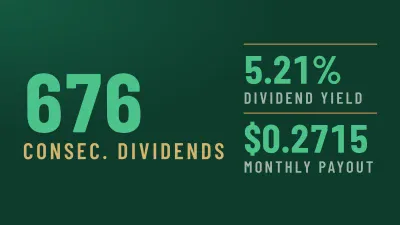
Long-term income investors often look for three things. They want a yield above the market’s, income that shows up like a paycheck, and a business strong enough to keep raising that paycheck through every rate cycle. Realty Income (NYSE:O) has all three. The net lease real estate investment trust (REIT) recently declared its 676th consecutive monthly common stock dividend.
Realty Income: A Monthly Paycheck That Keeps Growing
A 5.21% Yield Paid Every Month
At $59.25 a share, Realty Income yields 5.21%. That puts it firmly in high-yield territory without the warning signs that often come with double-digit payouts. The current monthly dividend is $0.2715, or $3.258 a year on a forward basis. For retirees matching income to monthly bills, that schedule is a real advantage over quarterly payers.
For long-term income investors, Realty Income’s track record is what sets it apart. Realty Income recently announced its 116th consecutive quarterly dividend increase, its 136th since its New York Stock Exchange listing in 1994. It is also part of the S&P 500 Dividend Aristocrats index. The increases are small, but they keep coming. The monthly payout has grown from $0.264 in early 2025 to today’s rate.
Dividend Safety: Cash Flow Covers the Payout With Room to Spare
REIT dividends depend on adjusted funds from operations (AFFO), a measure of the cash a REIT generates, and Realty Income’s AFFO comfortably covers what it pays out. Management raised 2026 AFFO guidance to $4.45 to $4.46 per share, well above the $3.258 annualized dividend. Third-quarter AFFO came in at $1.12 per share, up 3.7% from a year earlier. On the earnings call, CEO Sumit Roy said, “If you look at our AFFO payout ratio, it’s amongst the lowest it has been in the history of Realty Income.”
Those rents come from a very broad base: 15,536 properties, 1,842 clients, and 96 industries, with a weighted average remaining lease term of about 8.5 years. Occupancy reached 98.8%, and management cut its credit loss guidance to about 30 basis points from 40. The stock’s free cash flow yield is 6.90%, higher than its dividend yield.
The balance sheet holds a Fitch “A” rating with a Stable Outlook, and net debt is 5.4x annualized pro forma adjusted EBITDA. More than 94% of the company’s pro rata debt carries a fixed rate.
Bull Case: A Bigger, Broader Net Lease Platform
Third-quarter revenue reached $1.62 billion, up 10.3% year over year. Realty Income invested $2.6 billion in the quarter at a 6.8% initial cash yield, making a spread of about 170 basis points over its cost of capital. It also reaffirmed its $10 billion investment target for 2026.
Growth now extends well past U.S. retail. The company invested $940.1 million in Europe during the quarter, and data centers made up 11.7% of new property investments by Cash Income. A joint venture with KKR (NYSE:KKR | KKR Price Prediction) brought in €528.0 million for a 49% stake in European properties. Private capital like this means less share dilution for existing holders: public equity funded just 19% of pro rata investment volume so far this year, compared with a 47% average over the prior three years. That leaves more AFFO growth per share to support future increases.
One Risk to Monitor: Rising Cost of Capital
Realty Income grows by borrowing money and buying properties that earn more than the borrowed money costs, so financing costs matter a lot. Third-quarter interest expense increased to $333.6 million from $294.5 million, and impairment provisions rose to $111.6 million. Management cut 2026 net income guidance to $1.55 to $1.56 per share from $1.59 to $1.60. The company also has about $2.9 billion of debt maturing next year at 2.9%, which it will likely refinance at higher rates.
Why Realty Income’s Dividend Record Stands Out
Realty Income offers a high yield and pays it monthly. It supports that payout with AFFO coverage, an A-rated balance sheet, and 116 straight quarterly increases. Its expansion into Europe, industrial properties, and data centers broadens the base that funds those increases. Investors should monitor refinancing costs on next year’s debt maturities, AFFO per share growth, and progress toward the investment target.
Contact [email protected] for any questions or corrections.
Lee Jackson has covered Wall Street analysts' equity and debt research and equity strategy daily for 24/7 Wall St. since 2012. His broad, diverse career, including a stint as creative services director at an NBC affiliate in Austin, Texas, gives him unique insight into the financial industry.
Lee Jackson's journey in the financial industry spans more than 30 years, including nearly two decades as an institutional equity salesperson at Bear Stearns, Lehman Brothers, and Morgan Stanley. His career spanned pivotal sell-side Wall Street events, from the dot-com rise and bubble to the Long-Term Capital Management debacle, 9/11, and the Great Recession of 2008. This reflects his resilience and adaptability amid market volatility.
Lee Jackson’s practical financial industry experience, gained through a career at some of the biggest banks and brokerage firms, is complemented by a lifetime of writing across various platforms. This unique combination allows him to shed light on the intricacies of Wall Street in a way only someone with deep insider experience and knowledge can. Moreover, his extensive network across Wall Street continues to provide direct access for him and 24/7 Wall St., a privilege few firms enjoy.
Since 2012, Jackson’s work for 24/7 Wall St. has been featured in Barron’s, Yahoo Finance, MarketWatch, Business Insider, TradingView, Real Money, The Street, Seeking Alpha, Benzinga, and other media outlets. He attended the prestigious Cranbrook Schools in Bloomfield Hills, Michigan, and has a degree in broadcasting from the Specs Howard School of Media Arts.