Lucid Stock Collapses

This post may contain links from our sponsors and affiliates, and Flywheel Publishing may receive compensation for actions taken through them.
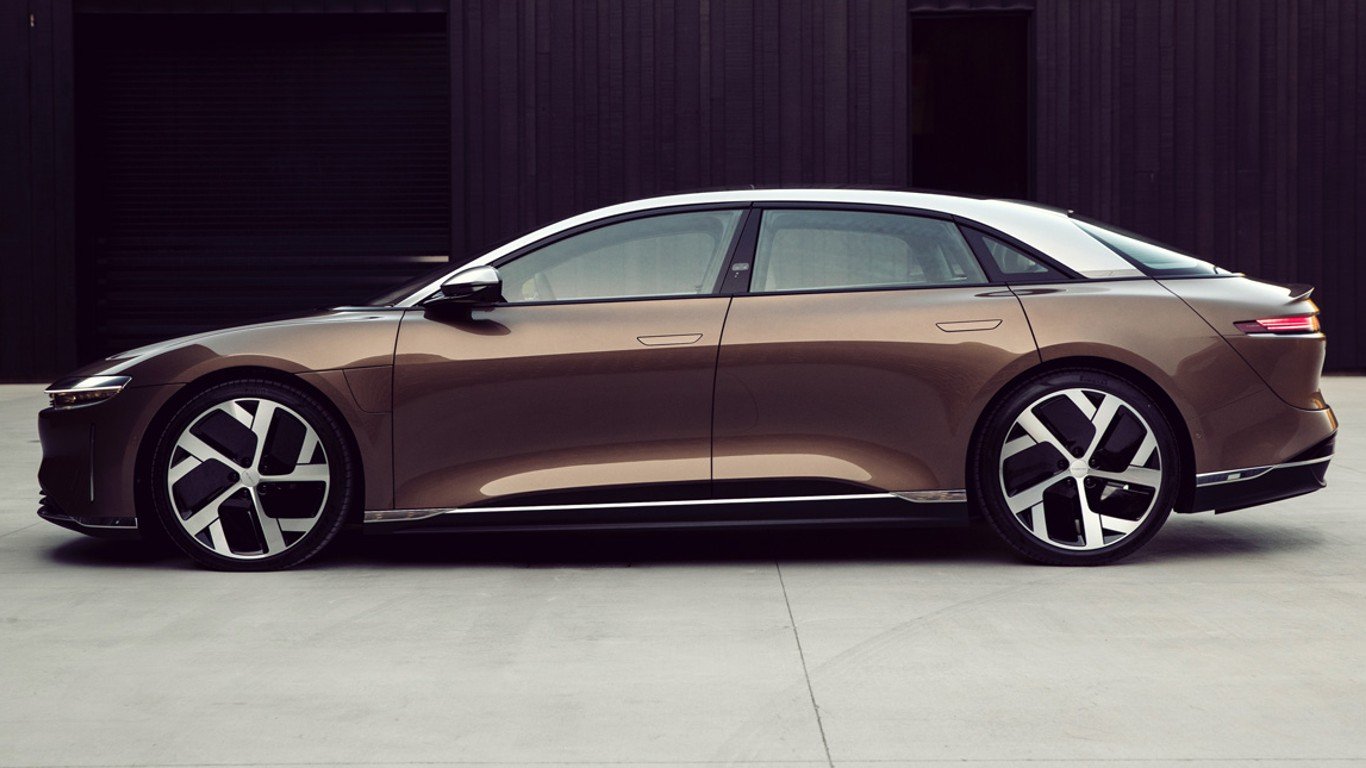
It is a grim drop. Lucid (NASDAQ: LCID | LCID Price Prediction), the crippled EV company, has posted a 25% stock drop in the last five days. Year-to-date, the drop is 74%. The collapse suggests the market has given up on Lucid and views its prospects for recovery as near zero.
One would think that Lucid has posted good news, but other news overwhelmed it. The “good” news was that Saudi Arabia’s Public Pension Fund loaned Lucid $1.75 billion. That raised the question of how it would be repaid. Lucid’s Gravity won the 2026 World Luxury Car of the Year from the World Car Awards program. Most people in the car industry pay little attention to the obscure award.
Lucid continues to post remarkably poor numbers, another sign it is not a viable public company. Perhaps the Saudis will buy it. Revenue in the most recent quarter was $350 million, up from $337 million in the year-ago period. Lucid’s net loss was $830 million compared with $976 million in the year-ago period. It is hard to do the math on what it would take to move to profitability. It delivered only 2,954 vehicles in the third quarter while producing 3,806.
To calculate the units the company would need to sell to break even, you need to know what it costs to build each vehicle. It also needs to account for at least some of Lucid’s overhead and, by some analysts’ views, all of it. At a retail price of $80,000 for each car, the figure would need to be in the low tens of thousands a quarter—at least. From its total costs of $1.2 billion in the recent quarter, the cost of revenue was $607 million.
What happens to Lucid now? The company is unlikely to go bankrupt, although if its assets are primarily intellectual property, that is possible. The Saudis could buy the company, but it is hard to see an advantage unless they have a conduit for much higher unit sales. If so, they would have already done it.
What is left beyond its inventory? Perhaps the software that runs its cars and the value of the brand. However, the brand may be worth nothing given the current sales level.
Could a large car company buy Lucid? Perhaps, but not at its current share price of $2.80.
Contact [email protected] for any questions or corrections.
Douglas A. McIntyre is the co-founder, chief executive officer and editor in chief of 24/7 Wall St. and 24/7 Tempo. He has held these jobs since 2006.
McIntyre has written thousands of articles for 24/7 Wall St. He is an expert on corporate finance, the automotive industry, media companies and international finance. He has edited articles on national demographics, sports, personal income and travel.
His work has been quoted or mentioned in The New York Times, The Wall Street Journal, Los Angeles Times, The Washington Post, NBC News, Time, The New Yorker, HuffPost USA Today, Business Insider, Yahoo, AOL, MarketWatch, The Atlantic, Bloomberg, New York Post, Chicago Tribune, Forbes, The Guardian and many other major publications. McIntyre has been a guest on CNBC, the BBC and television and radio stations across the country.
A magna cum laude graduate of Harvard College, McIntyre also was president of The Harvard Advocate. Founded in 1866, the Advocate is the oldest college publication in the United States.
TheStreet.com, Comps.com and Edgar Online are some of the public companies for which McIntyre served on the board of directors. He was a Vicinity Corporation board member when the company was sold to Microsoft in 2002. He served on the audit committees of some of these companies.
McIntyre has been the CEO of FutureSource, a provider of trading terminals and news to commodities and futures traders. He was president of Switchboard, the online phone directory company. He served as chairman and CEO of On2 Technologies, the video compression company that provided video compression software for Adobe’s Flash. Google bought On2 in 2009.