Lucid Shares Down 96% In Five Years
A Saudi billionaire's $129.5 million bet sparked hope for the struggling EV maker, but bankruptcy rumors are now shadowing every move Lucid makes in a collapsing US electric vehicle market.


Lucid (NASDAQ: LCID | LCID Price Prediction), the very troubled EV company, has posted a 96% drop in its stock price over the last five years. It is unlikely it will recover much. Its revenue would need to “hockey stick” for investors to have any faith in a recovery.
Lucid shares did run up recently. This is because Saudi Prince Alwaleed bin Talal Al Saud bought a $129.5 million stake in Lucid. He is a famed billionaire investor. However, TheStreet, via Yahoo Finance, recently reported, “Now bankruptcy chatter is following the stock everywhere it goes.”
The first evidence of how deeply troubled Lucid is has to do with sales. In the second quarter, “the company produced 4,774 vehicles and delivered 3,953 vehicles.” The number would need to rise by an extraordinary amount for the company to break even.
Lucid will release second quarter earnings soon. The first quarter’s numbers were shocking. Revenue was $282 million, up from $235 million in the same quarter a year ago.
Lucid’s net loss for the period was just over $1 billion. It lost $367 million in the same quarter last year. It is an understatement to say this number is going in the wrong direction.
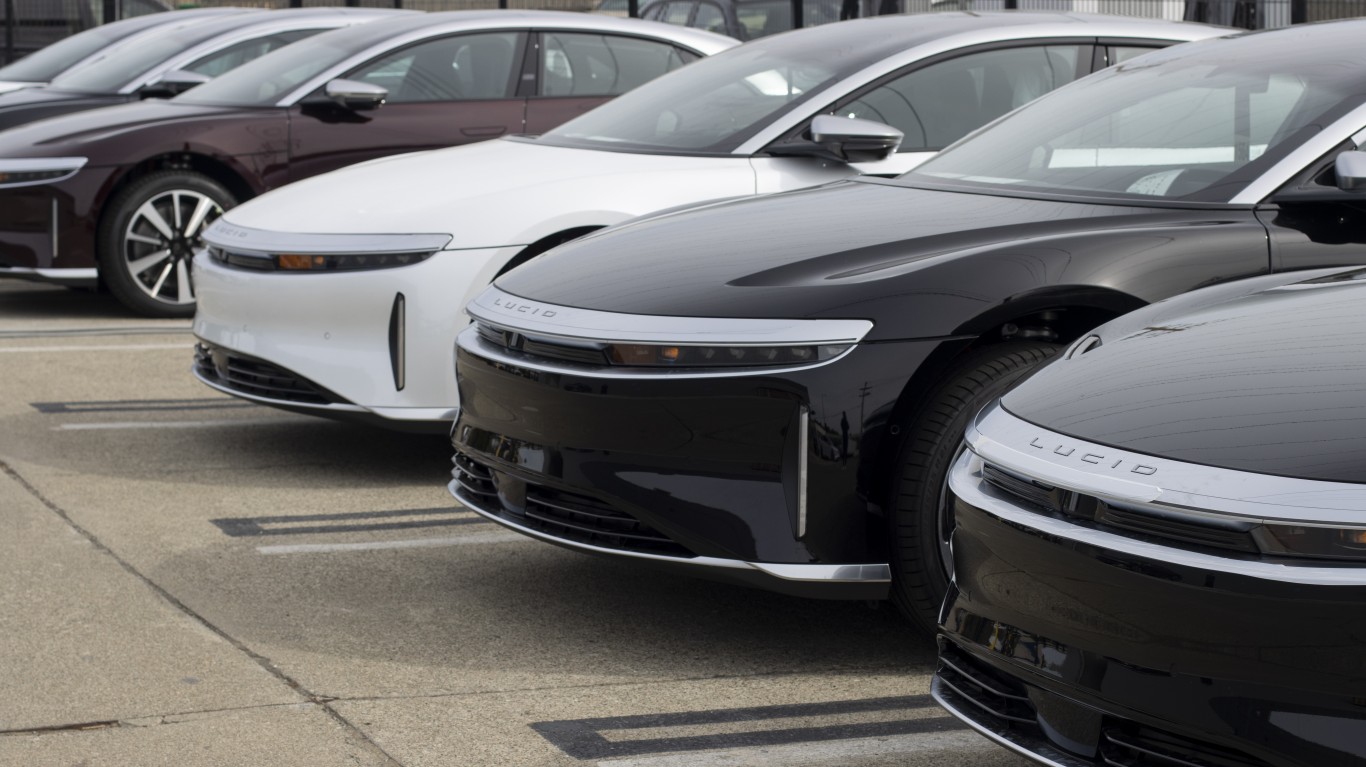
Another hurdle is that Lucid’s cars are very expensive. The least expensive version of the Air is $75,000. The high-end models are priced well above $100,000. The base price of the Gravity is $85,000. Higher-end models can cost as much as $107,000.
Additionally, Lucid is a US company, selling models in the US. While China is the world’s largest EV market and EV sales are up in the EU, the US is in trouble. Here, according to Kelley Blue Book estimates, 247,226 EVs were sold in the second quarter. That was down sharply year over year for a third consecutive quarter, with a 20.5% decrease from the same period in 2025. There is no evidence that it will get better anytime soon.
It is very hard to see why anyone would buy the stock, other than day traders.
Contact [email protected] for any questions or corrections.
Douglas A. McIntyre is the co-founder, chief executive officer and editor in chief of 24/7 Wall St. and 24/7 Tempo. He has held these jobs since 2006.
McIntyre has written thousands of articles for 24/7 Wall St. He is an expert on corporate finance, the automotive industry, media companies and international finance. He has edited articles on national demographics, sports, personal income and travel.
His work has been quoted or mentioned in The New York Times, The Wall Street Journal, Los Angeles Times, The Washington Post, NBC News, Time, The New Yorker, HuffPost USA Today, Business Insider, Yahoo, AOL, MarketWatch, The Atlantic, Bloomberg, New York Post, Chicago Tribune, Forbes, The Guardian and many other major publications. McIntyre has been a guest on CNBC, the BBC and television and radio stations across the country.
A magna cum laude graduate of Harvard College, McIntyre also was president of The Harvard Advocate. Founded in 1866, the Advocate is the oldest college publication in the United States.
TheStreet.com, Comps.com and Edgar Online are some of the public companies for which McIntyre served on the board of directors. He was a Vicinity Corporation board member when the company was sold to Microsoft in 2002. He served on the audit committees of some of these companies.
McIntyre has been the CEO of FutureSource, a provider of trading terminals and news to commodities and futures traders. He was president of Switchboard, the online phone directory company. He served as chairman and CEO of On2 Technologies, the video compression company that provided video compression software for Adobe’s Flash. Google bought On2 in 2009.