Travelers Has Surged 40% in 2026. Chubb Offers Retirees a Different Dividend Opportunity

This post may contain links from our sponsors and affiliates, and Flywheel Publishing may receive compensation for actions taken through them.
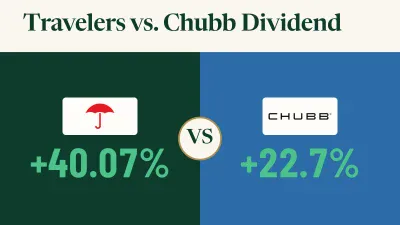
Travelers (NYSE:TRV | TRV Price Prediction) or Chubb (NYSE:CB): Which property and casualty insurance company offers the stronger income profile for investors building a retirement portfolio? Both stocks ran hard in 2026. Travelers is up 40.07% year to date, and Chubb is up 22.7%, so both yields are thin. What separates them is which dividend is built to keep growing.
How Insurers Fund Your Dividend Check
Property and casualty insurance companies earn money two ways. First, underwriting: collect premiums, pay claims, and keep the difference. A combined ratio below 100% means an underwriting profit. Travelers posted 86.8%[1] in the third quarter, and Chubb posted 84.1%[2]. Second, investing: premiums sit in bond portfolios before claims are paid. Travelers earned record pre-tax net investment income of $1.098 billion[1], while Chubb booked a record $1.89 billion[2] in adjusted net investment income.
Hurricanes and wildfires make earnings lumpy. Travelers took $2.27 billion[3] in catastrophe losses in the first quarter of 2025 versus $761 million a year later. Chubb’s prior-year first quarter carried $1.64 billion[4], driven by California wildfires.


Dividend Yield and Growth: Travelers Takes It
Travelers pays a forward $5 per share annually, a yield of about 1.24% at $401.80. Chubb’s forward $4.08 yields roughly 1.08% at $379.52.


Growth separates them further. Travelers raised its quarterly payout 14% to $1.25[3], its 22nd consecutive year of increases at an 8% compound annual rate (that kind of multi-decade run is exactly what we screened for in our free Dividend Kings report). Chubb lifted its quarterly dividend from $0.97 to $1.02, a raise of about 5.2%. Coverage is a non-issue for both: trailing dividends take roughly 12% of Travelers’ earnings versus 14% for Chubb.
Valuation: Chubb Is the Cheaper Ticket
Travelers looks cheap at a trailing P/E of 11, but its forward P/E jumps to 14, suggesting analysts expect earnings to come off a peak. Chubb trades at 13 on both trailing and forward earnings. On book value, Chubb is valued at 1.96 times versus 2.85 for Travelers. Travelers also trades above its average analyst target of $376.54, with 17 hold ratings outnumbering buys.


Risk and Durability: Chubb’s Global Book Wins
Chubb carries a beta of 0.286 versus 0.397 for Travelers, and it operates in 54 countries and territories. Overseas General revenue grew 10.2%[5] in the second quarter. Its key risk is pricing: management flagged soft property conditions spreading to certain areas of casualty and financial lines. Chief Executive Evan Greenberg put it bluntly: “Casualty underwriting is not for optimists.”[2]
Travelers’ risk sits in personal lines. Personal auto policies in force fell 9.2%, and homeowners policies fell 6.8%, while the company added $295 million[1] to asbestos reserves in the third quarter.
Verdict: Travelers Pays Retirees Better
Travelers is the dividend winner. It delivers the higher yield, a raise nearly triple the size of Chubb’s, a confirmed 22-year run, and the lower payout ratio. Its profitability backs that up: core ROE of 24.1%[1] over the trailing four quarters against Chubb’s core operating ROE of 14.9%[2]. Buybacks of $4.585 billion through the third quarter keep shrinking the share count, which makes each future raise cheaper to fund.
Chubb wins for a different retiree: one whose priority is principal protection over income growth. Its lower beta, cheaper forward multiple, and global diversification make it the steadier of the two stocks. For an investor who lives on the quarterly check and wants it climbing faster, Travelers offers the stronger dividend profile. The one crack in an otherwise superior income story is whether its personal insurance policy counts stabilize in the next earnings report.
Contact [email protected] for any questions or corrections.
Chris Lange is a financial and geopolitical writer with more than a decade of experience covering a myriad of topics. He has published thousands of articles for 24/7 Wall St., with past coverage focused heavily on stocks, IPOs, healthcare, defense, global affairs, and technology.
His work has been quoted, or referenced by a number of outlets including Business Insider, USA Today, Yahoo Finance, MSN, The Motley Fool, and many other publications. A graduate of Southwestern University, he studied business with a focus on investments and has previous experience in banking and startups.
When not reading or writing the news, he is following his passion for Lacrosse, playing chess, or building solar projects with his dad.