Want Rising Dividend Income? Invest in These 5 Dividend Growers Still Raising Payouts

This post may contain links from our sponsors and affiliates, and Flywheel Publishing may receive compensation for actions taken through them.
A small yield that grows fast can eventually pay more income than a big yield that never moves. Each raise lifts your yield on the price you originally paid, so a stock that starts at 1% and compounds its payout at double digits can pass a static high yielder if you hold it for a decade or more. This second edition of The Accelerators covers five dividend growers from five different sectors. Each has modest current income, a verified history of raising its payout, and earnings and free cash flow to fund further increases. The clearest example: Visa (NYSE: V | V Price Prediction) just raised its quarterly dividend 16% to $0.780 per share[1].
Visa: A 16% Raise With Plenty of Room Left
Visa (NYSE: V) yields 0.66%, so the case for owning it rests on growth. The quarterly payout climbed from $0.21 in 2018 to $0.30 in 2020, $0.52 in 2023, $0.67 in 2025, and now $0.78. The payout has increased every year across that period.
Dividend safety: The forward annual dividend of $3.12 works out to roughly 23.5% of fiscal 2026 non-GAAP EPS of $13.27[1]. Operating cash flow of $23.728 billion[1] minus capex of $1.671 billion leaves about $22.06 billion of free cash flow. That was enough to fund $20.5 billion[1] of buybacks on top of the dividend. Quarterly earnings grew 21.9% year over year, which means earnings are growing faster than the dividend.
Bull case: Fiscal 2026 revenue rose 14.8% to $45.903 billion[1], and Visa beat EPS estimates for the sixth straight quarter. Chief executive Ryan McInerney called it a “milestone year”[1]. Shares trade at 28 times forward earnings and are up 21.84% year to date.
Risk: Interchange litigation and global payments regulation could squeeze the fees that drive Visa’s margins.
Broadcom: AI Cash Flow Funding the Next Hike
Broadcom (NASDAQ: AVGO) yields 0.71%. Its most recent raise lifted the quarterly payout from $0.59 to $0.65, about 10.2%. The record shows annual increases since 2010. Recent raises have been declared in December, alongside fiscal fourth-quarter results.
Dividend safety: The $2.60 annual payout is about 33.2% of trailing EPS of $7.83. Third-quarter dividends of $3.1 billion[2] used only about 22.7% of free cash flow of $13.665 billion[3], which itself rose 94.6%. Broadcom ended the quarter with $23.975 billion[3] in cash and paid down $5.6 billion[2] of long-term debt. Quarterly earnings growth of 215.3% is running far ahead of the dividend.
Bull case: Fourth-quarter guidance calls for revenue of $34.8 billion (+93% YoY)[3] and AI chip revenue of $21.7 billion. Hock Tan said the company is “very much on target to exceed $30 in earnings per share in fiscal 2028.”[2] Even so, the stock trades at just 18 times forward earnings after a 1.82% year-to-date drop.
Risk: Much of the AI revenue comes from a small group of hyperscale buyers, so losing one customer would hit results hard.
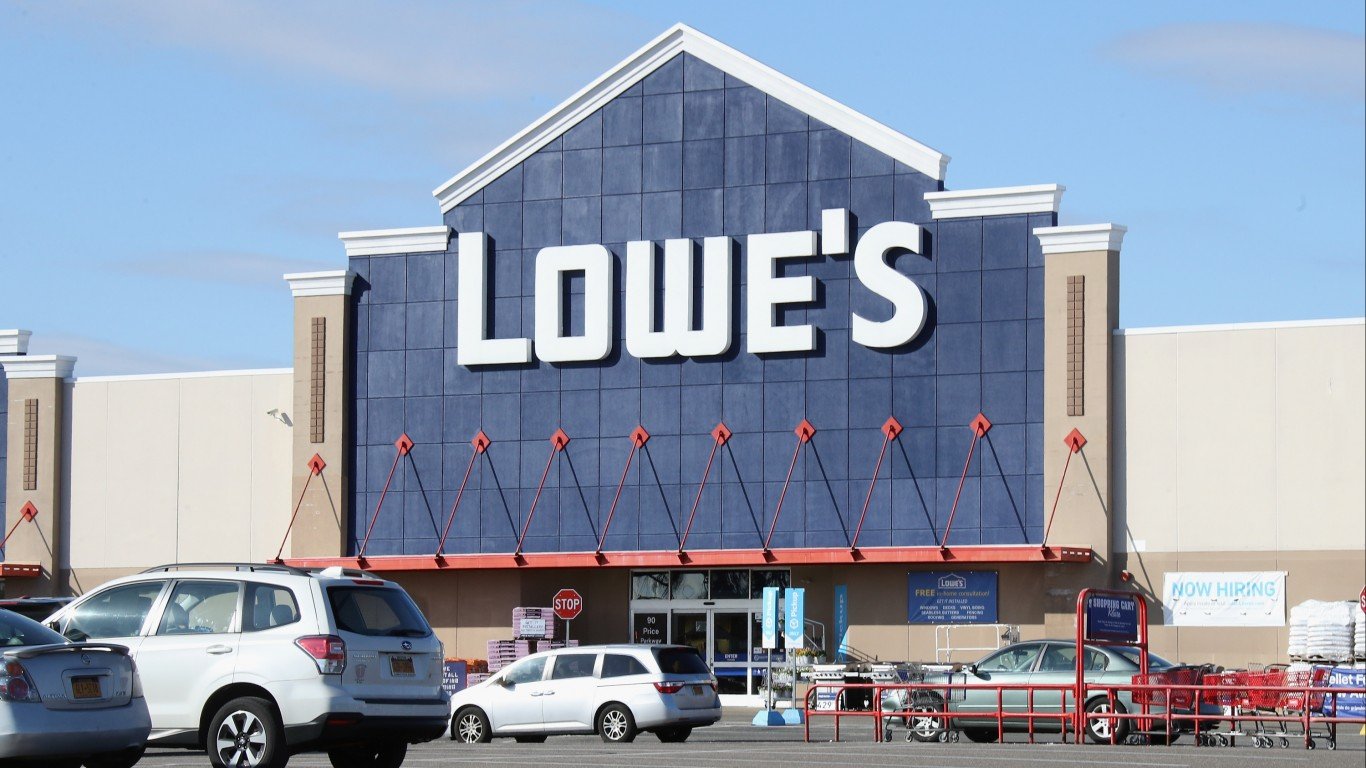
Lowe’s: The Second-Highest Starting Yield in the Group
Lowe’s (NYSE: LOW) yields 2.13%, the second-highest starting income in this group. The quarterly dividend rose from $1.20 to $1.25, about 4.2%. Over the longer run, the payout climbed from $0.55 in 2020 to $1.05 in 2022 and $1.15 in 2024. Its dividend records go back to 1999, and CFO Brandon Sink cited the company’s “status as a dividend aristocrat.”[4]
Dividend safety: The forward $5 annual payout is about 40.8% of the adjusted EPS outlook of ~$12.25[5]. Free cash flow of $3.1 billion[4] was more than enough to cover $673 million in quarterly dividends. Interest coverage is 6.65x, and adjusted debt-to-EBITDA of 3.0x is moving toward a 2.75x target. Book equity is negative because of years of buybacks. With comparable sales roughly flat, the latest raise slightly exceeded earnings growth, which explains why it was modest.
Bull case: Online sales rose 15.7%[5], and the stock trades at 17 times forward earnings with a free cash flow yield of 6.06%. Marvin Ellison cited estimates of “between $20 and $50 billion of pent-up deferred project demand in home improvement.”[4]
Risk: DIY spending is still weak, and housing turnover remains slow. Gross margin narrowed 77 bps[5] in the second quarter.
UnitedHealth Group: Earnings Recovery Rebuilds the Runway
UnitedHealth Group (NYSE: UNH) yields 2.24%, the highest in this group. The quarterly payout rose from $2.21 to $2.32, about 5%. The data shows an annual increase since 2012, taking the payout from $0.125 in 2011 to today’s level.
Dividend safety: The forward $9.28 annual dividend is about 45.3% of adjusted EPS guidance of at least $20.50[6]. Operating cash flow is guided to ~$24B, compared with dividends that management expects will “exceed $8 billion by year-end.”[7] Debt-to-capital stood at 41.7%, and cash was $28.549 billion[6]. Quarterly earnings grew 76.1%, well ahead of the dividend.
Bull case: The medical care ratio improved to 88.4% from 89.9%[6], and adjusted EPS was $4.69[7], up from $2.92 a year ago. The CFO called the low end of the 13%-16%[7] long-term growth range “a more reasonable starting point” for next year. The stock trades at 18 times forward earnings.
Risk: Medicare Advantage membership has fallen by 935K since the end of last year, and pressure on Star Ratings could reduce bonus payments.
Cintas: A Double-Digit Raise, With One Flag
Cintas (NASDAQ: CTAS) yields 0.82%. It raised the quarterly payout from $0.45 to $0.52, about 15.6%, after an earlier step-up from $0.39.
Dividend safety: The forward $2.08 annual payout is about 41% of trailing EPS of $5.07. Free cash flow came in at $1.881 billion for fiscal 2026, and first-quarter free cash flow rose 48.7% to $464.8 million[8], well above the $208.8 million paid in dividends. The raise outpaced the roughly 11.2% growth implied at the midpoint of fiscal 2027 adjusted EPS guidance. Future raises will likely align more closely with earnings growth.
Bull case: Gross margin reached a record 51.5%[8], organic growth was 8.9%, and management raised its adjusted EPS guidance to $5.45-$5.54. That quality comes at a high price: the stock trades at 41 times forward earnings.
Risk: The FTC review of the UniFirst acquisition could delay or block the deal.
Five Payouts Built to Keep Climbing
These five accelerators cover payments, semiconductors, home improvement, healthcare, and business services. Every one pays out less than half of earnings and generates free cash flow well above its dividend bill. Visa and Broadcom have the most room to keep raising quickly, UnitedHealth and Lowe’s offer the most income today, and Cintas needs earnings to catch up with its latest raise. Holders who reinvest these rising payouts would see their yield on cost climb as long as the raises continue.
Contact [email protected] for any questions or corrections.
Lee Jackson has covered Wall Street analysts' equity and debt research and equity strategy daily for 24/7 Wall St. since 2012. His broad, diverse career, including a stint as creative services director at an NBC affiliate in Austin, Texas, gives him unique insight into the financial industry.
Lee Jackson's journey in the financial industry spans more than 30 years, including nearly two decades as an institutional equity salesperson at Bear Stearns, Lehman Brothers, and Morgan Stanley. His career spanned pivotal sell-side Wall Street events, from the dot-com rise and bubble to the Long-Term Capital Management debacle, 9/11, and the Great Recession of 2008. This reflects his resilience and adaptability amid market volatility.
Lee Jackson’s practical financial industry experience, gained through a career at some of the biggest banks and brokerage firms, is complemented by a lifetime of writing across various platforms. This unique combination allows him to shed light on the intricacies of Wall Street in a way only someone with deep insider experience and knowledge can. Moreover, his extensive network across Wall Street continues to provide direct access for him and 24/7 Wall St., a privilege few firms enjoy.
Since 2012, Jackson’s work for 24/7 Wall St. has been featured in Barron’s, Yahoo Finance, MarketWatch, Business Insider, TradingView, Real Money, The Street, Seeking Alpha, Benzinga, and other media outlets. He attended the prestigious Cranbrook Schools in Bloomfield Hills, Michigan, and has a degree in broadcasting from the Specs Howard School of Media Arts.