A December Rate Hike Looks Likely: Buy These 3 Dividend Growers Before the Fed Moves

This post may contain links from our sponsors and affiliates, and Flywheel Publishing may receive compensation for actions taken through them.
Prediction-market traders now put 89% odds on a quarter-point Fed rate hike at the December meeting. For income investors, that changes how a dividend has to be judged. When savings accounts and Treasuries pay more, a flat payout loses value every year. A payout that grows faster than inflation can keep up with cash yields. Visa (NYSE:V | V Price Prediction), Lowe’s (NYSE:LOW) and TJX Companies (NYSE:TJX) have each raised their dividends faster than consumer prices, and their earnings and free cash flow cover those payouts with room to spare.
Why Growing Payouts Hold Up Better When Rates Rise
The upper bound of the federal funds target rate is 4.00%, where it has been for at least the past month. The Fed’s next decision comes at its Dec. 8 to 9 meeting. On Kalshi, a 25 basis point increase trades at 89%, a larger increase at 7% and a hold at 4%. Those figures show what traders expect, and the Fed can still surprise them. Portfolio manager Susan Schmidt told Marketplace that inflation is running near 3.7% annualized, well above the Fed’s 2% target.
The latest year-over-year Consumer Price Index comparison in the BLS data puts the index at 336.940, up from 324.800 a year earlier. That is a 3.74% increase. That is the bar each of these dividends has to clear:
| Company | Prior Quarterly Dividend | New Quarterly Dividend | Raise | Forward Yield |
|---|---|---|---|---|
| Visa | $0.67 | $0.78 | 16.42% | 0.73% |
| TJX Companies | $0.425 | $0.48 | 12.94% | 1.41% |
| Lowe’s | $1.20 | $1.25 | 4.17% | 2.03% |
Visa: A 16% Raise Backed by $22 Billion in Free Cash Flow
Visa’s forward dividend of $3.12 per share yields 0.73% at $426.27. The starting yield is the lowest of the three. The growth rate is the highest. The quarterly payout was raised to $0.78 from $0.67, a 16.42% increase that is several times the latest inflation reading.
Dividend safety: The forward dividend uses only 23.51% of fiscal 2026 adjusted EPS of $13.27. Operating cash flow of $23.728 billion minus capital spending of $1.671 billion left about $22.057 billion in free cash flow. Visa also bought back $20.5 billion of stock during the fiscal year and still has $24.4 billion left on its authorization. Cash was at $12.938 billion, with shareholders’ equity of $36.111 billion. Visa has raised its quarterly payout every year since it reached $0.14 in late 2015. The current rate is 2.08 times the $0.375 it paid in early 2022.
Bull case: Fiscal 2026 revenue rose 14.76% to $45.903 billion. Fourth-quarter adjusted EPS of $3.48 beat the $3.44 consensus, helped by cross-border volume growth of 14%. Chief executive Ryan McInerney called it "the strongest growth in over 15 years excluding the post-pandemic recovery and acquisitions." With a payout ratio that low, Visa can keep raising its dividend at double-digit rates for years without stretching its finances.
Risk: Visa still carries provisions for the ongoing interchange multidistrict litigation, and merchants and regulators are pressing to lower acceptance costs. Either could weigh on growth in its fee revenue.

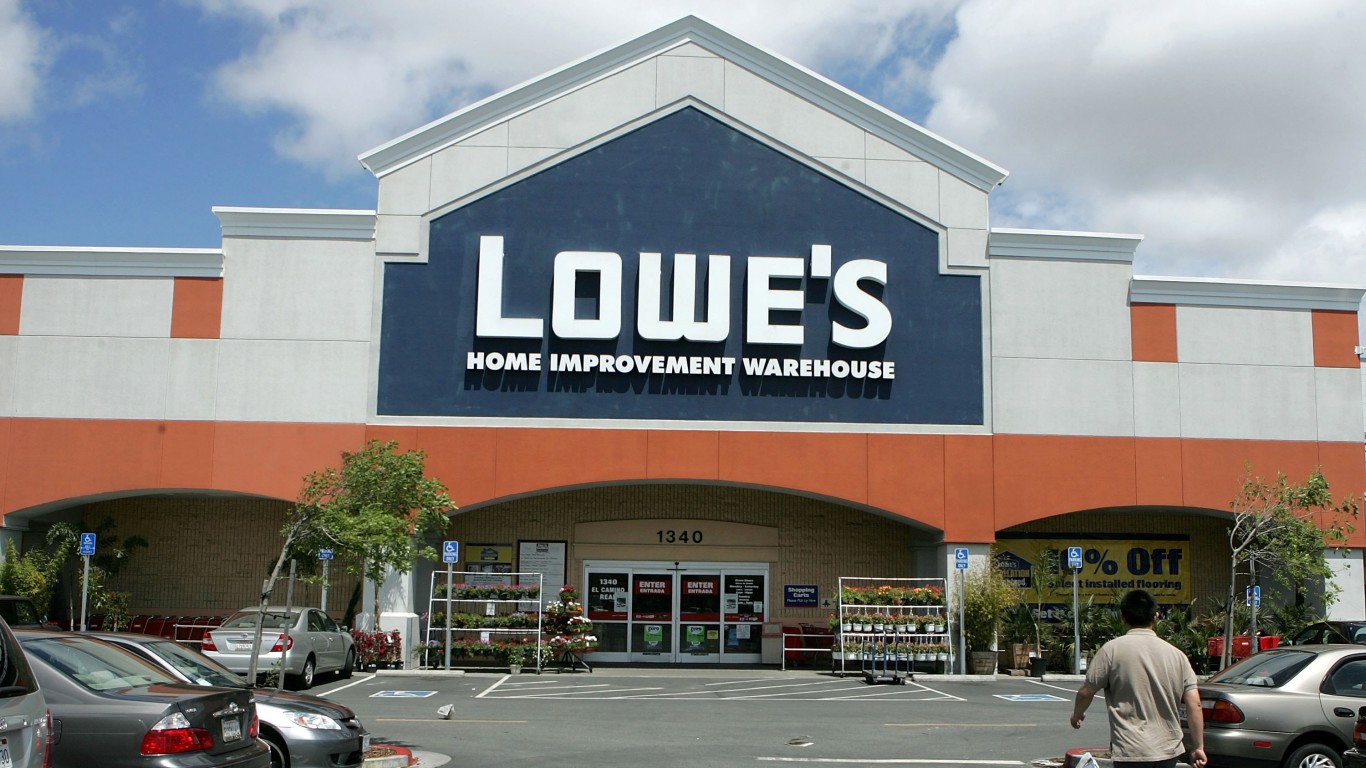
Lowe’s: Cash Flow Covers the Dividend More Than Four Times
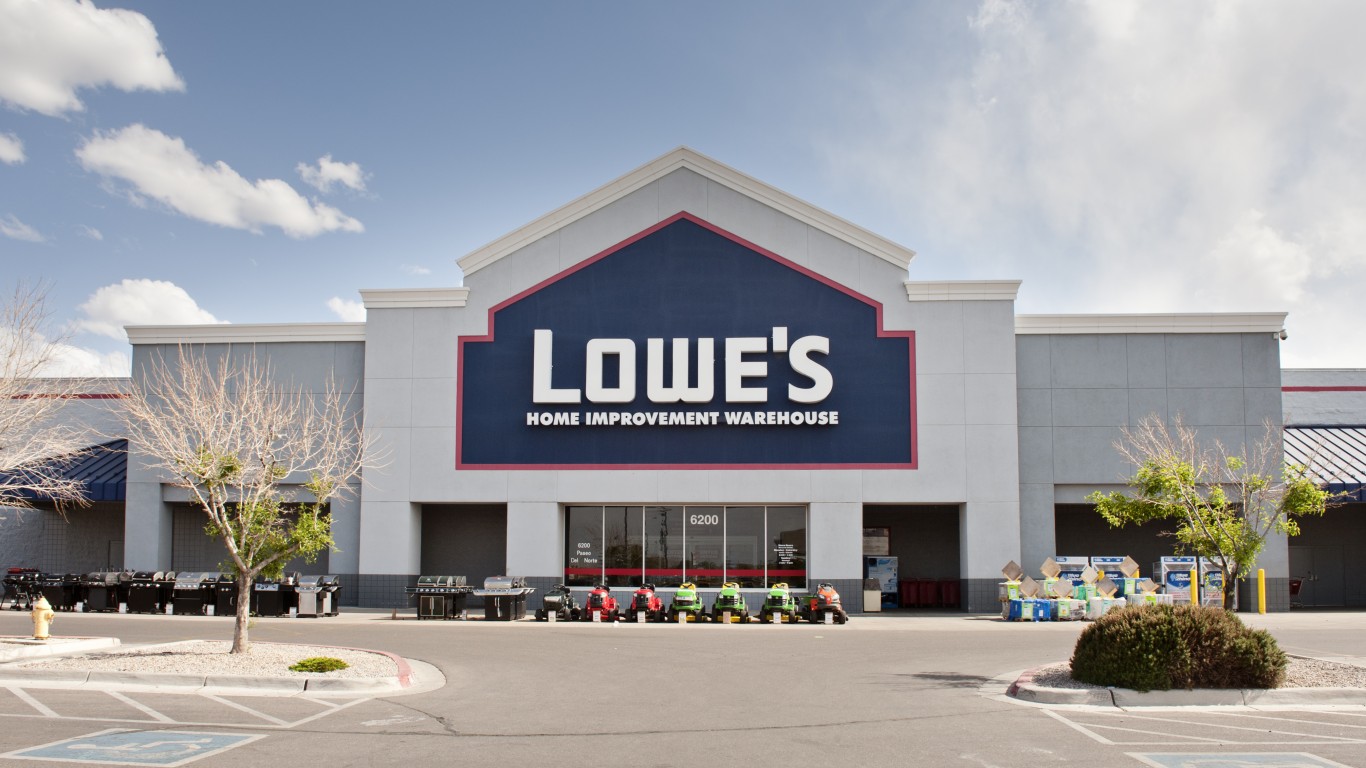
Lowe’s yields 2.03%, the highest of the three, on an annualized forward dividend of $5. Its latest increase took the quarterly payout to $1.25 from $1.20, up 4.17%. That is a smaller raise than the other two, but it still came in above the 3.74% CPI increase.
Dividend safety: The forward dividend equals 40.82% of management’s fiscal 2026 adjusted EPS outlook of about $12.25. Lowe’s produced $3.1 billion in free cash flow during the second quarter and paid $673 million in dividends, or 4.61 times coverage. Years of buybacks have pushed book equity negative, to -$7.44 billion. Interest coverage of 6.65x is still healthy, and the adjusted ratio of debt to EBITDA at 3.0 times is above management’s target of 2.75 times by mid-2027. The CFO pointed to "our status as a dividend aristocrat." Lowe’s dividend record shows the quarterly payout climbing from $0.08 in 2008 to $1.25, and the current rate is 2.27 times the $0.55 it paid in 2020.
Bull case: Shares trade at about 20 times earnings with a free cash flow yield of 5.89%. Second-quarter adjusted EPS of $4.40 beat the $4.22 consensus, and online sales rose 15.7%. CEO Marvin Ellison described the housing slowdown as cyclical: "It goes down, but at some point it comes back up." A recovery in home sales would add to cash flow that already covers the dividend several times over.
Risk: Discretionary DIY demand is weak. Comparable transactions fell 2.1% in the second quarter, and guidance calls for roughly flat comparable sales.

TJX Companies: A 13% Raise and a Larger Store Growth Plan
TJX’s forward dividend of $1.92 yields 1.41% at $136.18. The stock is down 10.53% year to date, so new buyers pay less per dollar of dividend than they would have at the start of the year. The latest raise took the quarterly payout to $0.48 from $0.425, up 12.94%.
Dividend safety: The forward dividend equals 37.28% of the low end of fiscal 2027 adjusted EPS guidance of $5.15 to $5.20. Cash rose 29.42% from a year earlier to $6.004 billion, and shareholders’ equity is positive at $10.651 billion. TJX also plans $2.75 billion to $3.0 billion of buybacks this fiscal year. First-quarter free cash flow of $457 million came in just under the $471 million paid in dividends. Seasonal capital spending explains much of that gap, and the cash balance covers it easily. The quarterly payout has gone up every year since 2022, rising from $0.26 to 1.85 times that level.
Bull case: Consolidated comparable sales rose 4% in the second quarter, ahead of plan, and adjusted EPS of $1.22 beat the $1.19 consensus. HomeGoods comps grew 7%. The long-term store target was raised to 7,500, with plans to speed up openings to a 4% annual pace. On the earnings call, CEO Ernie Herrman said "We are in an excellent position to continue to invest in the growth of TJX while simultaneously returning significant cash to our shareholders."
Risk: Marmaxx, the largest segment, managed comparable sales growth of only 1%. Management blamed product mix and store allocation problems it called "entirely self-inflicted and within our control." If those problems continue into the holiday quarter, earnings could fall short of guidance.

Three Dividends Growing Faster Than Inflation
Visa, TJX and Lowe’s each raised their dividends faster than the latest 3.74% inflation rate, and each pays out well under half of its earnings. Visa offers the fastest dividend growth, TJX pairs double-digit raises with a strong cash balance, and Lowe’s has the highest yield and the most free cash flow coverage. Watch the Fed’s decision on December 9. If rates go up as markets expect, these payouts should keep growing while fixed coupons stay where they are.
Contact [email protected] for any questions or corrections.
Lee Jackson has covered Wall Street analysts' equity and debt research and equity strategy daily for 24/7 Wall St. since 2012. His broad, diverse career, including a stint as creative services director at an NBC affiliate in Austin, Texas, gives him unique insight into the financial industry.
Lee Jackson's journey in the financial industry spans more than 30 years, including nearly two decades as an institutional equity salesperson at Bear Stearns, Lehman Brothers, and Morgan Stanley. His career spanned pivotal sell-side Wall Street events, from the dot-com rise and bubble to the Long-Term Capital Management debacle, 9/11, and the Great Recession of 2008. This reflects his resilience and adaptability amid market volatility.
Lee Jackson’s practical financial industry experience, gained through a career at some of the biggest banks and brokerage firms, is complemented by a lifetime of writing across various platforms. This unique combination allows him to shed light on the intricacies of Wall Street in a way only someone with deep insider experience and knowledge can. Moreover, his extensive network across Wall Street continues to provide direct access for him and 24/7 Wall St., a privilege few firms enjoy.
Since 2012, Jackson’s work for 24/7 Wall St. has been featured in Barron’s, Yahoo Finance, MarketWatch, Business Insider, TradingView, Real Money, The Street, Seeking Alpha, Benzinga, and other media outlets. He attended the prestigious Cranbrook Schools in Bloomfield Hills, Michigan, and has a degree in broadcasting from the Specs Howard School of Media Arts.