3 Overlooked Dividend Stocks Paying 5% or More Right Now

This post may contain links from our sponsors and affiliates, and Flywheel Publishing may receive compensation for actions taken through them.

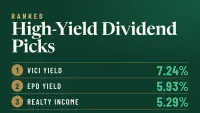
Income investors tend to crowd into the same popular payers, and solid dividend names in real estate, energy, and materials can slip down the priority list. Each of the three picks below yields 5% or more at live prices, and each also earns its place through payout coverage, cash flow, and track record, because a big yield alone doesn’t make a dividend safe. The clearest sign of neglect: Realty Income (NYSE: O) trades well below its 52-week high of $65.93, even though it keeps raising its monthly dividend.
Realty Income: A Monthly Raiser Priced Below Its Highs
Realty Income pays monthly, and its annualized forward dividend of $3.288 works out to a forward yield of about 5.7% at the current price of $57.56. That makes it a high-yield name that pays you every month (we rounded up seven of our favorite monthly payers in a free report here).
Why the market has moved on: the shares sit below their 200-day moving average of $61.52, and the stock has gained only 5.36% over five years. Analysts aren’t excited either. 17 ratings sit at hold, against 2 strong buys and 5 buys.
Dividend safety: For a REIT, adjusted funds from operations (AFFO) is the number that matters for the payout. Third-quarter AFFO came in at $1.12 per share, up 3.7%, while the quarter’s monthly dividends totaled $0.813. That puts the AFFO payout at roughly 72.6%. CEO Sumit Roy addressed the payout ratio. He said it currently stands at “among the lowest it has been in the history of Realty Income.”[1] Management raised full-year AFFO guidance to $4.45 to $4.46 per share. The balance sheet carries a Fitch “A” rating with a stable outlook, about $5.4 billion[1] of available liquidity and more than 94% fixed-rate debt. The track record backs it up. The company has announced its 116th consecutive quarterly dividend increase, its 136th raise since its 1994 NYSE listing, and the latest monthly payment rose to $0.274 from $0.2715.
Bull case: Occupancy stands at 98.8%. New money will work at an initial cash yield of about 6.8%[1], roughly 170 basis points above its short-term cost of capital. Management also cut credit-loss guidance to about 30 basis points[1]. Steady AFFO growth gives the dividend room to keep climbing.
Risk: Internal growth is slow. Same-store rental revenue rose just 1.1%, so dividend growth depends heavily on acquisitions and access to reasonably priced capital.
Enterprise Products Partners: Midstream Cash Flow Covering the Payout Nearly Twice
Enterprise Products Partners (NYSE: EPD | EPD Price Prediction) pays a quarterly distribution of $0.56 per unit, or $2.24 a year. At $36.38, that’s a forward yield of about 6.2%. A tax note in plain language: Enterprise is a master limited partnership, so unitholders receive a Schedule K-1 tax form instead of a 1099. That makes tax filing more involved, especially for retirement accounts.
Why the market has moved on: the units trade below their 52-week high of $39.12 and their 200-day average of $37.55, at a trailing P/E of 12. Institutions own only 25.568% of the units, partly because many funds avoid the MLP structure, and hold is the most common rating at 12.
Dividend safety: Third-quarter operational distributable cash flow rose 27%[2] to about $2.3 billion, covering the distribution 1.9 times, and the partnership kept $1.1 billion for growth, buybacks and debt reduction. Net leverage of 2.9x[3] sits inside its 2.7x to 3.25x target range. About 96%[3] of its debt is fixed-rate, and the weighted average cost of that debt is 4.7%. The distribution record shows quarterly payments without interruption back to 1999, and the payout has stepped up from $0.45 in 2021 to today’s $0.56, a 2.8%[2] year-over-year increase.
Bull case: Enterprise has $6.3 billion[2] of growth projects under construction through 2028, and Permian processing inlet volumes hit a record 4.6 Bcf/d, up 12%. A 300,000-barrel-per-day[3] LPG export expansion is due to be completed in the fourth quarter. Co-CEO Randy Fowler said, “We’ve got a lot of good growth opportunities coming in, and especially when you come in and look at just the gas and NGL-rich content in the Permian. We’ve got a lot of room to run.”[3] New volumes flowing through fee-based pipes support future increases.
Risk: Growth spending is heavy, with this year’s growth capital budget at $2.9 billion to $3.4 billion[3]. Much of it depends on continued Permian production so that a drilling slowdown would leave new capacity underused and slow distribution growth.

Westlake Chemical Partners: A Contracted Ethylene Payer Few Investors Follow
A note on the materials slot: LyondellBasell Industries (NYSE: LYB) looks like it yields more than 5% on trailing payments, but it cut its quarterly dividend to $0.69 from $1.37. On its $2.76 annualized forward dividend, the yield is about 4.72%, which falls short of the bar. Trailing yields after a cut are a classic yield-trap signal, so it’s been swapped out.
Westlake Chemical Partners (NYSE: WKLP) takes its place. Its $1.8856 annualized distribution yields about 9.0% at $21, which puts it in ultra-high-yield territory. It is also an MLP, so investors receive a K-1 tax form.
Why the market has moved on: The partnership has a market cap of about $740 million, has only 1 analyst rating, and institutions own just 27.742% of its units. The price sits below its 52-week high of $22.55 and its 200-day average of $22.00.
Dividend safety: The core of the case is a contract. Under its ethylene sales agreement with Westlake Corporation (NYSE: WLK), 95% of the operating company’s ethylene output trades at a cash margin of $0.10 per pound, net of operating costs, maintenance capital and turnaround reserves. Third-quarter distributable cash flow rose to $17.98 million as maintenance spending fell to $15.14 million from $24.15 million, lifting trailing 12-month coverage to 1.09x from 1.04x. Total liabilities of $454.9 million compare with equity of $770.3 million, and its credit facilities now run to 2031. The partnership has paid 49 consecutive quarterly distributions since its 2014 IPO, and the payout has held at $0.4714 every quarter in the record from 2020 onward.
For the bull case, third-party ethylene and co-product sales rose to $52.52 million from $32.4 million as conflict in the Middle East increased demand for North American chemicals. CEO Jean-Marc Gilson said, “Looking forward, we expect our earnings and cash flows to continue to benefit from the stability provided by our ethylene sales agreement with Westlake.” For retirees who want a large, flat, contract-backed check, few names in materials offer this kind of structure.
Risk: The coverage buffer is thin. During the Petro 1 turnaround year, trailing coverage fell to 0.80x, so the next major maintenance outage could again leave the distribution only partly covered by cash flow.
Three Overlooked Payers Built on Coverage
Each of these income streams is built differently. Realty Income offers monthly checks backed by an AFFO payout near 72.6%, and Enterprise covers its distribution 1.9 times[2] while it funds new growth. Westlake Chemical Partners has the highest yield of the three and leans on a fixed-margin contract to support it. All three trade below their 200-day averages. The LyondellBasell cut shows why coverage, more than headline yield, should decide which payers earn a place in an income portfolio.
Contact [email protected] for any questions or corrections.
Lee Jackson has covered Wall Street analysts' equity and debt research and equity strategy daily for 24/7 Wall St. since 2012. His broad, diverse career, including a stint as creative services director at an NBC affiliate in Austin, Texas, gives him unique insight into the financial industry.
Lee Jackson's journey in the financial industry spans more than 30 years, including nearly two decades as an institutional equity salesperson at Bear Stearns, Lehman Brothers, and Morgan Stanley. His career spanned pivotal sell-side Wall Street events, from the dot-com rise and bubble to the Long-Term Capital Management debacle, 9/11, and the Great Recession of 2008. This reflects his resilience and adaptability amid market volatility.
Lee Jackson’s practical financial industry experience, gained through a career at some of the biggest banks and brokerage firms, is complemented by a lifetime of writing across various platforms. This unique combination allows him to shed light on the intricacies of Wall Street in a way only someone with deep insider experience and knowledge can. Moreover, his extensive network across Wall Street continues to provide direct access for him and 24/7 Wall St., a privilege few firms enjoy.
Since 2012, Jackson’s work for 24/7 Wall St. has been featured in Barron’s, Yahoo Finance, MarketWatch, Business Insider, TradingView, Real Money, The Street, Seeking Alpha, Benzinga, and other media outlets. He attended the prestigious Cranbrook Schools in Bloomfield Hills, Michigan, and has a degree in broadcasting from the Specs Howard School of Media Arts.