AMD Just Plunged Almost 8%, Lost $67 Billion and Kept Falling After Hours. A Short Seller Says It Shares Nvidia’s China Risk

This post may contain links from our sponsors and affiliates, and Flywheel Publishing may receive compensation for actions taken through them.
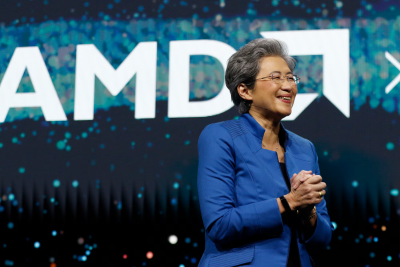
Advanced Micro Devices (NASDAQ: AMD) lost roughly $67 billion of market value on Thursday, by The Wall Street Journal’s count. The stock fell almost 8% to close at $489.19, and it kept falling after the bell. It ended the after-hours session at $472.50, another 3.4% lower.
Three things hit AMD at once. A short seller published a report on the company’s ties to China. Small investors sold AMD to buy Anthropic on the first day the AI company traded. And the whole market turned from a strong open to its lowest close in months.
The drop reads as a warning that AMD carries the same China risk investors have been fleeing at Nvidia all month. The limit on that reading: the report comes from a firm that makes money if AMD falls, that firm says its records do not on their own establish a violation of export law, and AMD says the claims misrepresent its business.
How Thursday went
AMD opened at $542.17, up 2.3%, and reached $555.01 in early trading. Hunterbrook Media published its report at 10:27 a.m. ET. The stock dropped as low as $470.56, a fall of 15.2% from the morning high, then recovered part of the loss. The close was 7.7% below Wednesday’s $530.14. About 70.6 million shares changed hands, 1.9 times the average of the prior 20 sessions.
On 100 shares, the regular session cost $4,095. At the after-hours price, the loss since Wednesday’s close is $5,764.
What the short seller alleged
The report is titled “AMD Has Its Own China Problem.” It asks whether AMD is “really a safer alternative to Nvidia” and answers that AMD “appears no less at risk from China chip restrictions than Nvidia.” Hunterbrook Capital, a fund under common control with the publisher, said it is short AMD, a bet that pays if the stock falls.
The central claim involves IEIT Systems, a Chinese server maker the Commerce Department put on its export blacklist in March 2025. Hunterbrook says IEIT kept posting software updates that contain newer AMD firmware, the code that lets AMD chips run inside a server. It counted at least six newer versions since the blacklisting, the latest on Oct. 19.
The report also sizes AMD’s exposure. AMD billed $7.75 billion to customers in China and Hong Kong in fiscal 2025, or 22.4% of revenue, and $4.28 billion to customers in Singapore. A Commerce rule that took effect Thursday requires licenses for advanced AI chips shipped to Singapore and four other countries.
Hunterbrook wrote that the records it found “don’t establish on their own a violation of export laws.” AMD answered through a spokesperson, who told Barron’s the claims “misrepresent AMD’s business practices and relationships.” The spokesperson added: “AMD complies with applicable U.S. export control laws and regulations and maintains rigorous processes to ensure compliance across our global operations.”
A second report, from a newsletter Hunterbrook owns called The Bear Cave, questioned the money AMD puts into its own customers. “If the very customers whose growth AMD is helping finance pull back on their spending, even briefly, AMD could face weaker chip sales at the same time it remains on the hook for tens of billions worth of commitments,” that report said, according to Barron’s.
Why the China question landed so hard
AMD had been the chip stock investors bought to get away from this exact problem. On Nov. 9, The New York Times reported that Nvidia’s board was investigating then-CEO Jensen Huang’s relationship with a woman suspected of spying for China. Huang has since resigned. From the Friday before that report through Wednesday, AMD rose 18.1% while Nvidia fell 19.1%.
Washington added to the pressure on Thursday afternoon. The House Foreign Affairs Committee released license data showing the Commerce Department approved sales of more than 879,000 Nvidia and AMD AI chips to Chinese companies, about one in four of the 3.4 million requested, CNBC and Reuters reported. Those sales were licensed. The release still puts both companies’ China business in front of lawmakers who want tighter export rules.
The Anthropic effect
Part of Thursday’s selling had nothing to do with AMD’s business. Individual investors have been unloading AMD and other AI stocks to free up cash for Anthropic’s debut, The Wall Street Journal reported, citing the retail flow tracker Vanda Research. Of the 17 AI names Vanda follows, 13 saw net selling, and AMD led the outflows.
Anthropic priced its record IPO at $83 and closed its first day at $97.17, up 17.1%.
The market fell with it. The largest S&P 500 fund lost 2.0%, the largest Nasdaq-100 fund 2.2%, and the largest chip fund 2.6%. AMD fell 5.1 points more than the chip fund, and the Journal counted it as the second-worst stock in the Nasdaq 100.
The fifth drop like this in three weeks
Thursday was the fifth time in 15 sessions that AMD closed down 7% or more.
| Date | One-day drop | Close |
|---|---|---|
| Oct. 30 | 10.9% | $504.80 |
| Nov. 2 | 7.5% | $466.84 |
| Nov. 5 | 17.3% | $404.40 |
| Nov. 13 | 8.8% | $534.06 |
| Nov. 19 | 7.7% | $489.19 |
It was the 12th such drop of 2026. All of 2025 had seven.
Ten of the earlier drops have five full sessions behind them. AMD was higher five sessions later in nine of the 10. The exception was Oct. 30, when it was 11.0% lower. The Nov. 13 drop is the open case: four sessions later, the stock is down another 8.4%.
Those rebounds came in a year when AMD rose 128.4%, even after Thursday, so they show how a rising stock behaved. They say little about a drop set off by an export-control report. The stock is 24.7% below its record close of $649.42, set on Oct. 6.
What it means if you hold AMD
Start with size. One hundred shares were worth $21,416 on Dec. 31 and $48,919 at Thursday’s close. A position that more than doubled in a year can become a large part of a portfolio without a single purchase. If AMD is 10% of a $1,000,000 portfolio, Thursday’s drop cost $7,724. At 25%, it cost $19,311. A stock that falls 7% in a day 12 times a year needs a size you can hold through the next one.
The price leaves little room. AMD trades at 28.4 times the earnings expected over the next 12 months, against 10 times for Nvidia, according to Barron’s.
CEO Lisa Su sold 70,000 shares on Monday for about $35.5 million, an average of $507.00 a share. The sale ran under a trading plan she adopted in June, so it says little about her view of this week. Thursday’s close is 3.5% below her average price.
Here is what to watch:
- A full answer from AMD. Hunterbrook says the company asked for more time before publication and did not send a detailed reply.
- Any word from the Commerce Department. No action against AMD has been announced.
- Jan. 10, 2027, when a paused rule covering firms at least 50% owned by blacklisted companies is set to return.
- Fourth-quarter results, against AMD’s forecast of about $17 billion in revenue, plus or minus 3%.
Analysts were positive before the report. Of 55 ratings, 44 are buys and none is a sell, and the average target of $657.74 sits 34.5% above Thursday’s close. Targets are opinions, and these were set before Thursday.
The bottom line
AMD reported a record quarter on Nov. 3, with data center sales up 97%. Thursday’s reports change none of those numbers. They raise a question the stock had been spared: whether AMD’s China sales will draw the scrutiny Nvidia’s have. Neither AMD nor Commerce has answered it in detail. Until one does, a holder should expect more days like Thursday, in both directions, and should own an amount of AMD that lets them wait.
Contact [email protected] for any questions or corrections.
I've been writing about stocks and personal finance for 20+ years. I believe all great companies are tech companies in the long run, and I invest accordingly.